


- 全て
- NEWTOPのお客様事例
- NEWTOP エクスプローラー ハブ
- NEWTOP 業界の洞察
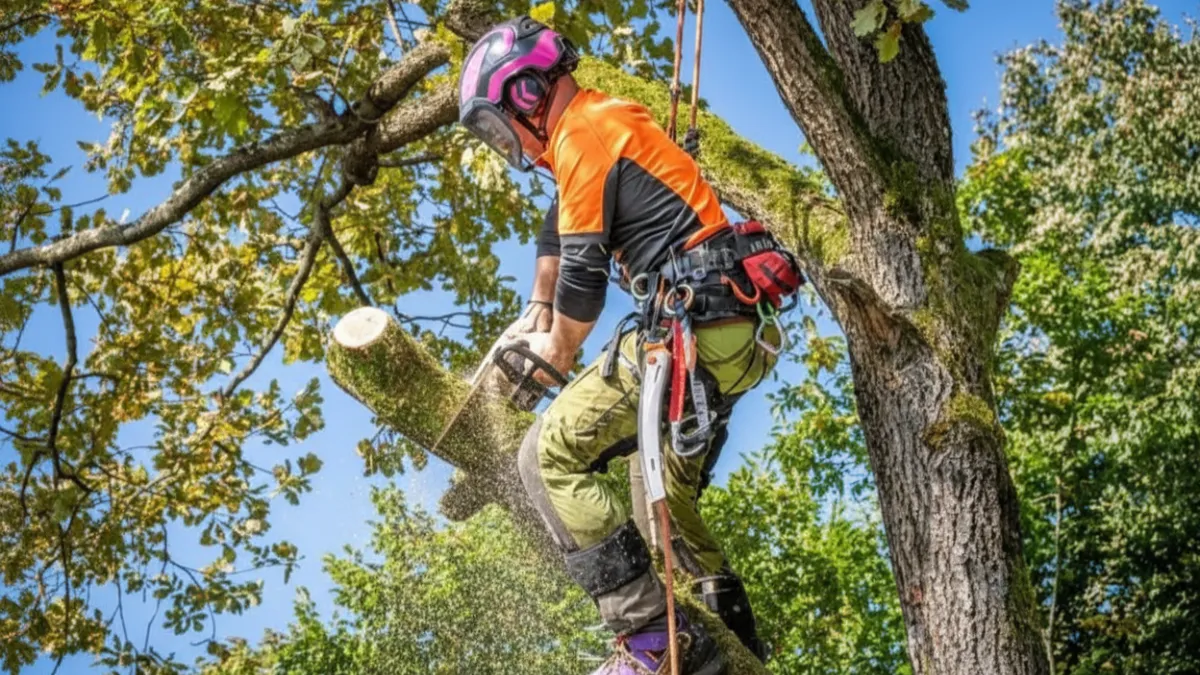
Arborists and tree care specialists require tools that prioritize balance and weight. When working high in a tree canopy, the design of your equipment directly affects your safety and how quickly you can finish a job. In 2026, the market offers various options ranging from traditional gasoline engines to new lithium battery models.
このガイドでは, we break down how top handle chainsaws work, how they compare to rear handle models, what technical specifications truly matter, and how professionals choose the right model for climbing operations. If you are sourcing for distribution, OEM branding, or large-scale procurement, this guide is written with decision-makers in mind.
What is a Top Handle Chainsaw?
A top handle chainsaw is a purpose-built tool for professional arborists, engineered with a compact, lightweight design that prioritizes balance and control for precision cutting in elevated or confined spaces.
A top handle chainsaw is a compact chainsaw designed with the primary handle positioned above the engine housing rather than at the rear. This configuration allows arborists to operate the saw in confined spaces—especially while suspended in a tree harness. These chainsaws are commonly used for pruning, crown reduction, sectional dismantling, and branch removal. In professional settings, they are considered climbing chainsaws, often paired with harness systems and lanyards for safety.
Primary Applications in Professional Tree Care
These saws are essential equipment for certified professionals performing tasks that require surgical cutting high off the ground. Their compact design allows arborists to navigate dense branch structures where a larger, rear-handle saw would be unsafe, cumbersome, or impractical to position correctly.
- Ideal for removing deadwood, thinning a tree’s crown, and shaping branches.
- Enables controlled cuts while secured by a rope and harness or operating from an aerial lift platform.
- The primary tool for tree maintenance in urban and residential settings where precision is critical.
The Professional User Requirement
Because they are intended for elevated use, they require advanced skill and training. In many regions, they are recommended only for certified arborists. An untrained user attempting to operate one of these chainsaws, especially on the ground, creates a high-risk situation. The growing demand for these chainsaws is driven directly by the professional tree care industry’s need for efficient and specialized equipment that performs in challenging aerial environments.
Pros and Cons of Handle Chainsaws
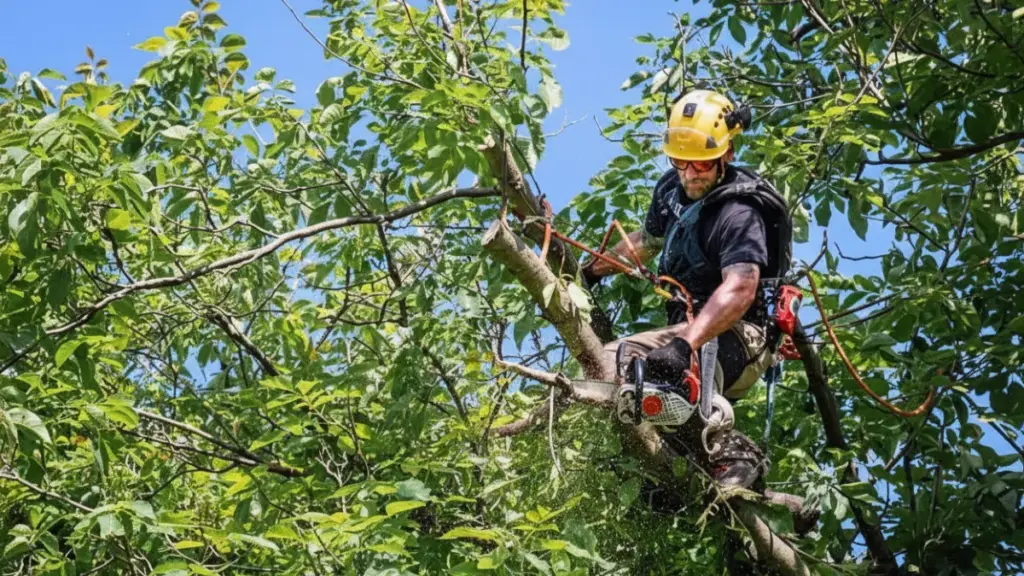
The choice between a top-handle and rear-handle chainsaw is a direct trade-off between aerial maneuverability for specialized arborist work and raw power with stability for ground-level felling and bucking.
Top-Handle Chainsaws: Pros and Cons
Top-handle chainsaws are specialized tools designed for professional arborists who need a compact and maneuverable saw for work performed at height. Their advantages in aerial situations are clear, but these benefits come with limitations for any ground-level applications.
- Pro: Excellent maneuverability and balance for in-tree cutting and pruning, allowing for precise control in tight or awkward spaces.
- Pro: Lightweight construction reduces operator fatigue during extended aerial work.
- Con: Generally less powerful than their rear-handle counterparts, making them unsuitable for heavy-duty felling or bucking.
- Con: Their design requires advanced handling skills and is intended almost exclusively for trained professionals working off the ground.
Rear-Handle Chainsaws: Pros and Cons
Rear-handle chainsaws are the industry standard for most ground-based cutting tasks. They provide superior power, stability, and safety for a wide range of users, from homeowners to forestry professionals, but they become cumbersome and unsafe for aerial work.
- Pro: Offers greater power and leverage, making it the ideal choice for felling trees, bucking logs, and clearing brush.
- Pro: The two-handed grip provides better stability and control, making it a safer and more accessible option for beginners.
- Con: Bulkier and heavier design makes it difficult and often unsafe to use for climbing or detailed pruning within a tree’s canopy.
- Con: Less agile compared to top-handle models, which can be a disadvantage when cutting in constrained ground-level areas.
Build Your Professional Chainsaw Line with a Reliable OEM Partner
Professional Technical Specs: 重さ, 変位, and Balance
When evaluating professional-grade top handle chainsaws for 2026, three specifications determine real-world performance: weight, engine displacement, and balance.
| Technical Specification | Professional Market Range (2026) | Primary Benefit |
|---|---|---|
| Engine Displacement | 25cc – 40cc (30cc–35cc mainstream) | Balanced torque output suitable for controlled pruning and hardwood branch cutting. |
| Power Output | 1.0 kW – 1.8 kW | Delivers efficient cutting performance while maintaining fuel economy and throttle responsiveness. |
| Dry Weight (Without Bar & Chain) | 2.6 kg – 3.8 kg | Reduces operator fatigue and improves maneuverability in confined canopy environments. |
| Key Performance Metric | High Power-to-Weight Ratio | Critical for maintaining control, precision, and productivity during elevated operations. |
Engine Displacement and Power Output
Most professional-grade top handle chainsaws operate within a 25cc to 40cc displacement range, with 30cc–35cc models representing the core segment for arborist applications. This range provides the optimal balance between torque and weight, ensuring clean, controlled cuts without unnecessary engine bulk. Power output typically falls between 1.0 kW and 1.8 kW, depending on engine tuning and design. This configuration delivers reliable cutting force for hardwood branches while maintaining fuel efficiency and throttle responsiveness—critical for extended in-tree operations.
Power-to-Weight Ratio
For professional arborists, power-to-weight ratio is the defining performance metric. A climbing saw must provide sufficient torque while remaining lightweight enough for controlled maneuverability in canopy environments. High-quality top handle models typically weigh between 2.6 kg and 3.8 kg (dry weight), striking the balance between durability and operator fatigue reduction. A superior ratio enhances cutting precision during complex pruning and rigging tasks, contributing directly to both productivity and long-term operator safety.
Ergonomic Balance and Key Features
Beyond the core engine specs, ergonomic design determines a saw’s real-world usability. Modern professional saws integrate systems that support the operator and reduce downtime. Advanced anti-vibration technology minimizes the strain on an arborist’s hands and arms, which is critical for all-day use. Features like spring-assisted starting are essential for restarting the saw safely mid-climb. Likewise, centrifugal air filtration systems eject dust and debris before they reach the filter, significantly extending service intervals and keeping the engine running at peak performance.
Safety Standards for In-Tree Operation: Brakes and Lanyards
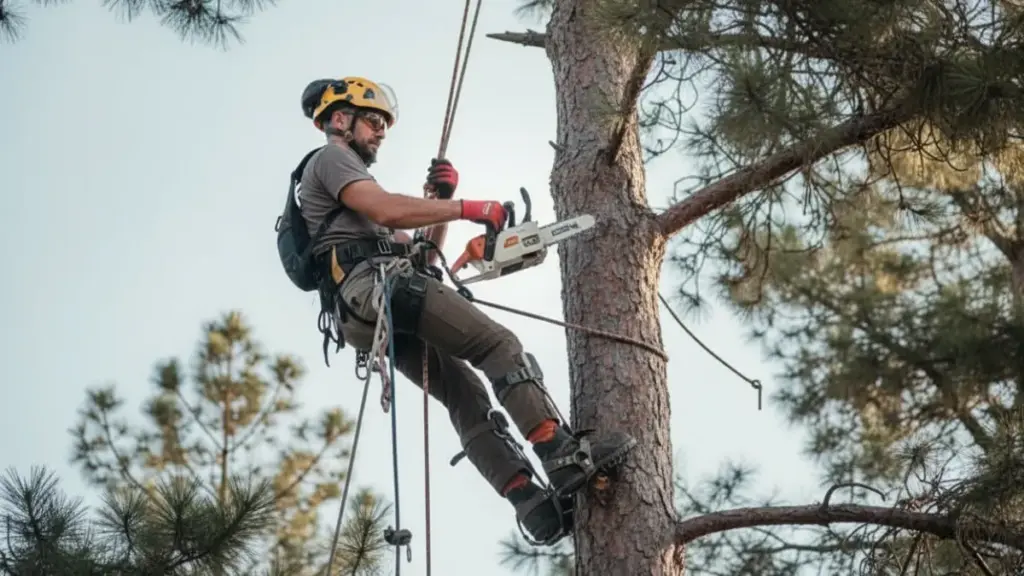
Safe in-tree chainsaw operation depends on a strict system of regulatory compliance, redundant tie-in protocols, and mandatory pre-use equipment checks.
Regulatory Compliance and Industry Standards
In-tree chainsaw operations follow strict industry standards like ANSI Z133, which sets the baseline for safe tree care. Regulatory bodies such as OSHA enforce these guidelines, mandating documented worker training, clear equipment protocols, and proactive risk management to minimize hazards. These standards apply equally to both gasoline and battery-powered chainsaws, as both present identical cutting risks when working at height.
Continuous Tie-In and Lanyard Systems
A core rule for any arborist is to remain continuously tied in throughout an operation. This is achieved with a dual-redundancy system. The worker uses a primary climbing line for main support and a secondary lanyard for precise work positioning and backup security. This setup ensures the operator is secured from the moment they leave the ground until they return, allowing them to establish a stable stance for making controlled cuts.
Chainsaw Brake Function and Inspection
The chainsaw’s chain brake is a non-negotiable safety device engineered to stop the chain instantly during a kickback event. Regular inspection and testing of this mechanism are mandatory before every use. An operator must confirm the chain brake engages properly when activated by hand and regularly clean the brake band and clutch cover to check for wear or damage. A functional brake, paired with correct handling techniques, is a critical layer of operator protection.
Pre-Operation Hazard Assessment and Equipment Checks
Proactive risk management is central to in-tree safety. Before climbing, every arborist must conduct a thorough hazard assessment of the tree and the surrounding worksite, identifying risks like weak limbs, electrical lines, or ground obstacles. A complete inspection of all climbing and cutting equipment—including ropes, harnesses, lanyards, and the chainsaw itself—is required to check for defects. The crew must also establish a clear work plan and an emergency protocol before work begins.
Top Handle vs. Rear Handle Chainsaw
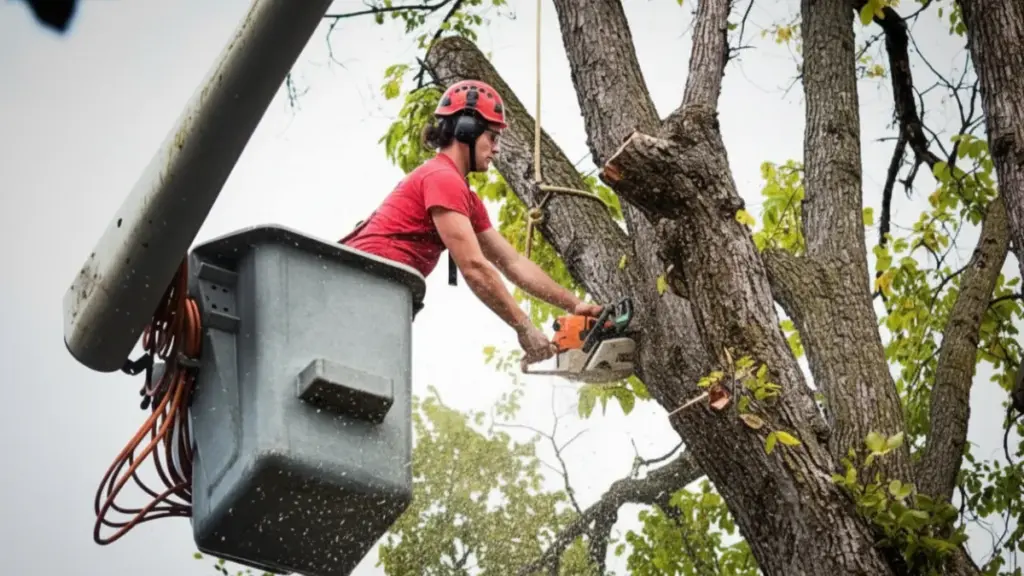
The choice between a top handle and rear handle chainsaw is determined entirely by the work environment; top handle saws are specialized for professional, in-tree operations, while rear handle saws are built for stable, ground-level cutting.
| Attribute | Top Handle Chainsaw | Rear Handle Chainsaw |
|---|---|---|
| Primary User | Certified professional arborists and tree surgeons | Homeowners, property managers, and forestry workers |
| Work Environment | Elevated, in-tree, or from an aerial lift | Ground-level operations |
| Core Design Trait | Compact, lightweight, and balanced for maneuverability | Longer body with separated handles for stability and leverage |
| Typical Application | 剪定, limbing, and navigating tight tree crowns | Felling trees, bucking logs, and processing firewood |
Design and Ergonomics for Specific Tasks
The fundamental difference lies in their physical layout, which is optimized for two distinct working environments. Top handle saws are compact and balanced for maneuverability in elevated, awkward positions. Rear handle saws are built for leverage and stability on the ground. This separation of design intent dictates how each tool performs in its intended role.
- Top handle models integrate the handle directly above the saw’s body, creating a center of gravity ideal for one-handed use by a climbing arborist.
- Rear handle models use a separated two-handle design, giving the operator greater control and a stable platform for felling trees or bucking logs.
Intended User and Application
Each saw type targets a different user. Top handle chainsaws are specialized tools exclusively for certified tree care professionals working at height. Rear handle saws cater to a wider audience, from homeowners to loggers, who perform work at ground level. The industry has clearly segmented these tools for specific operational contexts rather than creating an all-purpose solution.
- Top handle saws are the standard for professional arborists who need to prune limbs while secured in a tree.
- Rear handle saws are suited for felling, limbing, and processing firewood on solid ground, making them the choice for property owners and forestry workers.
力, Control, and Safety
Rear handle saws generally provide more leverage for cutting power and stability, making them a safer choice for novices. Top handle saws offer a high power-to-weight ratio but introduce significant safety risks that demand professional training and certification. The operator’s ability to manage kickback is directly tied to the saw’s handle configuration.
- The wider grip on rear handle saws offers superior control, which helps manage kickback during powerful cuts.
- Due to their design for potential one-handed operation, top handle saws require strict adherence to safety protocols and are not recommended for groundwork or inexperienced users.
How to Select the Right Top Handle Chainsaw?
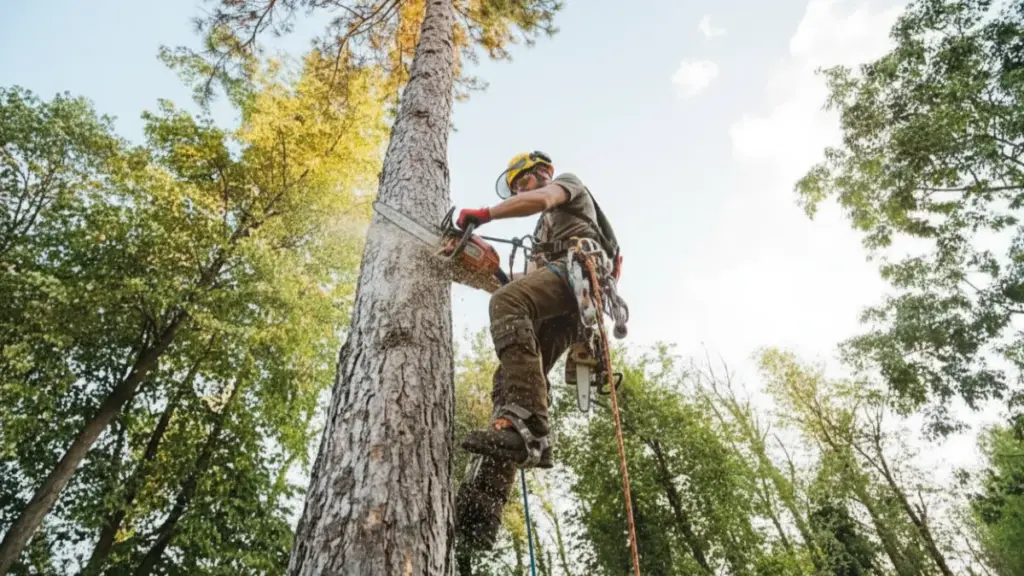
Choosing the right top handle chainsaw requires matching professional certifications and specific in-tree job demands with key technical features like power-to-weight ratio, バランス, and power source.
Selecting the right model requires aligning technical specs with market demand.
First, identify your target users. Are they certified arborists, landscaping companies, or small contractors? Professional arborists demand durability and brand reliability. Entry-level buyers may prioritize price.
Second, evaluate climate and wood density. In tropical markets (Latin America, 東南アジア, アフリカ), hardwood species require stronger torque output. In colder climates, cold-start reliability becomes critical.
Third, consider after-sales support and spare parts availability. Components such as carburetors (例えば, Walbro type systems), spark plugs (NGK or TORCH), bearings (日本精工), chains (Oregon type), and guide bars should be globally accessible.
Fourth, assess OEM flexibility. Custom color schemes, 梱包, and localized branding significantly increase distributor competitiveness.
Gas vs Battery Top Handle Chainsaws Technical Comparison Table
| Technical Category | Gas Top Handle Chainsaw | バッテリー (Li-ion) Top Handle Chainsaw |
|---|---|---|
| Power Source | 2-Stroke Gasoline Engine (25cc–40cc) | Lithium-Ion Battery System (36V–60V typical) |
| Power Output | 1.0 kW – 1.8 kW continuous mechanical output | Comparable cutting performance in short bursts; torque delivered instantly via brushless motor |
| 重さ (Dry) | 2.6 kg – 3.8 kg (without bar & chain) | 2.3 kg – 3.2 kg (tool only; battery adds 0.8–1.5 kg) |
| Runtime | Continuous operation with refueling; suitable for all-day field work | 30–60 minutes per battery depending on load; requires spare batteries for full-day operation |
| Torque Delivery | Strong mid-range torque; consistent under heavy hardwood cutting | Instant torque response; highly efficient for pruning and light-to-medium cuts |
| メンテナンス | Requires carburetor tuning, spark plug checks, fuel mixing | Minimal mechanical maintenance; battery lifecycle management required |
| Noise & Emissions | Higher noise level; subject to emission regulations (EPA / EURO V) | Low noise, zero direct emissions; suitable for urban arboriculture |
| Market Positioning | Dominant in Africa, Latin America, and price-sensitive markets | Rapidly growing in Europe and urban markets with strict environmental policies |
| Ideal User Profile | Forestry contractors, heavy-duty arborists, remote-area operators | Urban tree service companies, noise-restricted areas, environmentally regulated regions |
Market-Leading Top Handle Models in 2026
The professional arborist market is traditionally led by established European and Japanese manufacturers known for engineering precision and durability.
- スティル – Recognized for high-performance arborist saws with advanced anti-vibration systems and strong brand loyalty.
- Husqvarna – Known for lightweight designs and refined ergonomics tailored for professional tree care.
- Echo – Offers compact professional models with reliable two-stroke performance and competitive pricing.
のために distributors seeking a competitive alternative in high-volume categories, rear handle models often deliver stronger ROI, broader application coverage, and greater market scalability.
Professional Chainsaw Solutions from NEWTOP
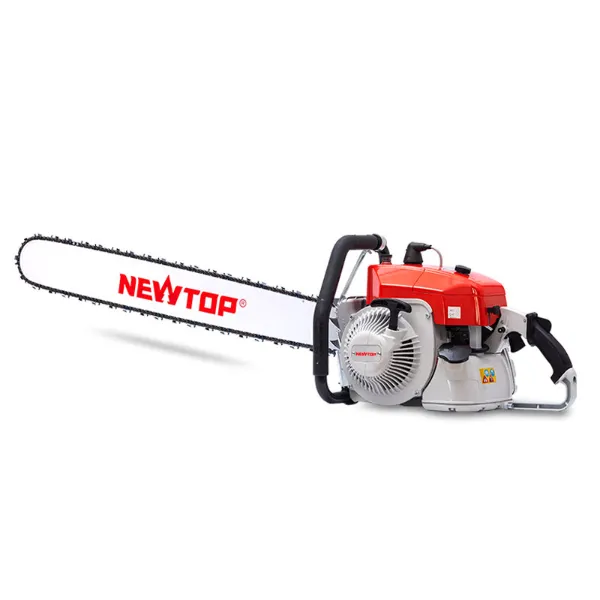
NT10500
High-displacement professional rear handle chainsaw engineered for forestry and large timber cutting.
View Details →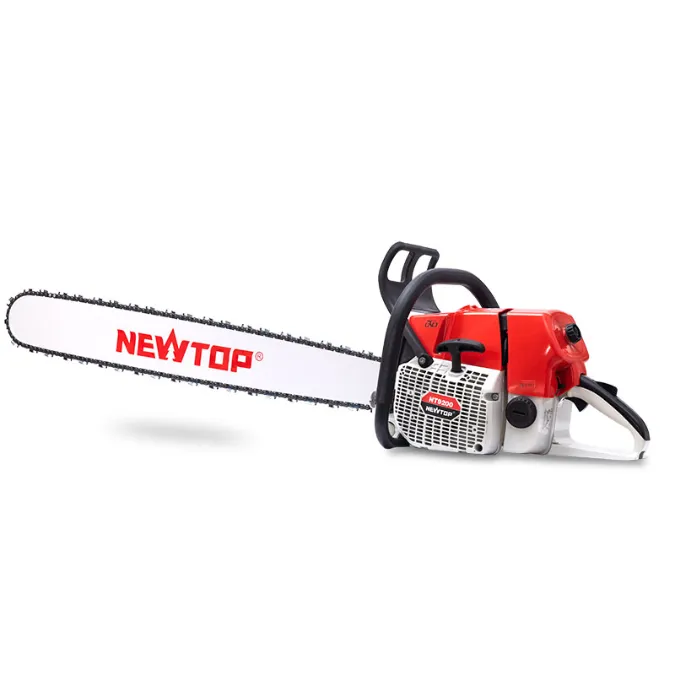
NT9200
Robust gasoline chainsaw designed for demanding field operations and hardwood cutting.
View Details →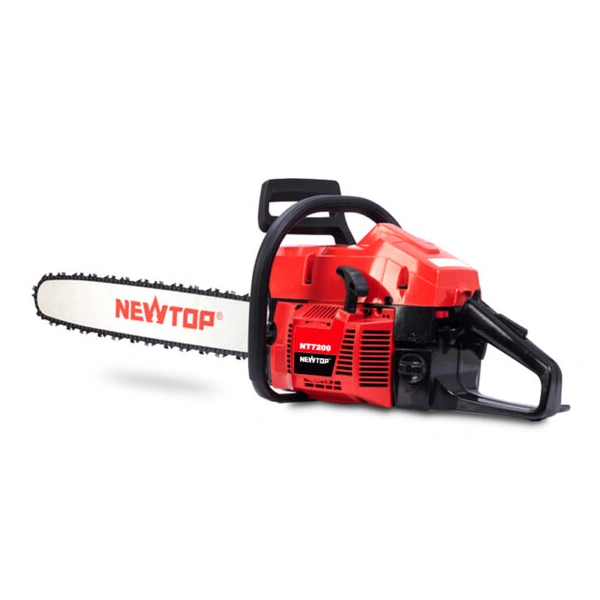
NT7200
Ideal balance of power and weight for landscaping and mid-range forestry work.
View Details →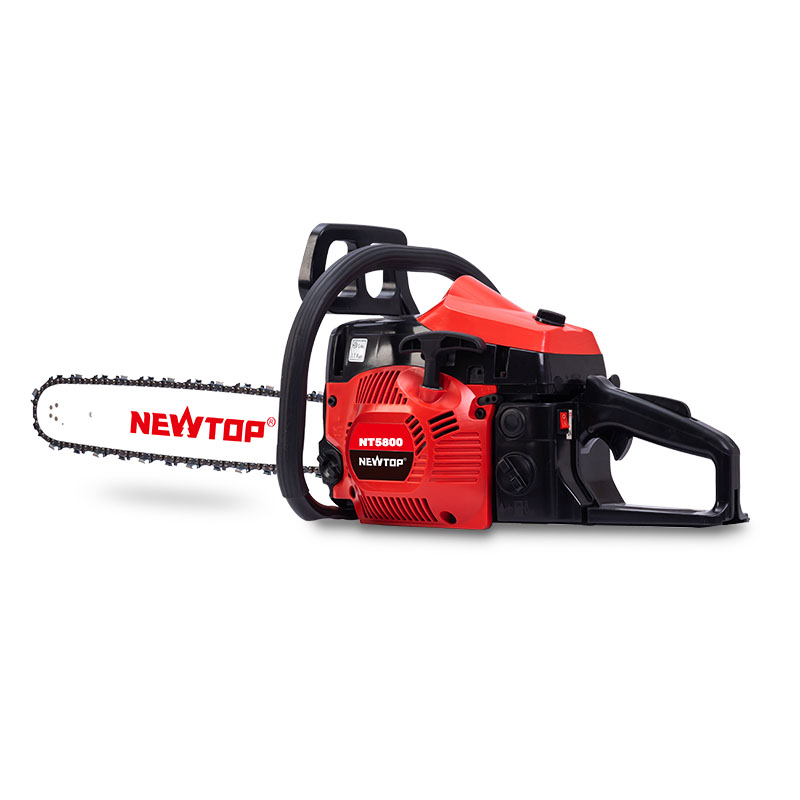
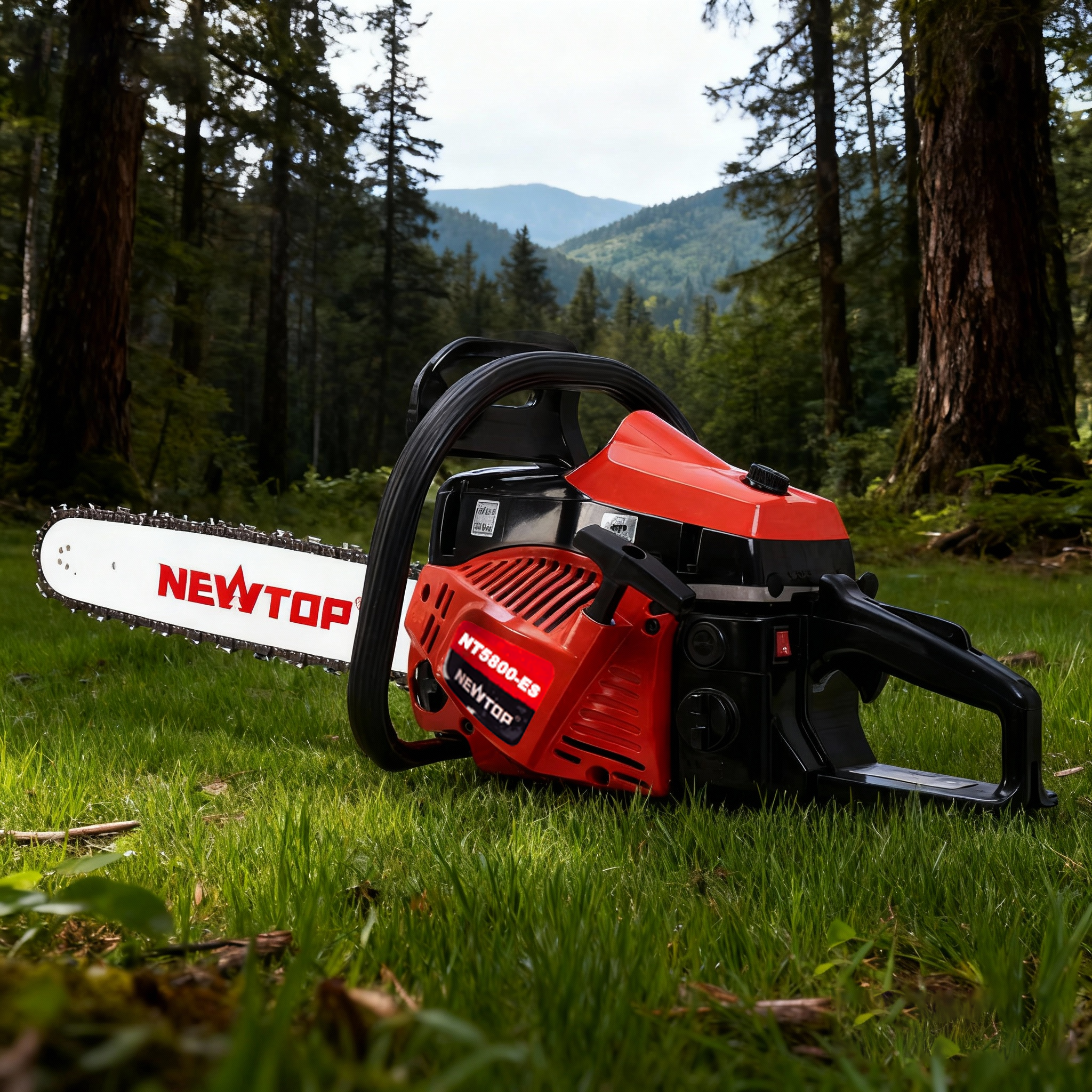
NT5800
Versatile mid-range chainsaw suitable for farm and general professional applications.
View Details →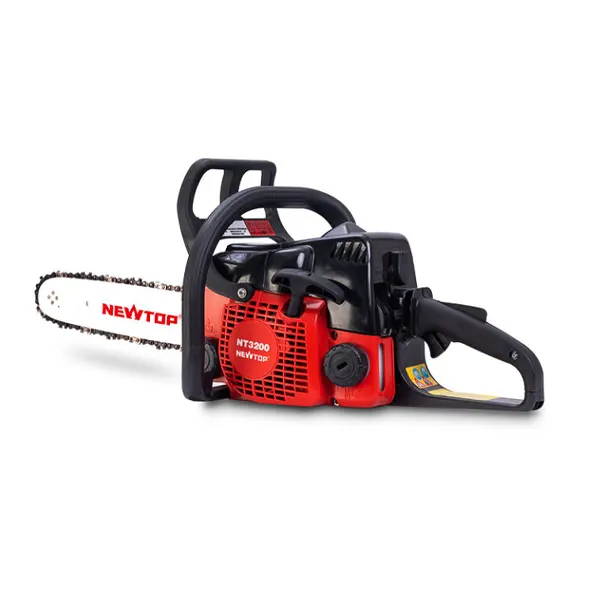
NT3200
Compact rear handle chainsaw ideal for light-duty landscaping and maintenance.
View Details →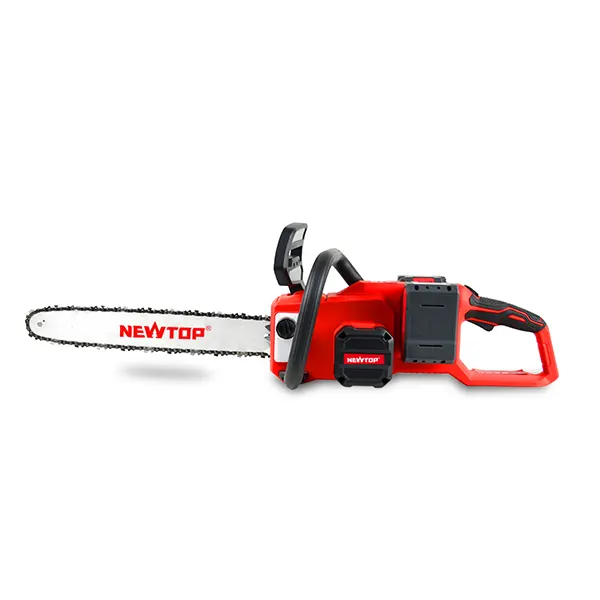
NTCS401Li
Portable lithium battery chainsaw delivering clean operation and minimal maintenance.
View Details →Ready to Work With NEWTOP Outdoor Power Equipment Manufacturer?
Selecting a manufacturing partner requires a direct evaluation of their vertical integration, supply chain quality, and business model flexibility to ensure both product reliability and market success.
ニュートップ has been manufacturing outdoor power equipment since 2003. With a 10,000㎡ production facility in Shanghai and over 300 employees, we supply chainsaws, 刈払機, 噴霧器, 発電機, and lithium garden tools to more than 65 国.
What differentiates NEWTOP is not only production scale but engineering depth. An independent R&D team oversees structural design, testing validation, and emission compliance, while automated assembly lines ensure consistency for OEM and private-label partners.
アフリカの代理店向け, Latin America, 東南アジア, and emerging European markets, NEWTOP provides:
- Flexible OEM customization
- Stable 30-day bulk lead times
- CE, GS, EPA, ETL certifications
- 1-year machine warranty
- 信頼できるスペアパーツ供給
If you are expanding your professional arborist product line or building a competitive climbing chainsaw range, partnering with an experienced manufacturer reduces long-term operational risk.
Contact NEWTOP today to discuss product catalogs, pricing structures, and distribution opportunities.
よくある質問
Why do professionals use top handle chainsaws?
They use them because the compact size allows for better movement in trees. The top handle design is easier to carry on a harness than a standard saw.
Are top handle chainsaws more dangerous than rear handle?
はい, top handle chainsaws are considered more dangerous for ground use or by untrained operators. Their design allows for one-handed operation, which reduces stability and control compared to the two-handed grip on a rear handle saw. This close-quarters grip significantly increases the risk of severe injury from rotational kickback.
What is the best top handle chainsaw for climbing?
The best model depends on the application. Professionals typically choose saws with strong power-to-weight ratios, responsive throttle systems, and advanced anti-vibration technology. Reliability and parts availability are equally important.
Can a beginner use a top handle saw?
No. Beginners should use a rear handle saw. Top handle saws require specific techniques to operate safely.
Why are top handle saws more expensive?
They often incorporate advanced engineering, lightweight materials, and reinforced safety systems. Additionally, they are targeted toward professional users, which influences pricing.
Do I need a license for a top handle chainsaw?
Regulations vary by country. In many regions, professional certification is required for commercial tree climbing operations. Always check local occupational safety laws before use.

Knowing how to measure a chainsaw bar correctly is a critical safety protocol that prevents dangerous kickback events and catastrophic equipment failure. A simple sizing error, often caused by measuring the entire physical bar from tip to tip, leads directly to ordering incompatible replacement parts. This mismatch not only causes poor cutting performance but also places excessive strain on the saw’s engine, resulting in accelerated wear and costly operational downtime.
この包括的なガイドでは、, we’ll walk you through the exact professional method used by service technicians and forestry equipment suppliers. You’ll also learn how to match bar length with engine displacement (CC), and how to avoid common sizing errors that reduce performance and damage your saw.
What is Chainsaw Bar Length?
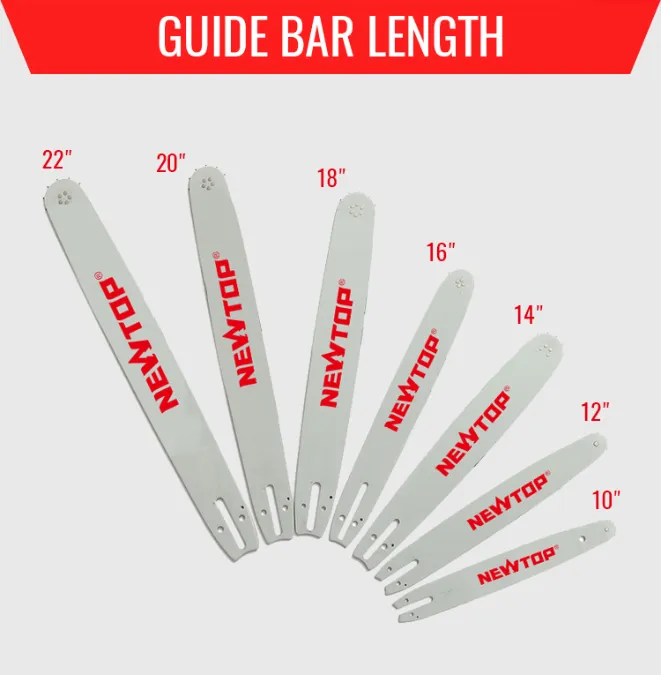
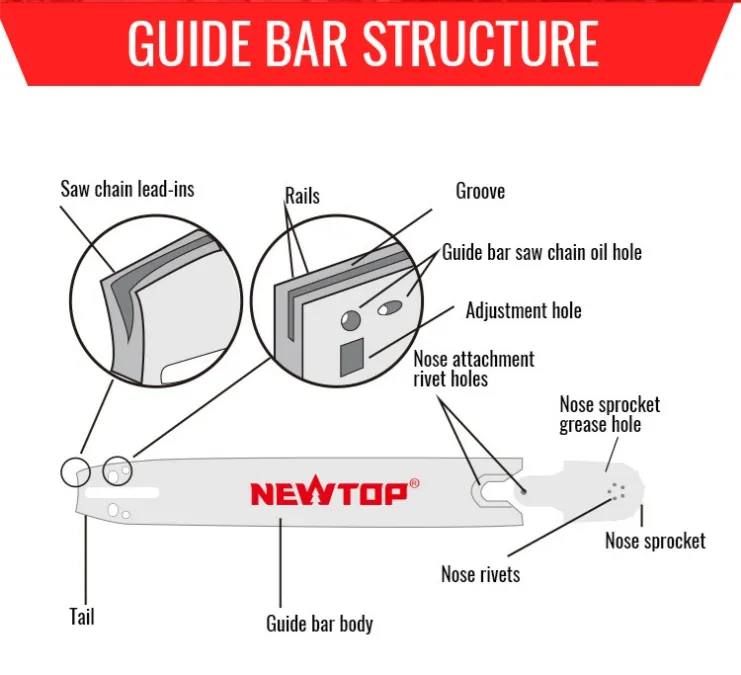
The guide bar is the long steel plate that supports and guides the chain during cutting. しかし, a portion of the bar sits inside the chainsaw body (the powerhead). That internal section does not contribute to cutting capacity.
Understanding Effective Cutting Length
Chainsaw bar length refers to the effective cutting length of the guide bar — not the total metal length from end to end. Technicians measure from the front of the saw’s body to the furthest tip of the bar, which represents the maximum width of wood you can cut in a single pass. When manufacturers list a bar as 16-inch, 18-inch, または 20-inch, they are referring to the usable cutting length, measured from the front of the saw housing to the tip of the bar.
How Bar Size Relates to Pitch and Gauge
While length is the primary specification, it works directly with pitch and gauge to create a compatible and safe cutting system. Pitch defines the distance between the chain’s drive links, and gauge measures the thickness of those links. The bar’s groove must match the chain’s gauge perfectly for proper function. Common pitch sizes are 0.325″ そして3/8″, while standard gauge sizes include .050″, .058″, そして .063″. Mismatching these critical measurements leads to poor cutting performance, chain derailment, and accelerated wear on the bar and sprocket.
Matching Bar Length to Application and Power
The ideal bar length depends entirely on the saw’s engine power and the job at hand. A longer bar requires more torque to drive the chain through dense wood, while a shorter bar provides better control and maneuverability for precise tasks. The relationship between length, 力, and application is straightforward.
- Shorter Bars (10–16 inches): Suited for saws with smaller engines. They are ideal for light tasks like pruning, limbing, and cutting small firewood where control is paramount.
- Medium Bars (16–20 inches): These are versatile all-rounders, common on homeowner and semi-professional models. They offer a good balance of cutting capacity and control for felling medium-sized trees.
- Longer Bars (22–30+ inches): Designed exclusively for powerful, professional-grade saws. These bars are used in forestry and land-clearing for felling large-diameter trees where maximum cutting width is necessary.
Different chainsaw types—such as gas, electric, または top-handle models—have varying bar length requirements. Learn more about the different types of chainsaws and how they influence your bar selection.
Step 1: Measuring the Effective Cutting Length (Called Length)
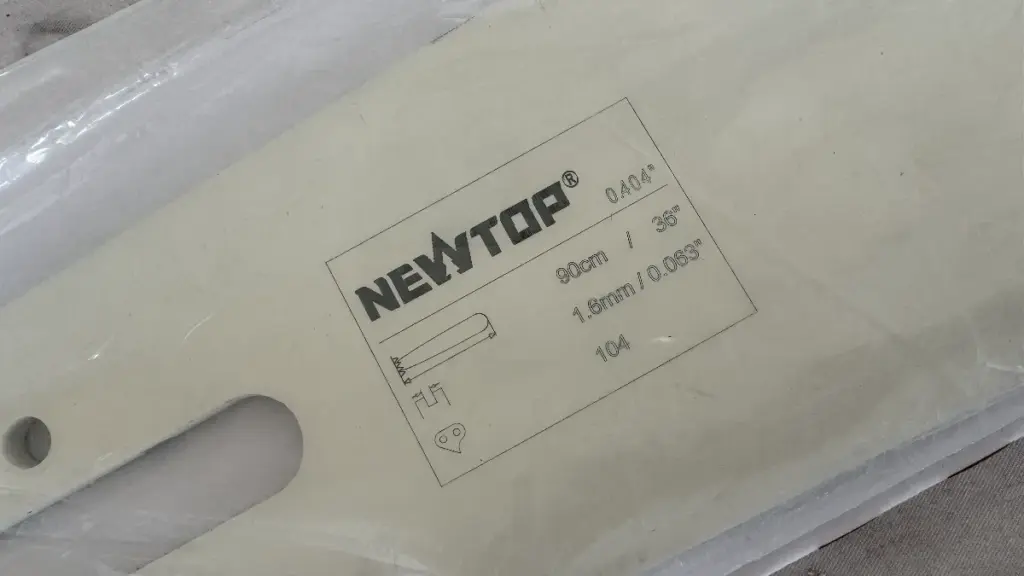
The industry-standard ‘called length’ is determined by measuring the bar’s usable cutting area from the tip to the saw’s body and rounding to the nearest standard size, a critical first step for ensuring correct chain and bar compatibility.
| Raw Measurement Example | Rounding Rule | Standard “Called Length” |
|---|---|---|
| 17.75 インチ | Round to the nearest standard size (typically 2-inch increments). | 18 インチ |
| 15.8 インチ | Round to the nearest standard size (typically 2-inch increments). | 16 インチ |
| 19.9 インチ | Round to the nearest standard size (typically 2-inch increments). | 20 インチ |
The Standard Measurement Technique
To find a chainsaw bar’s size, you measure its effective cutting length, also known as the “called length.” This is the only measurement that matters for part identification. For an accurate reading, keep the bar attached to the saw. Place the end of a tape measure at the very tip of the bar and extend it back to the point where the bar enters the chainsaw’s housing. The resulting distance is the effective cutting length, which represents the usable portion of the bar.
Rounding to Match Standard Bar Sizes
Your raw measurement must be converted to a standard commercial size. Chainsaw bars are manufactured and sold in fixed sizes, usually in two-inch increments like 16, 18, または 20 インチ. If your measurement is 17.75 インチ, you have an 18-inch bar. Always round your measurement to the nearest whole inch to identify its commercial classification. This industry standardization is what simplifies the process of buying replacement parts and guarantees that components from different batches or manufacturers will fit correctly.
Why This Measurement Is Foundational
Getting the effective length correct is the most important step in identifying your equipment. An incorrect measurement has a direct effect on cutting capacity, chain fitment, and operator safety. The called length determines the maximum diameter of wood you can cut in a single pass and is a required specification for purchasing the correct replacement chain. Using a bar that is too long for the saw’s engine will strain the motor, reduce performance, and create unsafe operating conditions.
Watch this step-by-step video, you’ll learn the proper technique for measuring your chainsaw’s effective cutting length. After watching, continue to Step 2 to count the drive links on your chain and make sure your saw and bar fit perfectly.
Step 2: Locating and Counting Drive Links on the Chain
An incorrect drive link count is a primary cause of chain derailment and operational failure, making an accurate manual count a critical maintenance step for safe equipment function.
| Verification Method | Purpose & Rationale | Common Pitfall to Avoid |
|---|---|---|
| Manual Count | Confirms the exact number of links required for the bar, preventing slack or excessive tension that leads to failure. | Losing count mid-way. Always mark the starting link with tape or a paint pen to ensure an accurate tally. |
| Check Stamped Bar Info | Provides the manufacturer’s exact specification (often abbreviated as “DL”) for quick and accurate chain replacement. | Relying on worn, illegible markings on an old bar. If you cannot clearly read the numbers, default to a manual count. |
What is a Drive Link and Why Does the Count Matter?
Drive links are the protrusions on the underside of the chain that sit inside the guide bar’s groove. They engage with the chainsaw’s drive sprocket to propel the chain and guide it along the bar. An accurate count of these links is fundamental for proper fitment. If the chain has too few links, it won’t fit onto the bar. If it has too many, the chain will be too loose, leading to poor cutting performance, binding, and a high risk of derailment during operation. The drive link count determines the precise length of the chain needed for a specific bar, ensuring safe and efficient power transfer from the engine to the wood.
A Reliable Method for Counting Drive Links Manually
To avoid errors, use a systematic counting method. First, remove the chain from the saw and lay it out on a flat, clean surface like a workbench or floor. This straightens the chain completely and prevents tangles that cause miscounts. Mark your starting drive link with a piece of tape or a paint pen to create a clear reference point. From there, carefully count each individual drive link until you return to your marked link. For better accuracy, count in small groups, such as by fives, and then perform a second count to verify your final number.
Where to Find Drive Link Information on Your Equipment
Many manufacturers stamp or laser-etch the required drive link count directly onto the guide bar to simplify replacement. Inspect the tail end of the bar, near the area where it mounts to the saw body. This information is often listed alongside the bar’s required pitch and gauge specifications. The drive link count is typically abbreviated as “DL” followed by a number (例えば, “72DL”). Even when this information is available, performing a manual count on your old chain remains a reliable verification method, especially if the bar is worn or the markings have become difficult to read.
Step 3: Determining Bar Gauge and Pitch for Perfect Fitment

Getting the pitch and gauge right is non-negotiable; these two measurements act as a lock-and-key system, and a mismatch guarantees poor performance and significant safety risks.
| Measurement | Technical Definition | Common Industry Sizes |
|---|---|---|
| ピッチ | The distance between the centers of three consecutive rivets on the chain, divided by two. | .325″, 3/8″, 1/4″ |
| ゲージ | The thickness of the drive links, which must match the width of the bar’s groove. | .043″, .050″, .063″ |
Understanding Pitch and Gauge
Pitch and gauge are the two critical measurements that ensure your chain and guide bar function as a single, efficient system. A proper match is essential for safe operation. Pitch defines the spacing between drive links, while gauge sets the thickness of those links. This ensures the chain seats perfectly within the bar’s groove, preventing binding or derailing during high-speed operation.
How to Measure and Identify
The most efficient way to find these measurements is to look for the information stamped directly on the tail of the guide bar, near the mounting slots. If the markings are worn or unreadable, your chainsaw’s operator manual is the next best source. It will list the exact factory specifications for your model.
- Check the base of the bar for stamped numbers that specify both pitch and gauge.
- Consult your chainsaw’s instruction manual for the original equipment specifications.
- If you are still unsure, bring the bar or saw to a local dealer for professional identification.
Why Matching Matters
Using a mismatched chain and bar introduces immediate operational problems and safety hazards. For the cutting system to work, the chain pitch, the drive sprocket pitch on the saw, and the bar’s nose sprocket pitch must all be identical. Any deviation breaks this alignment and causes performance failure.
- An incorrect pitch causes the chain to bind or jump in the groove, leading to poor cutting and potential kickback.
- If the gauge is too thin for the bar’s groove, the chain will wobble and can easily derail.
- If the gauge is too thick, the chain will bind, generating excessive friction, heat, and wear on both the bar and the engine.
Your Partner for Reliable, Profitable Power Tools
Pros and Cons of Using Longer vs Shorter Bars on One Saw
Selecting the right bar length is a critical balance between the cutting capacity needed for a job and the saw’s engine power, where shorter bars prioritize control and longer bars maximize reach and efficiency.
Advantages and Disadvantages of Shorter Bars (12-18 インチ)
Shorter bars offer superior control and safety, making them ideal for homeowners and light-duty tasks like trimming limbs or cutting small trees. Their compact size reduces operator fatigue and minimizes the risk of dangerous kickback, a significant advantage for users with less experience. This category of bar dominates the homeowner market because it provides a good balance of capability and manageability.
- Easier to handle and maneuver in tight spaces.
- Lower kickback potential, making them safer for less experienced users.
- Requires less engine power, putting less strain on the saw.
- Limited cutting diameter, making them inefficient for felling large trees.
Advantages and Disadvantages of Longer Bars (20+ インチ)
Longer bars provide a greater cutting capacity, allowing professional users to fell large-diameter trees and buck thick logs more efficiently. This performance comes at the cost of increased weight, reduced maneuverability, and a higher demand for operator skill. A long bar allows for cutting through thick logs in a single pass, which is essential for productivity in commercial forestry and farm applications.
- Enables cutting through wider logs in a single pass, increasing productivity.
- Provides extended reach for felling and limbing.
- Heavier and more difficult to balance, leading to quicker operator fatigue.
- Requires a more powerful engine to drive the chain effectively without bogging down.
Finding the Right Balance: Engine Power and User Skill
The best bar length for a chainsaw is a trade-off between the saw’s engine displacement (CCs) and the operator’s physical ability and experience. Overloading a small engine with a long bar leads to poor performance, slow cuts, and premature wear on the clutch and engine components. It’s not just about what fits; it’s about what the powerhead can realistically drive through dense material.
- Always match the bar length to the manufacturer’s recommended range for your saw’s engine size.
- A bar that is too long for the powerhead will cut slowly and strain the engine.
- Consider the type of wood; hardwoods require more power, often favoring a slightly shorter bar for a given engine.
- Operator experience is crucial, as longer bars amplify the forces of kickback and demand more physical control.
Common Sizing Mistakes: Why “End-to-End” Measuring Fails
Measuring the total physical length of a chainsaw bar instead of its functional cutting length is the primary cause of equipment incompatibility and performance issues.
Measuring Total Bar Length Instead of Effective Cutting Length
A frequent mistake is measuring the entire physical bar from tip to tail. The correct industry standard is the “effective cutting length” または “called length,” which only measures the usable portion of the bar that extends from the chainsaw’s body. Measuring the full bar guarantees you will purchase the wrong size replacement chain and potentially other mismatched accessories.
- This error results in selecting a chain that is too long for the bar’s actual exposed cutting area.
- An end-to-end measurement does not reflect the functional length specified by manufacturers for matching chains and accessories.
Including Mounting Hardware in the Measurement
Operators often incorrectly include the part of the bar that fits inside the powerhead when measuring. This mounting section, or tail, does not contribute to cutting and artificially inflates the length. This inflated number leads directly to incorrect sizing and equipment that will not fit or function properly.
- Accurate measurement must begin where the guide bar emerges from the front of the chainsaw’s casing.
- Failing to exclude the mounting hardware leads to equipment incompatibility, poor performance, and potential safety risks from an improperly tensioned chain.
Forgetting to Round to the Nearest Standard Increment
Chainsaw bars are sold in standardized even-inch sizes, such as 16″, 18″, or 20″. If your measurement of the effective cutting length is slightly off, like 17.5 インチ, you must round it to the nearest standard size, which would be 18 インチ, to find the correct replacement part. The market does not produce fractional or odd-numbered bar lengths.
- Industry practice is to round the effective cutting length to the closest even-inch number for marketing and sales.
- Ignoring this convention can lead to searching for non-existent bar sizes and purchasing the wrong equipment.
Selection Guide: How to Match Bar Length to Engine Power (CC)
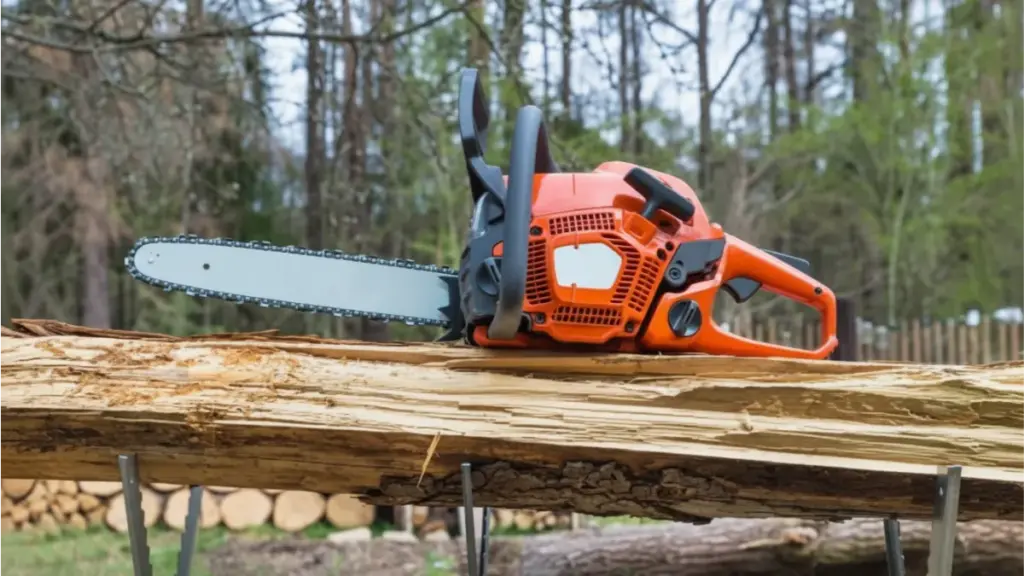
Matching the guide bar length to the engine’s displacement is critical for preventing clutch burnout and ensuring safe, efficient cutting performance.
Matching guide bar length to engine displacement (CC) is essential for maintaining cutting efficiency, protecting the clutch system, and extending engine lifespan. A bar that is too long for the engine’s torque output will reduce chain speed, increase vibration, and cause premature mechanical wear. Proper balance ensures smooth power transfer and safe operation.
| Engine Size (cc) | Typical Bar Length Suggestion (インチ) |
|---|---|
| 25–35 cc | ~10–14″ |
| 35–45 cc | ~12–16″ |
| 45–60 cc | ~16–20″ |
| 60–80+ cc | ~20–28″ |
| 30–35 cc | 10–12″ (Light Duty) |
| 35–45 cc | 12–16″ |
| 45–55 cc | 16–20″ |
| 55–65 cc | 18–24″ |
| 65–80 cc | 24–32″ |
| 10–14″ and Up | Varies by Use Case |
For small engines between 25cc and 35cc, the ideal bar length is typically 10 に 14 インチ. These compact saws are designed for pruning, limbing, and light firewood cutting. Installing a longer bar places excessive strain on the engine, especially when cutting hardwood.
Mid-range engines in the 35cc to 45cc category perform best with 14 to 16-inch bars. While some high-output 45cc models may technically accommodate an 18-inch bar, pushing beyond this range often results in slower chain speed and reduced efficiency under load.
のために 45cc to 55cc engines, a 16 to 18-inch bar is generally optimal, with certain 50cc+ models capable of handling up to 20 inches when properly tuned. This range offers a strong balance between maneuverability and cutting capacity.
Professional-grade engines from 55cc to 70cc can reliably operate 18 to 24-inch bars, depending on torque design. Engines above 70cc are typically paired with 24-inch bars or longer for heavy forestry work.
Factors Beyond CC: Wood Type and Operator Skill
While engine displacement provides a solid baseline, the ideal bar length also depends on the type of wood and the operator’s experience level. Hardwoods like oak or maple require significantly more power to cut, so you might choose a slightly shorter bar than you would for cutting softwoods like pine with the same saw. Operator skill is also critical, as a longer bar is more difficult to control and increases the risk of dangerous kickback. A well-balanced saw with an optimal power-to-weight ratio reduces user fatigue and improves safety during extended work periods.
Consequences of an Incorrect Match
Using an improperly sized guide bar directly compromises both performance and operator safety. An underpowered setup, where the bar is too long for the engine, results in slow cutting, frequent chain stalling, and potential clutch burnout from the constant strain. Conversely, a bar that is too short for a powerful engine underutilizes the saw’s capability and makes the work less efficient. The most significant consequence is the increased safety risk—a poorly balanced saw is difficult to handle and significantly raises the probability of dangerous kickback events.
Why Choose NEWTOP Precision-Engineered Guide Bars?
NEWTOP’s guide bars combine globally sourced components with in-house precision manufacturing to offer professional-grade reliability and a strong cost advantage in competitive markets.
If you are sourcing replacement guide bars for retail, OEM branding, or distribution, it is critical to select a reliable chainsaw guide bar manufacturer.
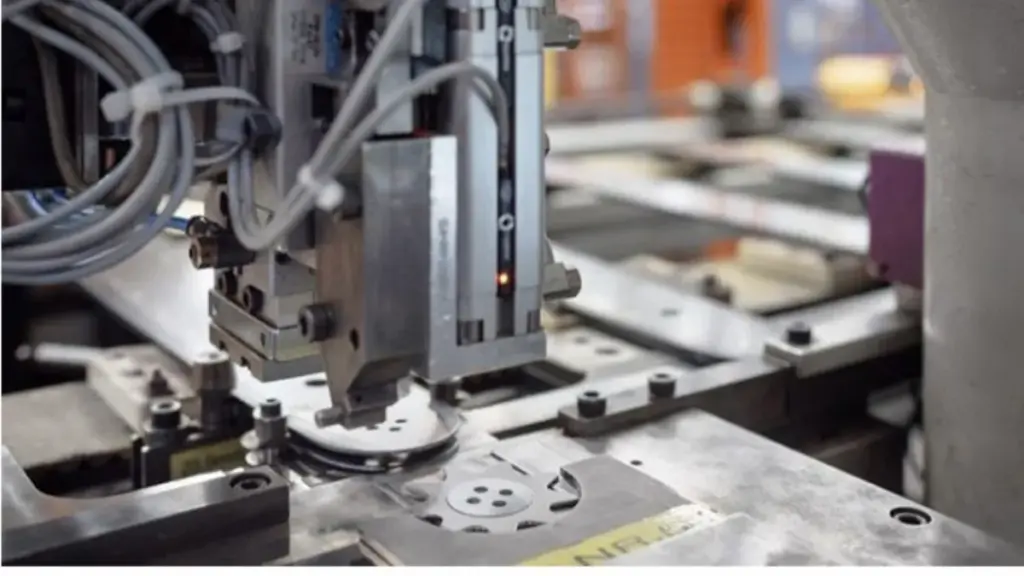
ニュートップ has specialized in garden machinery and forestry tools since 2003. With over 10,000㎡ production facilities and advanced CNC machining centers, NEWTOP manufactures precision-engineered guide bars designed for durability and long service life.
What Sets NEWTOP Guide Bars Apart?
- High-grade alloy steel construction
- Precision rail hardening for wear resistance
- Accurate groove machining for smooth chain tracking
- Compatibility with major chain standards (.325″, 3/8″, .404″)
- Strict QC testing including rail straightness and hardness verification
NEWTOP products are exported to 65+ countries across Latin America, アフリカ, 東南アジア, and Eastern Europe, supporting both OEM clients (60%) and brand distributors.
Whether you are replacing bars for professional logging or supplying regional dealers, NEWTOP offers stable supply, competitive pricing, and customizable packaging options.
If you’re looking to expand your product line with reliable chainsaw components, our engineering team can support OEM/ODM development tailored to your market needs.
結論
Measuring a chainsaw bar’s effective length, ピッチ, and gauge is fundamental for ensuring safe operation and optimal cutting performance. These steps guarantee you select a compatible replacement, preventing premature equipment wear and costly purchasing errors. This precision directly contributes to the reliability and longevity of your tools.
If you are sourcing new components, review our catalog of precision-engineered guide bars. Our team is available to help verify the correct fitment for a single saw or an entire fleet.
よくある質問
Do you measure a chainsaw bar from tip to tip?
No. You measure from the front edge of the chainsaw housing to the tip of the bar. Measuring tip to mounting tail gives an incorrect length.
How do I know what size bar fits my chainsaw?
To determine the correct bar size, consult your chainsaw’s user manual, which lists the manufacturer’s recommended bar lengths and specifications. You must match three critical specs: the bar’s mount pattern (which must fit your saw), the chain pitch (例えば, .325″), and the chain gauge (例えば, .050″). Using an incompatible bar can lead to poor performance and safety risks.
Is a 18-inch bar really 18 inches long?
The effective cutting length is approximately 18 インチ. The total physical length is slightly longer due to the mounting section.
Can I put a 20-inch bar on a 16-inch chainsaw?
Only if the engine displacement supports it and the sprocket matches the pitch. Otherwise, it may cause performance issues and mechanical strain.
Where is the size marked on the chainsaw bar?
The bar’s specifications are almost always stamped or printed on the tail end of the bar, near the mounting slots. Look for a series of numbers indicating the effective cutting length (例えば, 18″ or 45cm), chain pitch (例えば, .325″), gauge (例えば, .050″ or 1.3mm), and the required drive link count for the matching chain.
How do I measure the drive links on a chain?
Remove the chain, lay it flat, and count each drive link individually. Alternatively, check the packaging label if available
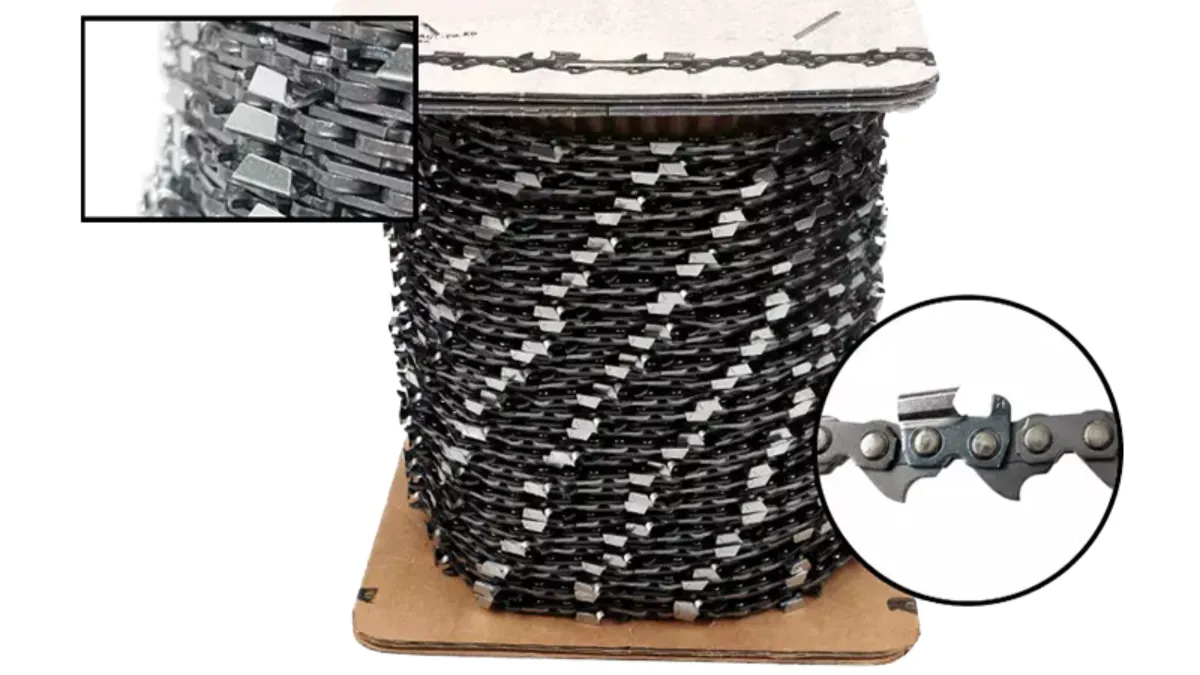
When selecting a chainsaw chain, most buyers focus on brand, bar length, or engine power. しかし, the real performance difference often lies in two critical technical parameters: pitch and gauge. These two measurements determine compatibility, cutting efficiency, vibration level, 耐久性, and even operator safety.
For distributors, OEM buyers, and professional users in forestry or agriculture, it is essential to understand these engineering fundamentals. このガイドでは, we break down pitch and gauge in detail, explain how they affect cutting behavior, and help you select the correct chain configuration for your market.
What is Pitch on a Chainsaw Chain?
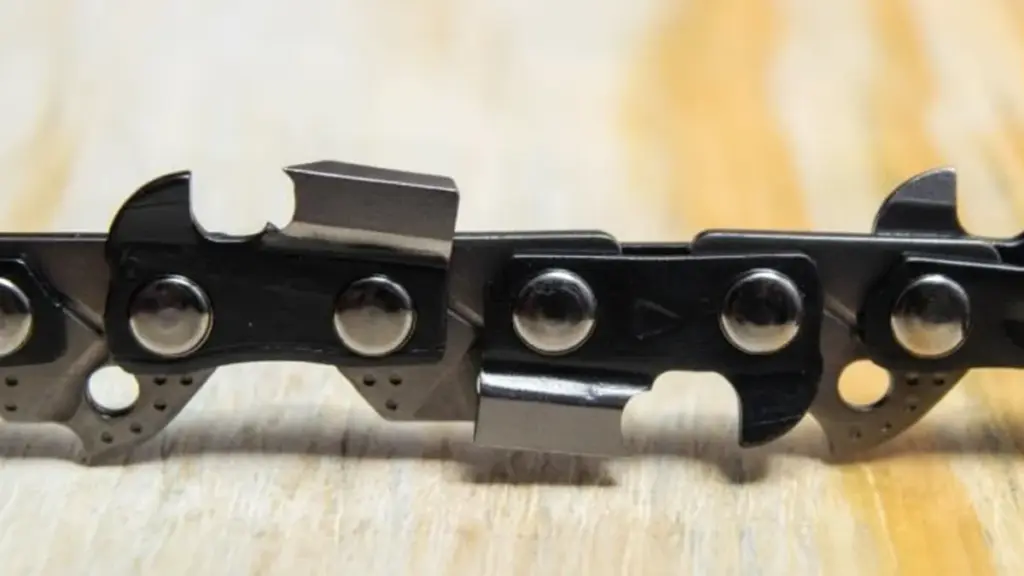
Chain pitch is the fundamental size specification of a chainsaw chain, calculated as half the distance between three consecutive rivets, and it must precisely match the guide bar and drive sprocket for safe operation.
Defining Chain Pitch
Chain pitch is the industry-standard measurement that defines the size of a chainsaw chain. You calculate it by measuring the distance between the center points of any three consecutive rivets and dividing that number by two. For a chainsaw to function correctly, this measurement must match the specifications of the saw’s guide bar and drive sprocket.
Why Pitch Compatibility is Critical
A chainsaw operates as a system where the chain pitch, chain gauge, and guide bar must be fully compatible. Using an incorrect pitch prevents the chain from seating correctly on the guide bar’s drive sprocket, which leads to equipment damage and complete operational failure.
- A mismatched chain will quickly wear down or break the drive sprocket.
- Running incompatible parts almost always voids the equipment’s warranty.
What is Gauge on a Chainsaw Chain?
Chain gauge is the thickness of the drive links, a critical measurement that must exactly match the guide bar’s groove to ensure safe, efficient operation without derailing or binding.
Defining Gauge: The Thickness of the Drive Link
The gauge of a chainsaw chain is the measured thickness of its drive links. These are the bottom, tooth-like parts of the chain that run inside the guide bar’s groove, or track. This single measurement ensures the chain fits securely, preventing excessive movement or friction. Gauge is typically expressed in thousandths of an inch, such as .050″, or in millimeters like 1.3 mm.
Why a Correct Gauge Match is Essential
Matching the chain gauge to the guide bar groove is non-negotiable for safe and effective chainsaw operation. Any mismatch introduces immediate performance and safety problems. An incorrect fit will cause the chain to behave erratically and can damage your equipment.
- Gauge too thin: If the drive links are too narrow for the bar’s groove, the chain will wobble side-to-side. This instability causes poor cutting performance and significantly increases the risk of the chain derailing from the bar during use.
- Gauge too thick: If the drive links are too wide, they will bind inside the groove. This creates excessive friction, which strains the engine, generates heat, and can stop the chain from moving at all.
Precision Saw Chains Built for Power & Profit
What Are Parts of Chainsaw Chain?
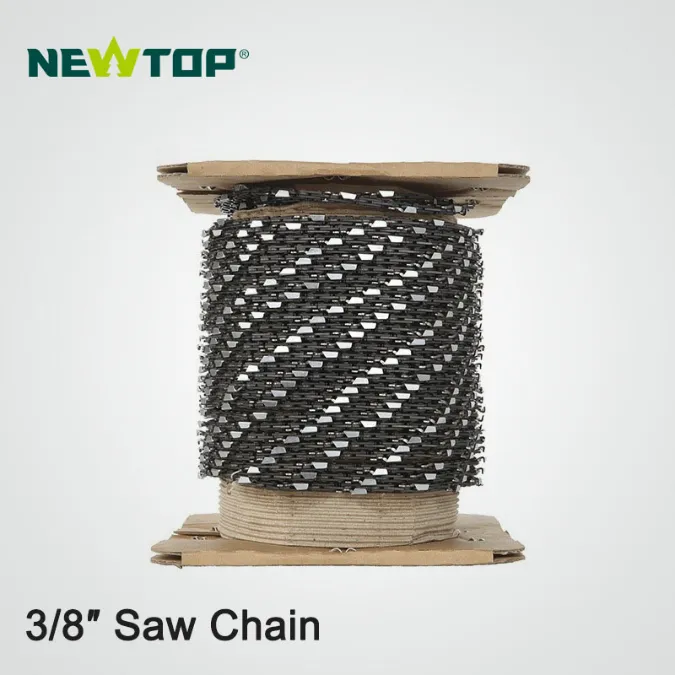
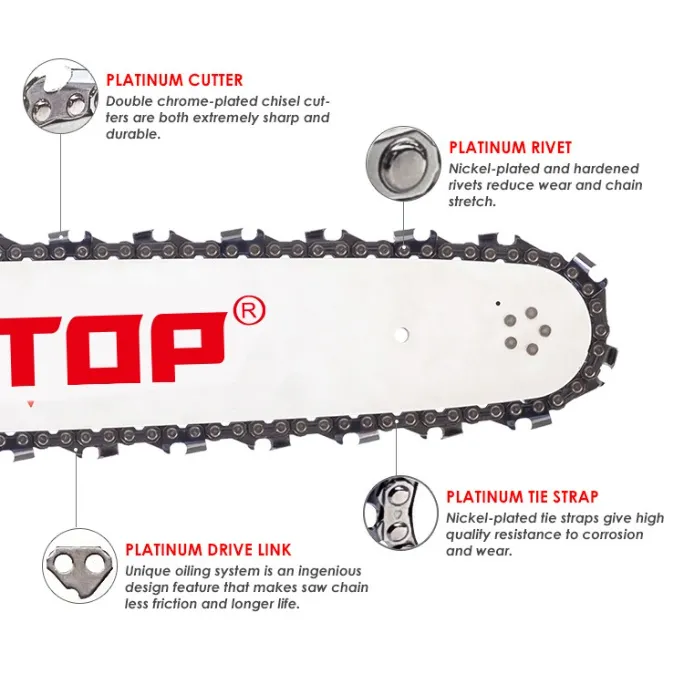
A chainsaw chain integrates three primary components—cutting links for slicing wood, drive links for power transfer, and tie straps for structural integrity—arranged in specific sequences to control cutting performance.
Cutting Links (Cutters)
These are the primary components that perform the actual cutting. Each cutter has a sharp tooth and a depth gauge (レイカー) that regulates how deep the tooth bites into the wood. The specific design of the cutter determines its performance in different conditions, impacting both speed and durability.
- Features a sharpened cutting corner responsible for slicing wood fibers.
- Includes a depth gauge that controls the thickness of the wood chip removed.
- Available in full-chisel, 半ノミ, and chipper designs for different cutting conditions.
ドライブリンク
Drive links are the bottom part of the chain that engages with the chainsaw’s sprocket. They pull the chain around the guide bar and help distribute oil for lubrication. The thickness of these links defines the chain’s gauge, which must match the guide bar’s groove precisely for safe and effective operation.
- The part of the chain that fits into the guide bar groove and is propelled by the sprocket.
- Their thickness determines the chain’s gauge, which must match the guide bar.
- Essential for transferring power from the engine to the chain.
タイストラップ
Tie straps are connecting components that hold the cutting links and drive links together in the correct sequence. They do not cut but provide the chain with its structure and flexibility, using riveted joints to allow the chain to move smoothly around the guide bar.
- Connects all links together using riveted joints.
- Allows the chain to move flexibly around the guide bar.
- Ensures the proper spacing and arrangement of cutters and drive links.
Chain Sequence Arrangements
The sequence refers to the pattern of cutters on the chain. Common arrangements like standard, semi-skip, and full-skip affect cutting speed and smoothness, especially on longer guide bars where efficient chip clearance is a critical factor for performance.
- Standard Sequence: Has a cutter on every other link for the smoothest cut.
- Semi-Skip Sequence: Features extra space between cutter groups for better chip clearance.
- Skip Sequence: Has the most space between cutters, ideal for long bars and powerful saws.
Key Details on Chain Measurements

Correctly matching the chain’s pitch to the sprocket and its gauge to the guide bar is non-negotiable for safe and efficient chainsaw operation.
| Measurement | Definition | Common Sizes |
|---|---|---|
| チェーンピッチ | Distance between three consecutive rivets, divided by two. Must match the drive sprocket. | 1/4″, .325″, 3/8″, .404″ |
| チェーンゲージ | The thickness of the drive links. Must fit precisely into the guide bar groove. | .043″, .050″, .058″, .063″ |
Common Sizes of Pitch on a Chainsaw Chain
- 3/8″ is the most common size, especially for consumer chainsaws. Many of these saws use a lighter “low profile” または “Picco” variant for reduced kickback.
- .325″ is standard for many semi-professional and mid-range professional saws, balancing cutting speed with durability.
- 1/4″ is a smaller pitch used on lightweight residential saws or specialized carving saws where precision is key.
- .404″ is a heavy-duty pitch reserved for high-powered, large-displacement professional saws used in demanding forestry and logging operations.
Common Thickness of Pitch on a Chainsaw Chain
- The most common gauge sizes are .043″ (1.1 mm), .050″ (1.3 mm), .058″ (1.5 mm), そして .063″ (1.6 mm).
- The .050″ gauge has become an industry standard for a wide range of consumer and professional chainsaws.
- To eliminate guesswork, manufacturers typically stamp the required gauge measurement directly onto the heel of the chainsaw’s guide bar.
How to Calculate Chainsaw Pitch on a Chainsaw Chain?
| Method | Description | Key Action |
|---|---|---|
| 3-Rivet Measurement | The industry-standard physical measurement to find the base distance. | Use a caliper to measure from the center of the first rivet to the center of the third. |
| Calculation | Converts the 3-rivet measurement into the final, industry-standard pitch value. | Divide the measured distance by two. |
| Stamped Markings Verification | Confirms the calculated pitch using the manufacturer’s provided specifications. | Check for numbers stamped on the guide bar, drive links, or in the owner’s manual. |
The Standard 3-Rivet Measurement Method
The universal industry method for determining chainsaw pitch involves measuring the distance between the centers of three consecutive rivets on the chain. This technique provides a consistent basis for calculation regardless of the chain’s manufacturer.
- Select any three rivets in a row on the chainsaw chain.
- Use a caliper or a precise ruler to measure the exact distance from the center of the first rivet to the center of the third rivet.
- Ensure the chain is taut but not stretched during measurement to get an accurate reading.
Applying the ‘Divide by Two’ Formula
After measuring the distance across three rivets, the final pitch is calculated by dividing that measurement by two. This simple formula converts the measurement into the industry-standard pitch size.
- Take the total distance you measured (例えば, 0.75 インチ).
- Divide this value by two to determine the pitch (例えば, 0.75 インチ / 2 = 0.375 インチ).
- Convert the decimal result to its common fraction equivalent; for example, 0.375 inches is equal to a 3/8″ ピッチ.
Verifying Pitch Using Stamped Markings
To confirm your calculation or skip measuring altogether, check for pitch information stamped directly on the equipment. Manufacturers often provide these details on the guide bar or the chain itself to ensure compatibility.
- Inspect the guide bar, typically near the motor end, for stamped numbers indicating pitch, gauge, and drive link count.
- Examine the drive links of the chain for an identification code or number that corresponds to its pitch.
- Referencing the owner’s manual for your chainsaw also provides the correct pitch specification without needing to measure.
How to Measure Gauges on a Chainsaw Chain?
Measuring a chainsaw’s gauge—the thickness of its drive links—is a non-negotiable step for safe operation, and while calipers offer precision, checking for stamped markings on the bar is the most efficient method.
Using Tools for an Accurate Measurement
Gauge is the thickness of the drive link that fits directly into the guide bar’s groove. For a precise reading, a caliper is the most reliable tool. It provides an exact measurement in thousandths of an inch. Alternatively, a go/no-go gauge offers a quick way to confirm the correct fit without needing to read a measurement.
- Use caliper jaws to measure the thickness of a single drive link directly.
- A go/no-go gauge has two sized slots; the drive link should slide easily through the correct slot but be blocked by the smaller one.
The Coin Method for a Quick Approximation
When specialized tools are not available, you can use common coins to get a rough estimate of the gauge. This method involves fitting a coin snugly into the bar’s groove. Before attempting this, make sure the groove is completely clean of any wood chips, oil, or debris to avoid an inaccurate reading.
- A U.S. dime is approximately 0.050″ thick.
- A U.S. penny is approximately 0.058″ thick.
- A U.S. quarter is approximately 0.063″ thick.
Finding Existing Markings and Common Sizes
The easiest way to identify the correct gauge is to inspect the chainsaw bar itself. Manufacturers typically stamp the required specifications, including gauge, directly onto the metal near the mounting point. This eliminates any need for manual measurement. Matching the gauge is critical; a chain that is too thin can derail from the bar, while a chain that is too thick will bind, creating excessive friction and heat.
Standard gauge sizes you will encounter include .043″, .050″, .058″, そして .063″.
Pros and Cons of High-Profile vs Low-Profile Pitch Designs
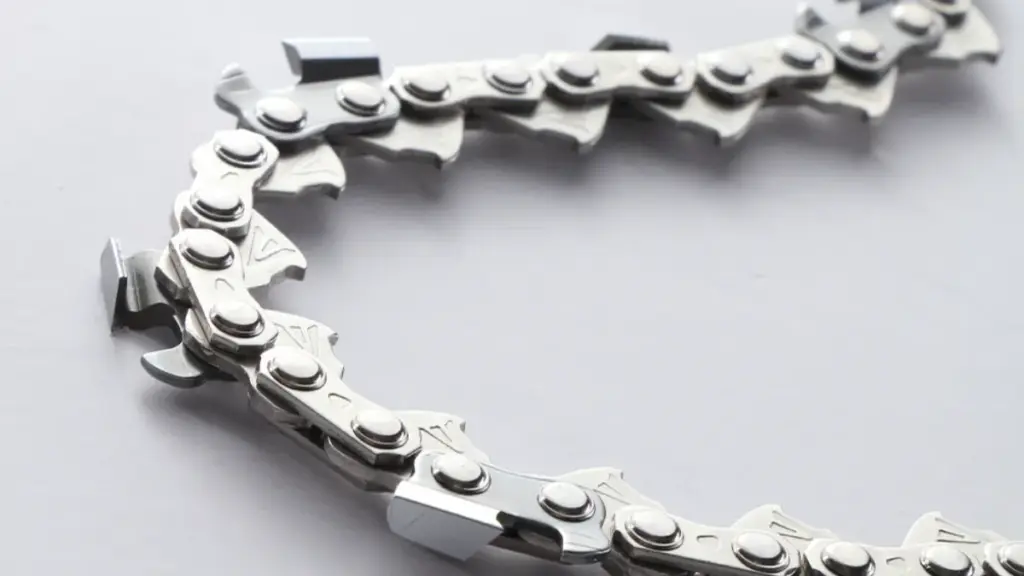
The choice between high-profile and low-profile chain pitch is a direct trade-off between the aggressive cutting power required for professional forestry and the enhanced safety features necessary for residential use.
High-Profile Chains: Performance and Applications
High-profile, or standard, chains are built for professional and heavy-duty applications. They prioritize cutting speed and power, making them the top choice for forestry work and tasks that require high-performance from gas-powered saws.
- Optimized for aggressive cutting and efficiency in demanding jobs.
- Best paired with chainsaws that have larger engine displacements.
- Carries a higher risk of kickback, requiring skill and experience to handle safely.
Low-Profile Chains: Safety and Accessibility
Low-profile chains dominate the consumer and residential market. Their design incorporates safety features that reduce kickback, making them ideal for homeowners, light-duty work, and electric or battery-powered saws.
- Engineered to minimize the intensity and frequency of kickback.
- Delivers a smoother, more controlled cut, which is great for less experienced users.
- Works well with lower-power saws and is common on equipment for general yard maintenance.
Key Trade-Offs: Durability and Maintenance
Choosing between the two designs comes down to balancing performance with safety. High-profile chains are more durable for high-production environments, but low-profile chains offer accessibility at the cost of faster wear.
- Standard chains typically last longer under constant professional use.
- Low-profile chains are built with user safety as the priority, which can affect their overall toughness.
- Professionals select pitch based on the specific cutting task, while consumers benefit from the built-in safety of low-profile chains.
How to Select Pitch Based on Your Chainsaw Sprocket Type
A chainsaw’s chain pitch must exactly match its drive sprocket pitch; any mismatch will damage the saw and create a significant safety risk.
| Sprocket Type | Key Characteristic | Pitch Flexibility |
|---|---|---|
| Spur Sprocket | A single, solid component with teeth integrated directly into the main body. | Fixed. The pitch cannot be changed without replacing the entire sprocket assembly. |
| リムスプロケット | A two-piece system with a central drum and a separate, replaceable rim that holds the teeth. | Modular. The pitch can be changed by swapping only the rim for a different size. |
Matching Sprocket Pitch with Chain Pitch
The single most important rule when selecting a chain is that its pitch must exactly match the pitch of the drive sprocket. Using mismatched components causes rapid wear on the drive links, sprocket, and guide bar. This leads to poor cutting performance and creates potential safety hazards from chain slippage or breakage. This compatibility is non-negotiable for proper chainsaw function.
- Your chainsaw’s sprocket, guide bar, and chain must all be designed for the same pitch measurement (例えば, .325″, 3/8″).
- Check the sprocket itself for a stamped number indicating its pitch; this is the primary measurement to follow.
- A mismatch prevents the chain’s drive links from seating correctly in the sprocket’s teeth, causing chain slippage and damage.
Identifying Your Sprocket Type: Rim vs. Spur
Chainsaws use one of two sprocket types to drive the chain: a spur sprocket or a rim sprocket system. While both perform the same function, the rim sprocket system offers more flexibility for changing the saw’s pitch. Identifying which type your saw has helps determine the easiest path for component selection and replacement.
- A spur sprocket is a single, solid piece with teeth that directly engage the chain. Its pitch is fixed.
- A rim sprocket consists of a central drum and a separate, replaceable rim that contains the teeth.
- With a rim sprocket, you can change your saw’s pitch by simply swapping the rim for one with a different pitch measurement, as long as a compatible bar and chain are also used.
Using Manufacturer Specifications for Guaranteed Compatibility
To eliminate guesswork, always refer to the manufacturer’s technical specifications for your chainsaw model. As of 2026, most professional-grade manufacturers provide detailed compatibility charts that ensure all components work together seamlessly as an integrated system. Sticking to these official recommendations is the surest way to guarantee both safety and performance.
- Consult your chainsaw’s owner’s manual, which lists the original equipment (OEM) specifications for pitch.
- Look for compatibility charts on the manufacturer’s website or in product catalogs for your specific saw model.
- Following these official recommendations ensures that the chain, bar, and sprocket combination has been tested for safety and optimal performance.
Why Choose NEWTOP Factory-Pitched Chains for Durability?
Direct factory oversight, from CNC machining to final quality control, produces chains with precise pitch and material integrity, resulting in longer operational life and reliable performance.
で ニュートップ, chain pitch and gauge are engineered as part of a complete power transmission system — not treated as isolated components.
Our chains are manufactured with:
- CNC-precision rivet spacing
- Heat-treated drive links
- High-carbon alloy steel cutters
- Compatibility testing with Oregon-standard sprocket geometry
We collaborate with global component suppliers such as Oregon and Walbro standards to ensure dimensional accuracy and durability.
With over 500,000 units annual production capacity and exports to 65+ 国, NEWTOP chains are designed for:
- Forestry logging
- Agricultural wood cutting
- Firewood preparation
- Commercial landscaping
For OEM partners, we offer:
- Custom pitch and gauge configurations
- Anti-corrosion coating options
- Packaging customization
- Private label branding
When durability, precision, and global compatibility matter, factory-matched pitch systems reduce field failure rates and increase long-term customer satisfaction.
結論
Selecting the correct pitch and gauge for your chainsaw chain is essential for both safety and performance. These precise measurements ensure compatibility with your guide bar and sprocket, preventing equipment damage and maximizing cutting efficiency. A proper match delivers a smoother, faster cut while reducing the risk of kickback.
To ensure your equipment is always ready, take a moment to confirm the pitch and gauge requirements for your saws. If you’re looking for durable, factory-specified chains that eliminate guesswork, our team can provide a full product catalog.
よくある質問
What does 3/8 LP pitch mean?
3/8 LP stands for 3/8-inch low-profile pitch. It has the same rivet spacing as standard 3/8″, but smaller cutter height to reduce kickback and engine load.
What does .325 pitch mean on a chainsaw?
.325 pitch refers to a chain where the rivet spacing divided by two equals 0.325 インチ. It is commonly used on mid-sized chainsaws for balanced cutting performance.
Is .325 または 3/8 pitch better for firewood?
The better pitch for firewood depends on your chainsaw’s power. A .325″ pitch chain is more efficient on saws between 40-60cc, offering a smoother cut with less vibration. For more powerful saws (60cc+), the larger 3/8″ pitch is superior, as its bigger cutters remove wood more aggressively for faster cutting of large-diameter logs.
What is the difference between a 3.8 and a .325 チェーンソーチェーン?
The primary difference is cutter size and spacing. 3/8″ chains have larger cutters and remove more material per pass, while .325 chains offer smoother handling and moderate engine demand.
What pitch is best for a chainsaw?
The best pitch depends on engine size and intended application. Small homeowner saws often use 3/8″ LP. Mid-range saws use .325. Professional forestry saws use 3/8″ standard or .404.
Can you run a different pitch chain on the same bar?
No, you cannot run a different pitch chain on the same bar. The chain’s pitch must perfectly match the guide bar’s nose sprocket and the saw’s drive sprocket. A mismatch will prevent the chain from seating correctly, leading to rapid wear, equipment damage, and a significant safety risk. Always use the pitch specified for your bar.
What happens if I use the wrong gauge chain?
Using the wrong gauge chain creates poor performance and a serious safety hazard. If the gauge is too thin, the chain will fit loosely in the bar groove, causing instability, poor oiling, and a high risk of derailing. If the gauge is too thick, it will not fit in the bar groove at all, making operation impossible.
Is 3/8 low profile the same as 3/8 standard?
No, 3/8″ low profile (LP) is not the same as a standard 3/8″ chain. While both share the 0.375-inch pitch measurement, the LP version has a smaller chassis with shorter cutters and depth gauges. This design reduces kickback and is intended for smaller, less powerful saws. They are not interchangeable and require different drive sprockets.
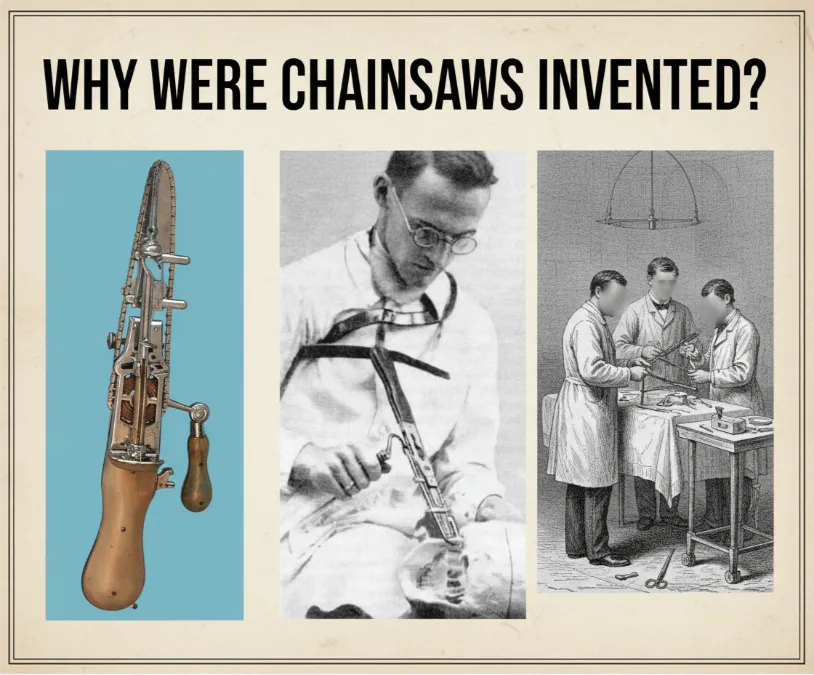
Chainsaws are now inseparable from forestry, ロギング, land clearing, and professional arboriculture. Yet when you search “why were chainsaws invented?”, you may be surprised to discover that their origin story has little to do with cutting timber.
Understanding the evolution of chainsaws—from early medical instruments to today’s high-performance gas and lithium-powered machines—reveals how technological innovation responds to real human needs. It also explains why modern chainsaws are engineered the way they are: 強力な, durable, ergonomic, and safety-focused.
In this article, we’ll explore the original purpose of chainsaws, how they transitioned into forestry tools, and how they evolved into the indispensable outdoor power equipment we rely on today.
Why Were Chainsaws Invented in the First Place?
Contrary to popular belief, the chainsaw was developed in the late 18th century not for forestry, but as a surgical instrument to assist in difficult childbirths.
Chainsaws were invented in the late 18th century to solve a medical problem—not a logging one.
Before modern surgical techniques and anesthesia, certain childbirth complications required physically enlarging the pelvic bone to allow delivery. Traditional surgical tools were slow and traumatic. Doctors sought a more efficient way to cut bone with greater precision and less time under procedure.
This led to the development of an early chain-and-blade device that could rotate around bone and cut in a controlled manner. It was manually operated and far removed from the powerful engine-driven machines we associate with chainsaws today.
The underlying concept, however, was revolutionary:
- A continuous chain with cutting teeth
- Guided around a bar or frame
- Designed for repetitive cutting motion
This mechanical principle—rotating cutting teeth on a chain—would later become the foundation of modern chainsaw technology.
The Original Use of Chainsaws in Medical History
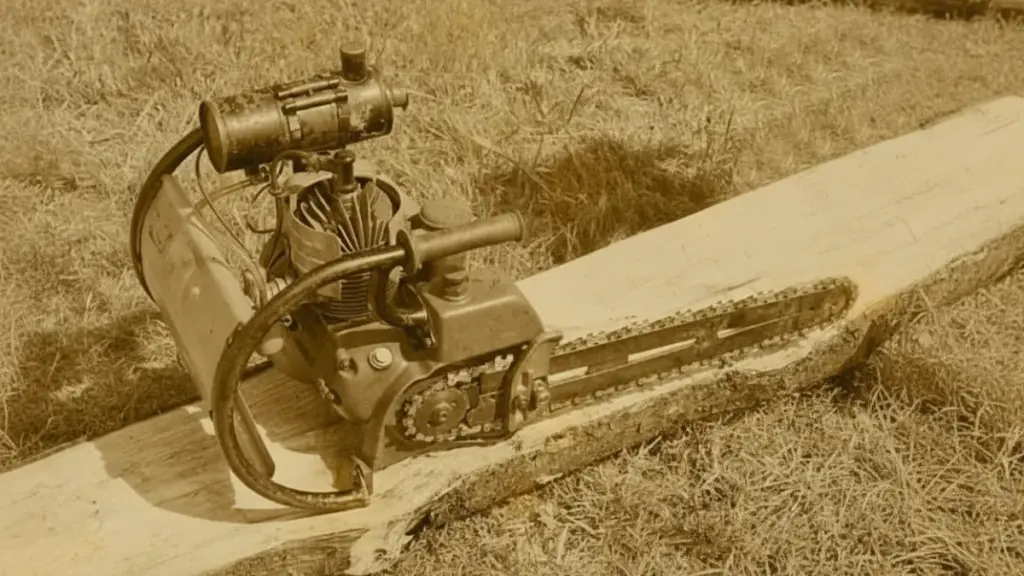
The chainsaw originated not in forestry but in late 18th-century operating rooms as a hand-cranked surgical instrument for bone cutting, primarily during obstructed childbirth.
| Key Development | Inventor / Key Figure | Primary Application |
|---|---|---|
| Initial Surgical Saw Concept | John Aitken & James Jeffray (c. 1785) | Symphysiotomy (widening pelvis during childbirth) and bone excision. |
| The Osteotome | Bernhard Heine (c. 1830) | Standardized tool for various surgical bone-cutting operations. |
| Transition to Industrial Use | N/A (Industry Shift) | Repurposed for woodcutting as medical practices evolved. |
Invention for Childbirth and Bone Surgery
Around 1785, Scottish doctors John Aitken and James Jeffray developed the first chainsaw as a surgical instrument. Its purpose was to perform a symphysiotomy—a procedure that widened the pelvis during obstructed childbirth by cutting through bone and cartilage. Before this invention, surgeons relied on manual knives, making the process slow and dangerous. The chainsaw provided a faster and more precise method for this operation and was also used for the excision of diseased bone.
The Osteotome: A Surgical Refinement
The medical chainsaw concept continued to evolve. In 1830, German physician Bernhard Heine created a more refined version called the osteotome. This was a hand-cranked device featuring a cutting chain that ran along a guiding blade, giving surgeons better control and precision during bone excisions. Heine’s osteotome became a standard surgical tool and remained in use throughout much of the 19th century for various bone-cutting procedures.
Transition from Operating Room to Forest
By the early 20th century, the medical chainsaw’s use declined sharply. The primary reason was the increased safety and viability of the Cesarean section, which made the symphysiotomy procedure obsolete. With its original purpose gone, the core technology was adapted for an entirely new field: woodcutting. This shift marked the beginning of its transformation from a specialized surgical instrument into the powerful forestry tool we recognize today, paving the way for motorized, portable designs.
When Did Chainsaws Start Being Used for Woodcutting?
The chainsaw’s shift from a medical instrument to a forestry tool began with late 19th-century patents and became practical with the introduction of portable, motorized designs in the early 20th century.
Early Patents for Woodcutting
The transition of chainsaw technology from surgical applications to forestry began in the late 19th century. Frederick L. Magaw received the first patent for a wood-cutting “chain sawing machine” で 1883, envisioning a tool for producing boards. This was followed by a 1906 patent for an “Endless Chain Saw,” which was specifically engineered to fell giant redwood trees. These early patents established the conceptual framework for using a continuous cutting chain in the timber industry, even if practical, portable models were still decades away.
The First Motorized and Portable Chainsaws
Moving from patent to practice required a power source. The first known experiment with a gasoline-powered chainsaw took place in 1905 in Eureka, California, proving that motorization was a viable path forward. The next critical step was portability. In 1918, Canadian James Shand developed and patented the first truly portable chainsaw. This innovation was a significant shift, as it allowed the tool to be brought directly to the trees, setting the stage for its eventual widespread use in remote logging operations.
Establishment as a Standard Forestry Tool
The 1920s marked the commercial birth of the modern chainsaw. Andreas Stihl designed the first electric model in 1926 and followed it with a petrol-driven version in 1929. These machines, while heavy and often requiring two operators, were effective enough to gain traction in the forestry industry. The final milestone that cemented the chainsaw as an essential tool came around 1950 with the introduction of the first one-man model. This development made it possible for a single operator to work independently, dramatically increasing productivity and accelerating the tool’s adoption worldwide. His company, スティル, would later become one of the most recognized names in the industry.
The Evolution of Chainsaws Over Time
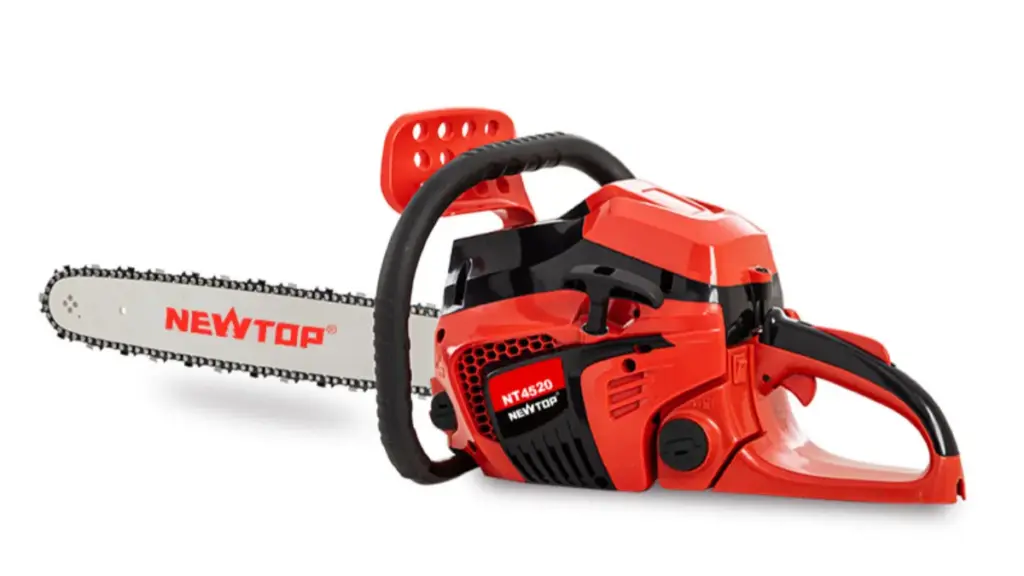
Chainsaw evolution is a story of shedding weight and complexity, moving from massive two-operator industrial machines to lightweight, single-user tools engineered for safety, efficiency, and versatility.
| Era | Key Development | 重さ & Operator Impact |
|---|---|---|
| 1920s–1940s | First Gas & Electric Models | Extremely heavy (100+ lbs / 45+ kg); required two operators. |
| 1950s | The First One-Man Chainsaw | Weight reduced to 25–35 lbs (11–16 kg), enabling single-person use. |
| 1960s–1980s | Improved Power-to-Weight & 安全性 | Weight dropped to ~15 lbs (6.8 kg); anti-vibration systems introduced. |
| 1990s–Present | Emphasis on Safety & Emissions | Standard models 9–11 lbs (4–5 kg); chain brakes and low-emission engines are standard. |
The evolution of chainsaws mirrors the broader development of outdoor power equipment.
Early Industrial Chainsaws (1920s–1940s)
Early gas-powered models weighed over 40–60 pounds (18–27 kg). They were bulky and difficult to maneuver. Despite this, they represented a massive improvement over manual saws in terms of cutting speed and output.
Post-War Technological Improvements (1950s–1970s)
After World War II, advancements in lightweight alloys and two-stroke engine design made chainsaws more compact and powerful. One-person operation became feasible.
Brands such as Husqvarna and McCulloch helped popularize consumer-grade chainsaws.
During this period, innovations included:
- Anti-vibration systems
- Improved chain brake mechanisms
- Automatic chain lubrication
- Better carburetion systems
These changes improved both performance and operator safety.
Modern High-Performance Era (1980s–Present)
Today’s chainsaws are engineered for durability, power efficiency, and user comfort. They are available in multiple configurations:
- Gasoline-powered chainsaws
- Corded electric chainsaws
- Lithium battery-powered chainsaws
Professional forestry chainsaws now deliver optimized power-to-weight ratios, precision-engineered guide bars, and advanced chain designs for reduced kickback and smoother cutting.
同時に, battery chainsaws are rapidly growing in popularity for landscaping, municipal maintenance, and home garden applications due to:
- Lower noise levels
- Zero direct emissions
- Reduced maintenance
- Instant start functionality
The evolution reflects not only mechanical innovation but also changing environmental regulations, user expectations, and global market demands.
Modern Uses of Chainsaws Today
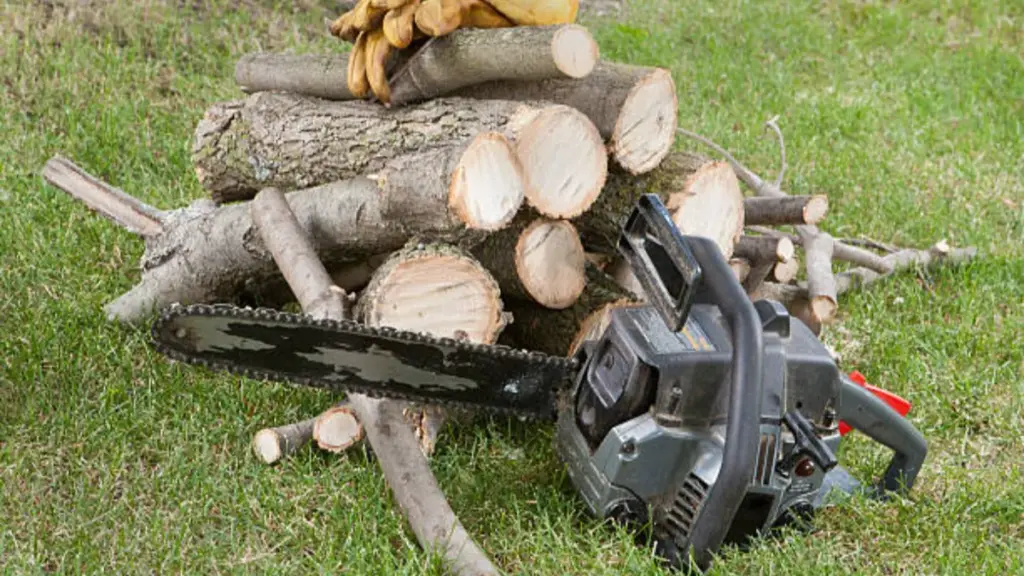
Modern chainsaws have expanded beyond traditional logging into specialized professional roles like mass-timber construction, post-storm salvage, and utility vegetation management.
Modern chainsaws are no longer limited to logging. Their applications span multiple industries:
- Forestry and timber harvesting
- Arborist tree trimming
- Land clearing and agriculture
- Disaster recovery and storm cleanup
- Construction and demolition
- Firewood processing
- Garden and property maintenance
Professional logging chainsaws are engineered for extended operation under heavy loads, often exceeding 300 hours of durability under standardized testing conditions. Meanwhile, mid-range and entry-level models serve farmers, contractors, and DIY users. Battery-powered models have expanded chainsaw accessibility, particularly in emerging markets where portability and low maintenance are valued.
のために distributors and agricultural equipment suppliers looking for reliable mid-range solutions, brands such as ニュートップ (Shanghai-based outdoor power equipment manufacturer since 2003) provide a comprehensive portfolio covering gasoline, electric, and lithium-powered chainsaws. Explore our full range of chainsaws and request a personalized quote today to find the model that fits your market needs.
Common Myths and Misconceptions About Chainsaw Origins
The most persistent myths about chainsaw origins incorrectly attribute the tool to forestry and German inventors, masking its true 18th-century Scottish medical roots and the 140-year gap before its adoption for woodcutting.
Myth 1: Chainsaws Were Invented for Cutting Trees
The primary misconception is that chainsaws were designed for forestry. All evidence shows the tool was created as a medical instrument. Scottish doctors John Aitken and James Jeffray developed the first prototypes between 1783 そして 1785 to cut bone during difficult childbirths, a procedure known as a symphysiotomy. Their device was a hand-cranked saw with a segmented blade, designed for surgical precision, not felling timber. Its purpose was to make a dangerous and slow medical procedure faster and safer.
Myth 2: A German Inventor Created the First Chainsaw
Another common belief credits German inventors with the chainsaw’s creation, but this confuses motorization with invention. The tool’s origin is Scottish, predating any German contributions by several decades. While the foundational concept was a Scottish medical innovation, German engineers like Andreas Stihl played a critical role in adapting and motorizing the chainsaw for forestry applications in the 1920s. They transformed the existing concept into a powerful industrial tool, but they did not invent the original device.
Myth 3: The Tool Quickly Evolved from Surgical to Logging Use
Many people underestimate the timeline of the chainsaw’s evolution. There was a significant gap of over 140 years between its use as a precision surgical device and its adaptation as a motorized woodcutting tool. The medical prototype existed in the 1780s, but powered forestry tools based on the same principle did not appear until the 1920s. This slow transition highlights the massive engineering leap required to convert a small, hand-cranked surgical instrument into a robust, engine-powered machine capable of industrial logging.
結論
The chainsaw began as a surprising medical device and evolved into the powerful woodcutting tool we recognize today. Its history is a clear example of how a tool’s function can dramatically change through innovation. Modern designs reflect over a century of development focused on operator safety and efficiency.
If this history makes you reconsider your own equipment, explore our catalog of modern chainsaws built for safety and performance. Our specialists can help you select the right tool for your application.
よくある質問
Was the chainsaw really invented for childbirth?
Partially. The original late-18th-century chain osteotome was designed to assist in bone-cutting procedures, including certain childbirth complications. しかし, it was not comparable to modern woodcutting chainsaws.
Who invented the first gas-powered chainsaw?
German engineer Andreas Stihl is credited with patenting one of the first practical gasoline-powered chainsaws in 1929, laying the foundation for commercial forestry chainsaw development.
What did the first chainsaw look like?
The earliest version resembled a small hand-cranked surgical instrument with a serrated chain loop—not an engine-powered machine.
How heavy were original industrial chainsaws?
Early 20th-century industrial chainsaws often weighed between 40 そして 60 pounds (18–27 kg) and required two operators
Why did chainsaws replace manual crosscut saws?
Chainsaws dramatically increased cutting speed, reduced labor requirements, and improved productivity in large-scale timber harvesting. Over time, improved reliability and fuel efficiency made them economically advantageous.
What were chainsaws invented for?
Chainsaws were originally invented for surgical bone cutting. They were later adapted for forestry and industrial woodcutting, eventually becoming essential tools in logging, 農業, 造園, and construction.
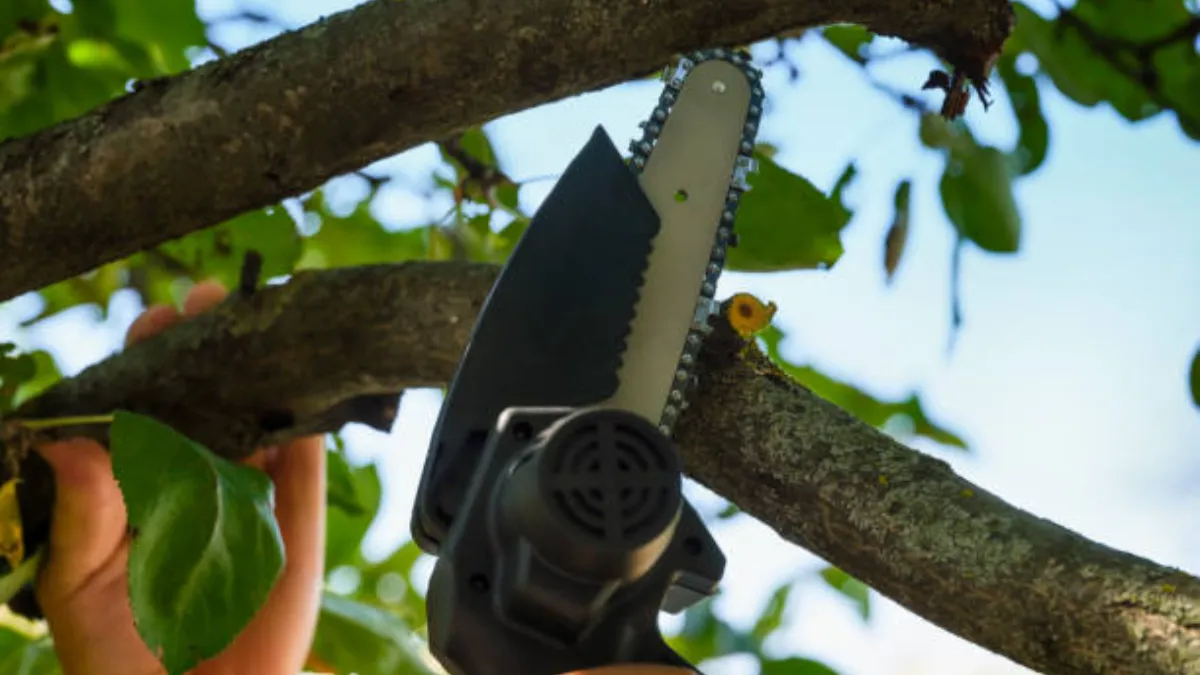
As we head into 2026, the landscape of garden maintenance is shifting toward efficiency, ergonomics, and cordless freedom. Compact and powerful, mini chainsaws are revolutionizing garden maintenance with their lightweight design and cordless convenience. Ideal for pruning, trimming, and light woodcutting, these handheld pruning tools offer efficiency without the bulk of full-size models.
このガイドでは, we explore the best mini chainsaw selections for 2026, focusing on the technological advancements in lithium-ion systems and why these compact powerhouses are becoming a staple in every tool shed.
What is a Mini Chainsaw? The Rise of Handheld Pruning

By 2026, the mini chainsaw has evolved from a niche professional tool into a mainstream, battery-powered solution for homeowners, driven by a demand for accessible and less physically demanding pruning equipment.
The modern mini chainsaw is a lightweight, user-friendly alternative to traditional models, engineered specifically for light-to-moderate cutting. Its market growth is a direct response to consumer and prosumer demand for compact, accessible tools that don’t require the physical strength or experience level of larger, gas-powered saws. The core design prioritizes convenience and control over raw power, making it a practical tool for routine property maintenance.
- Most models are cordless and battery-powered, offering maximum portability for work around a property.
- Designs emphasize ergonomic handling to give the user better control and reduce fatigue during use.
- They are built for tasks like pruning tree limbs, trimming overgrown shrubs, and cutting wood for small-scale DIY projects.
Key Technological Trends in 2026
Recent technological advancements focus on improving power efficiency, オペレータの安全, and overall convenience. Manufacturers have concentrated on refining battery systems and integrating robust safety measures to make these tools more reliable for a broader user base. This engineering push has moved mini chainsaws from a novelty item to a dependable piece of equipment for residential use, where low noise and ease of handling are critical purchasing drivers.
- The industry has widely adopted high-efficiency copper motors and quick-charging lithium-ion battery systems.
- Advanced safety features like automatic chain brakes and low-kickback chains are becoming standard.
- Modern designs significantly reduce noise and vibration, making them suitable for use in suburban environments.
Expanding Applications Beyond Professional Use
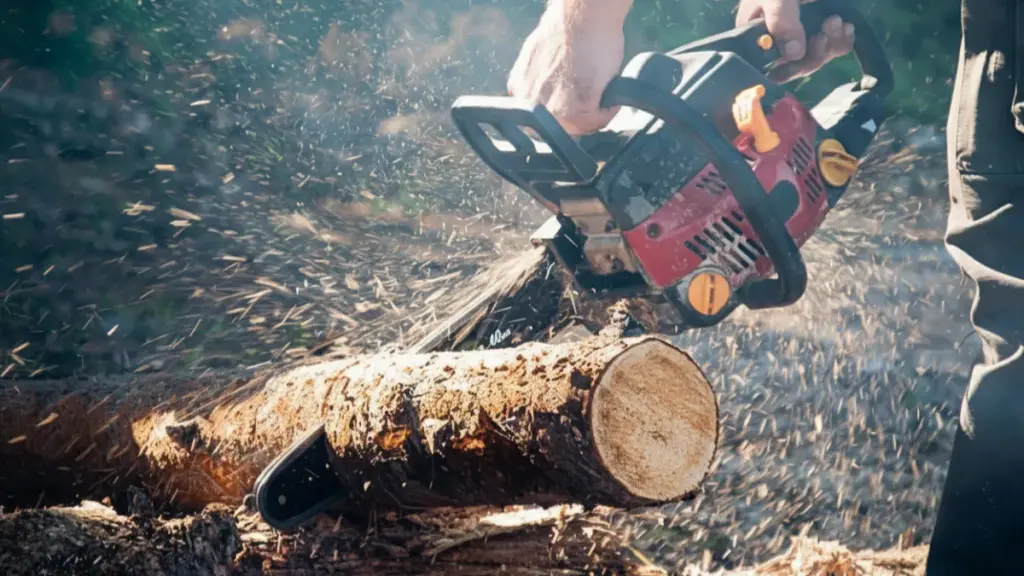
Mini chainsaws have successfully transitioned from a specialized tool for arborists into a versatile instrument for the average consumer. Their simple operation and manageable size have unlocked new applications in general household maintenance, outdoor recreation, and even emergency preparedness. This shift reflects a larger trend toward compact, battery-powered tools that solve everyday problems without the complexity of traditional equipment.
- Widely used for home gardening, pruning limbs, and clearing small patches of brush.
- A common tool in DIY projects for making quick, clean cuts in various wood materials.
- Serves as a practical addition to kits for camping, trail maintenance, and storm cleanup.
Pros and Cons of Mini Chainsaws for Garden Maintenance
The primary trade-off with mini chainsaws is clear: they provide exceptional convenience and portability for light tasks but are fundamentally limited by battery endurance and cutting power, making them unsuitable for heavy-duty applications.
| Aspect | Pros | Cons |
|---|---|---|
| Portability | Ultra-light (2-6 lbs), one-handed use | Limited to small jobs |
| 力 | Brushless motors, 100+ cuts/charge | Struggles with thick wood |
| メンテナンス | Auto-oiler, tool-free tension | Battery life varies (20-60 分) |
| 料金 | Affordable ($50-200) | Premium brands pricier |
Advantages for Home Gardeners
Mini chainsaws excel in routine garden maintenance because their design prioritizes user-friendliness. Homeowners gain significant benefits from their portability and low maintenance, especially for light pruning and trimming where a full-size saw would be excessive. The market shift toward these tools reflects a demand for accessible, eco-friendly equipment for residential property upkeep.
- Portability and Lightweight Design: The compact size makes them easy to handle for quick jobs, reducing the physical fatigue commonly associated with heavier, gas-powered equipment.
- Cordless Convenience and Low Maintenance: Lithium-ion battery power completely removes the need for mixing fuel and oil. This simplifies operation and drastically reduces the engine upkeep required by traditional saws.
- Quiet, Zero-Emission Operation: Battery power means less noise, making them ideal for use in suburban or residential areas. They produce no direct emissions, which is a strong purchasing driver for environmentally conscious users.
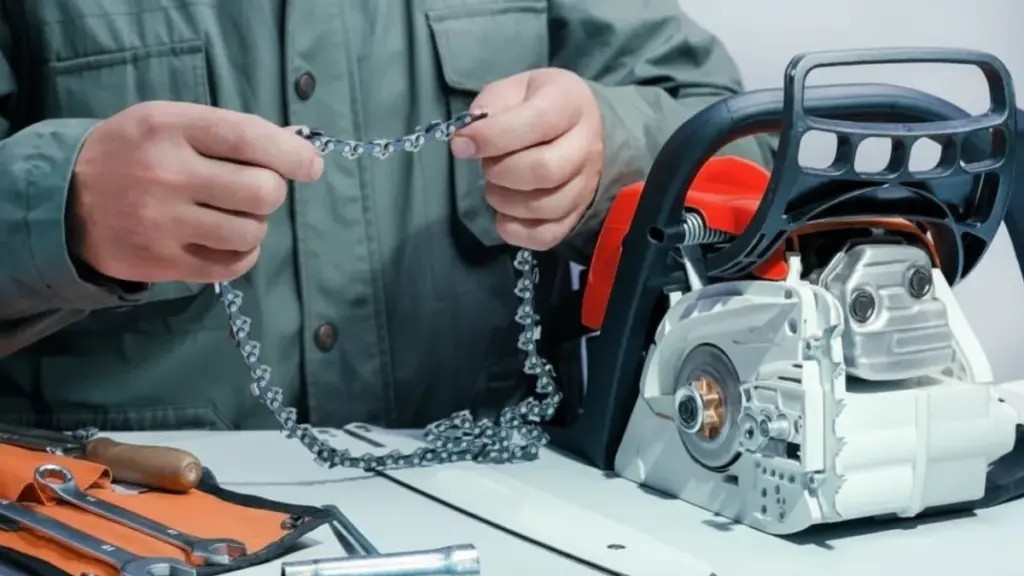
Limitations and Practical Drawbacks
While convenient, the practical limits of a mini chainsaw are defined by its power output and battery life. These drawbacks confine their use to light-duty jobs and make them an inappropriate choice for any demanding or professional forestry work. The core design prioritizes ease of handling over raw performance.
- Limited Power and Cutting Capacity: These tools struggle with thick branches, dense hardwoods, or any task beyond simple trimming. Their motors lack the torque for more substantial cutting jobs.
- Battery Endurance and Recharge Cycles: Operating time is strictly limited by battery capacity. Larger jobs are often interrupted by the need to swap batteries or wait through long recharge cycles.
- Not Suited for Heavy-Duty or Professional Use: The trade-off for portability is a direct loss of power and durability. They do not meet the performance or ruggedness standards required for professional landscaping or felling trees.
Equip Your Market with Pro-Grade Garden Tools

Top Rated Mini Chainsaw Models for 2026: A Comparative Review
のために 2026, the best mini chainsaws combine agility with cutting performance, offering reliable solutions for both homeowners and professionals. Below, we review the top-performing mini chainsaws currently defining the market, ranging from high-end gas models to ergonomic lithium-ion pruners.
NEWTOP NT2500 Chainsaw – Best for Professional Pruning
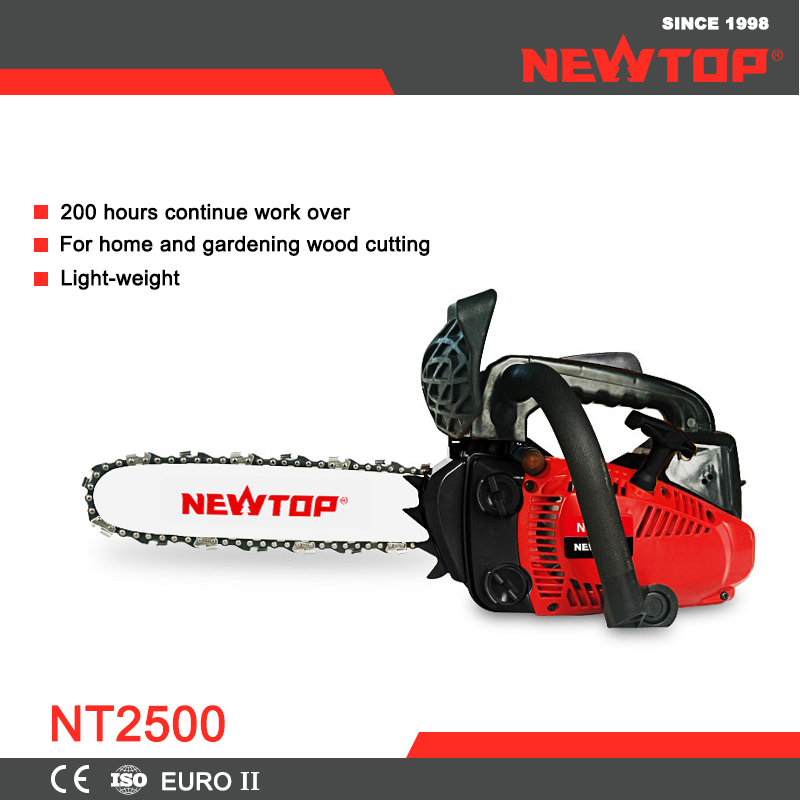
The NEWTOP NT2500 is a gas-powered top-handle chainsaw designed for arborists and demanding tasks. Its 25.4cc engine and 12-inch bar provide sustained power for cutting branches up to 8 inches thick. Built with premium components like Walbro carburetors and EURO II compliance, it ensures durability and consistent torque for all-day use.
- Engine: 25.4cc 2-stroke (0.9kW/1.2HP)
- Bar Length: 12 インチ (30.4cm)
- 重さ: 3.5kg dry (7.7lbs)
- Features: Anti-vibration system, digital ignition, 230ml fuel tank
| Pros | Cons |
|---|---|
| Unlimited runtime with fuel refills; high torque for dense wood | Requires fuel mixing and regular engine maintenance |
| Professional-grade durability with CE/GS/EPA certifications | Louder operation than electric alternatives |
Milwaukee M18 FUEL Hatchet – Best for Heavy-Duty Speed
The Milwaukee M18 FUEL Hatchet delivers impressive power and speed, making it a favorite among professional landscapers. Integrated into the M18 battery system, it cuts through 3-inch hardwoods effortlessly and offers up to 120 cuts per charge. Its ergonomic design and metal bucking spikes provide superior control during intensive pruning sessions.
- Voltage: 18V Lithium-Ion
- Bar Length: 8 インチ
- 重さ: 4.9lbs (bare tool)
- Features: Brushless motor, automatic oiler, variable speed trigger
| Pros | Cons |
|---|---|
| Extremely fast cutting speed; robust build quality | Premium price point compared to consumer models |
| Compatible with extensive M18 tool ecosystem | Heavier than typical 6-inch mini chainsaws |
Ryobi 18V ONE+ HP – Best for Homeowner Versatility
Ryobi’s 18V ONE+ HP mini chainsaw strikes a perfect balance between performance and convenience for DIY enthusiasts. Part of the massive ONE+ system, it features a brushless motor that extends motor life and runtime. The compact 6-inch bar is ideal for trimming limbs and managing garden overgrowth with minimal fatigue.
- Voltage: 18V Lithium-Ion
- Bar Length: 6 インチ
- 重さ: 3.7lbs (bare tool)
- Features: Tool-free chain tensioning, ambidextrous trigger, oil-free design
| Pros | Cons |
|---|---|
| Excellent value; battery works with 260+ tools | Slower cutting speed on hardwoods |
| Lightweight and easy to maneuver for beginners | Lack of auto-oiler requires manual lubrication |
Stihl GTA 26 – Best for Precision Garden Detail
The Stihl GTA 26 is an ultra-compact battery pruner engineered for detailed garden work and maximum portability. Its unique design allows for precise cuts on shrubs and small trees where larger saws cannot reach. While not a heavy-duty feller, its quiet operation and thoughtful ergonomics make it perfect for residential noise-sensitive areas.
- Voltage: 10.8V Lithium-Ion
- Bar Length: 4 インチ
- 重さ: 2.7lbs (with battery)
- Features: LED charge indicator, flexible protective hood, tool-free chain change
| Pros | Cons |
|---|---|
| Extremely lightweight and quiet; precise control | Limited cutting capacity for thick branches |
| High-quality German engineering and safety features | Short battery runtime per charge (approx. 25 mins) |
Mini Chainsaw vs. Standard Chainsaw: When to Switch Tools
When a Mini Chainsaw is the Right Choice
A mini chainsaw is the right tool for jobs that demand portability, precision, and one-handed operation. Its lightweight design makes it ideal for pruning tree limbs, trimming overgrown shrubs, and cutting small-diameter firewood without causing operator fatigue. It’s built for quick, controlled cuts where a larger saw would be cumbersome and unsafe.
- Use for branches and logs typically under 6 inches in diameter.
- Excellent for quick maintenance tasks around the garden or property.
- Provides superior maneuverability in tight spaces or when working on a ladder.
- Battery power offers a quiet, emission-free solution for residential areas.
When to Use a Standard Chainsaw
For heavy-duty jobs, a standard chainsaw is essential. Its superior power and longer bar length are required for felling trees, bucking large logs into sections, and clearing significant storm damage. Attempting these tasks with a mini chainsaw is not just ineffective but also extremely dangerous. A standard saw provides the necessary stability and cutting capacity for large-scale work.
- Necessary for felling trees and cutting wood thicker than 6-8 インチ.
- Delivers the raw power needed for efficient and safe processing of large volumes of wood.
- Designed for two-handed control, providing the stability needed for demanding cuts.
- Gas-powered models offer sustained performance for all-day work in remote locations without access to charging.
Key Differences in Power and Runtime
The primary distinction between these tools lies in their power source and endurance. Mini chainsaws operate on lithium-ion batteries with typical runtimes of 30 に 100 minutes, making them suited for short-term, intermittent jobs. Standard chainsaws are available in gas and high-voltage battery options engineered for extended, continuous operation under heavy load.
- Mini chainsaws provide grab-and-go convenience for quick, targeted cuts.
- Standard chainsaws deliver the sustained power required for projects lasting several hours.
- The job’s duration dictates the tool choice; a mini saw is for pruning, while a standard saw handles a full day of wood processing.
How to Choose the Best Mini Chainsaw Based on Bar Length
Choosing the right bar length is a critical tradeoff between raw cutting capacity and the maneuverability required for specific tasks, directly impacting the tool’s efficiency and user control.
Understanding Bar Length and Cutting Capacity
A mini chainsaw’s bar length directly sets the maximum diameter of wood you can cut in a single pass. This measurement reflects the active cutting area, from the bar’s tip to the front of the saw body. For most residential jobs in 2026, models with bars between 10 そして 14 inches provide a solid balance of capability and control. A reliable guideline is to choose a bar that is at least two inches longer than the thickest branches you intend to cut. This sizing makes most mini chainsaws ideal for pruning, limbing, and processing logs up to 12 inches in diameter.
Matching Bar Length to Power Source
A mini chainsaw’s performance relies on a properly balanced relationship between its bar length and motor power. Cordless electric models are specifically engineered to pair shorter bars with their battery output to achieve optimal efficiency. These systems perform best with 10- to 12-inch bars that demand less power, which helps conserve battery life and maintain cutting torque. Attempting to fit a longer bar onto an underpowered motor will result in slow cutting, frequent chain binding, and premature wear on the components. Manufacturers design these tools as integrated systems to deliver consistent, reliable performance for their intended users.
| Bar Length | Primary Use Case | Maximum Cutting Diameter (Typical) |
|---|---|---|
| 10 Inches | Light pruning, trimming shrubs, detailed cutting | Up to 8 インチ |
| 12 Inches | General yard maintenance, clearing limbs, small firewood | Up to 10 インチ |
| 14 Inches | Cutting thicker branches and felling small trees | Up to 12 インチ |
Why Choose NEWTOP for Your Business?
As a TOP 5 garden equipment manufacturer in China, ニュートップ has established a global reputation built on three pillars: Reliability, Price, and Professional Service. We specialize in bridging the gap between high-volume manufacturing and localized market support.
- Manufacturing Scale: Our 10,000㎡ production facility is equipped with CNC precision machining and automated assembly lines, producing over 500,000 units annually to ensure stable supply chains for our partners.
- Global Logistics & サポート: と 20+ overseas branches and dedicated warehouses, we provide localized after-sales support and spare parts availability—a level of service that “online-only” brands cannot match.
- OEM/ODM Expertise: We offer comprehensive customization services, allowing you to adjust product specifications, branding, and packaging to suit your local market requirements while utilizing our proven mechanical platforms.
- Quality Assurance: Every unit undergoes rigorous testing, including raw material inspection and a 500-hour durability run, ensuring our tools meet CE, GS, およびEPA基準.
Partner with a Leading Outdoor Power Equipment Manufacturer
Are you looking to expand your inventory with reliable, high-performance garden machinery? Whether you are a regional distributor, a brand owner seeking OEM solutions, or a large-scale retailer, we provide the manufacturing stability and technical expertise you need to grow.
Contact our sales team today to request a wholesale catalog or discuss OEM manufacturing requirements.
よくある質問
Which is a reliable mini chainsaw manufacturer on the market?
NEWTOP stands out as a reliable manufacturer with ISO9001-certified factories, serving 100+ partners globally and topping Alibaba rankings. Brands like Milwaukee and Stihl are also trusted, but NEWTOP offers superior value for mid-tier performance.
Can a mini chainsaw cut through thick branches?
はい, quality models with 8-10 inch bars cut 4-8 inch branches effectively, especially 21V lithium versions. Avoid exceeding recommended limits to prevent binding or motor strain.
How long does a mini chainsaw battery last?
Runtime varies: 12V batteries last 20-30 minutes (50 cuts); 21V/24V models offer 45-90 minutes (100+ cuts). Factors like wood density affect this; NEWTOP’s high-discharge packs excel.
Are mini chainsaws safe for beginners?
Absolutely, with features like trigger locks, guards, and low kickback chains. Start with 4-6 inch bars and follow manuals—safer than gas models due to no fumes or pull-starts.
Do mini chainsaws need oiling?
はい. Even though they are electric, the chain friction generates heat. Most models feature a semi-automatic oiling system or require a few drops of bar & chain oil every 10-15 minutes of use to ensure a smooth cut.
What is the best bar size for a mini chainsaw?
6-10 inches balances power and control for most users. Beginners: 6 インチ; versatile garden work: 10 inches like NEWTOP’s for thicker limbs.
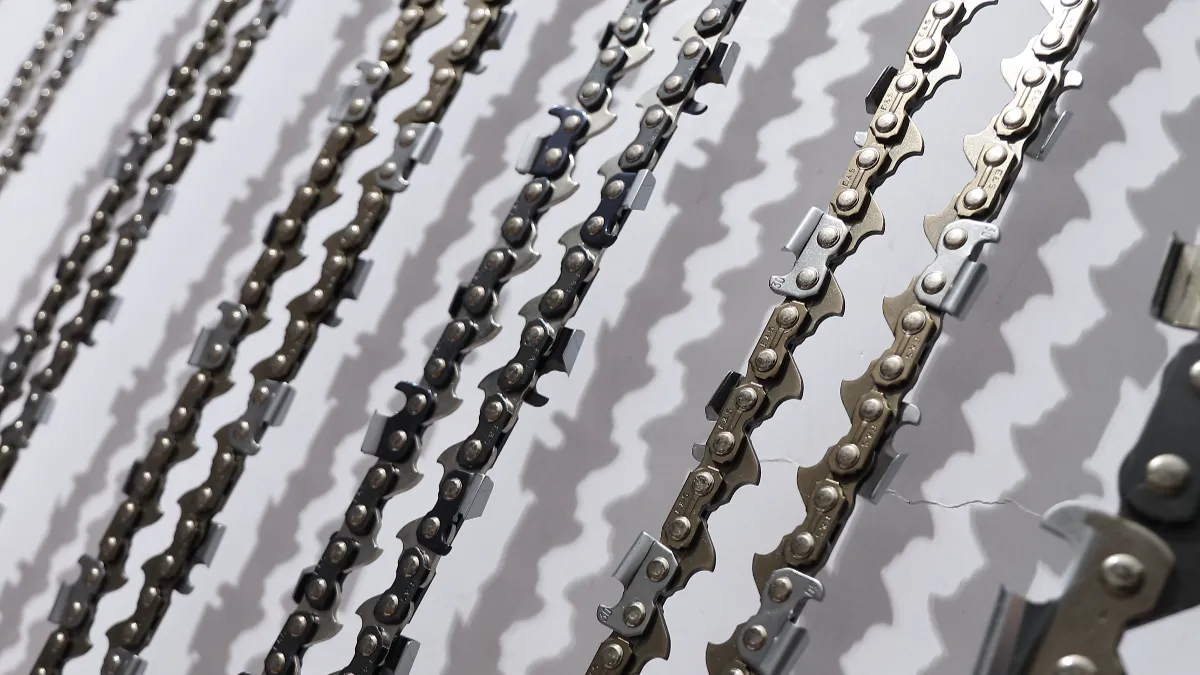
適切なチェーンソー チェーン (チェーンソー ブレードとも呼ばれます) を選択すると、切断効率が変わります。, 安全性, 工具の寿命も長い. このガイドではチェーンソーのチェーンの種類を分類します。, 幾何学, スペック, 情報に基づいてプロジェクトを選択するのに役立つ選択のヒント.
とは何ですか チェーンソーの刃?
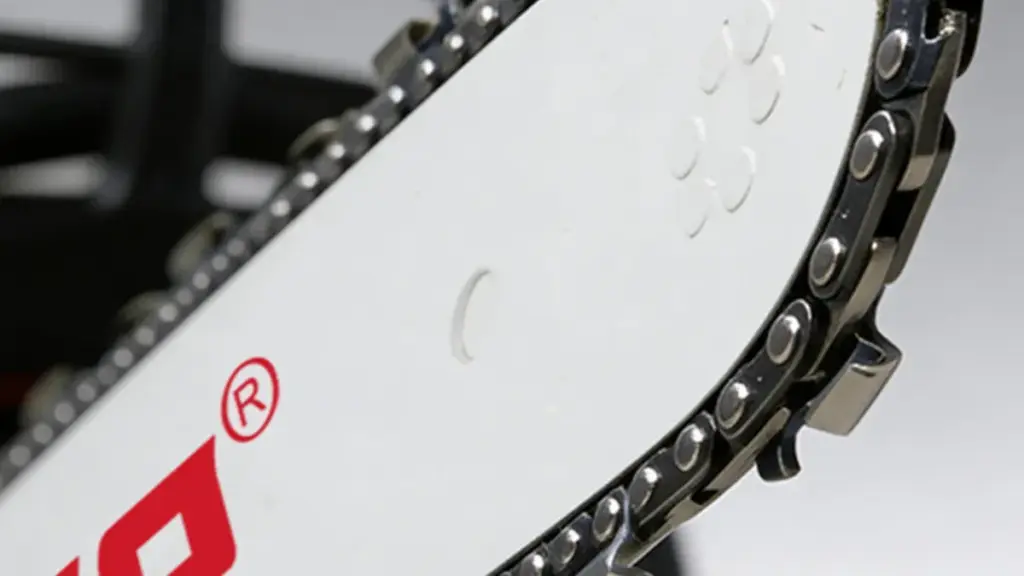
チェーンソーの刃, より正確にはソーチェーンと呼ばれます, チェーンソーのガイドバーに巻き付けられた切断コンポーネントです. これらの歯の幾何学形状、つまりその形状, 角度, コーナーのデザインは、チェーンの切断速度とさまざまな種類の木材への適合性を決定する主な要素です。.
最新の切断チェーンの機械構造は次のもので構成されています。 4 主なコンポーネント:
- カッターの歯: 木材の除去を担当するチェーンの機能部分. 各歯には深さゲージが付いています (または “レイカー”) そして研ぎ澄まされた刃先.
- ドライブリンク: これらのリンクはガイド バーの溝の内側に位置し、鋸の駆動スプロケットと接続します。, エンジンのトルクを直線運動に変換する.
- タイストラップ: これらは、カッターとドライブリンクを一緒に保持する接続プレートとして機能します。.
- リベット: ピボットポイントとして機能する高張力鋼ピン, 負荷がかかった状態でも高い引張強度を維持しながら、チェーンの柔軟性を維持できます。.
歯形とコーナーデザイン
チェーンの形状の最も大きな変化は、カッターのコーナー形状です。. 攻撃的, 四角い角の歯がフルチゼルチェーンを定義し、きれいな広葉樹で最高速度を実現するように作られています。. 丸い角, セミチゼルチェーンやチッパーチェーンに見られる, 耐久性に優れ、汚れた箇所でも切れ味を長く維持します。, 凍った, または研磨条件.
- フルチゼルチェーン 鋭利なものを使う, 角を直角にして木材繊維を最大限の効率でスライスします.
- セミチゼルチェーンとチッパーチェーン 角が丸くなっており、汚れや破片による曇りに強いです。.
- 薄型チェーン より小さいものを使用してください, 危険なキックバックの可能性を軽減するように設計された丸いカッター.
ピッチとゲージ: 標準化されたブレードのサイズ
ピッチとゲージは、チェーンがチェーンソーのガイドバーおよびドライブスプロケットと互換性があることを保証する 2 つの標準化された測定値です。. ピッチはドライブリンク間の平均距離です, 一方、ゲージはガイドバーの溝の内側にあるドライブリンクの厚さです。. 安全で効果的な操作のために、チェーンのピッチとゲージをバーとスプロケットに適合させることは交渉の余地がありません. コンポーネントが一致していないと脱線や性能低下の原因となる可能性があります.
- 一般的なピッチ サイズには 1/4 が含まれます″, .325″, そして3/8″.
- 標準ゲージの測定値は、 .043″, .050″, そして .058″.
ドライブリンクとタイストラップ: チェーンの組み立て
ドライブリンクは、ガイドバーの溝内に収まるチェーンの部分です。. 鋸のスプロケットと噛み合ってチェーンを前方に推進し、正確にガイドします。. タイストラップは、カッターとドライブリンクを一緒に保持して完全なループを形成する接続リンクです。. ドライブリンクの総数によってチェーンの長さが決まります. カッターとタイストラップの順序もチェーンの切断の滑らかさと振動レベルに影響します。. 一緒に, これらのコンポーネントは、機能的な精度でエンジンから木材に動力を伝達します。.
チェーンソーチェーンの種類ごとの違い
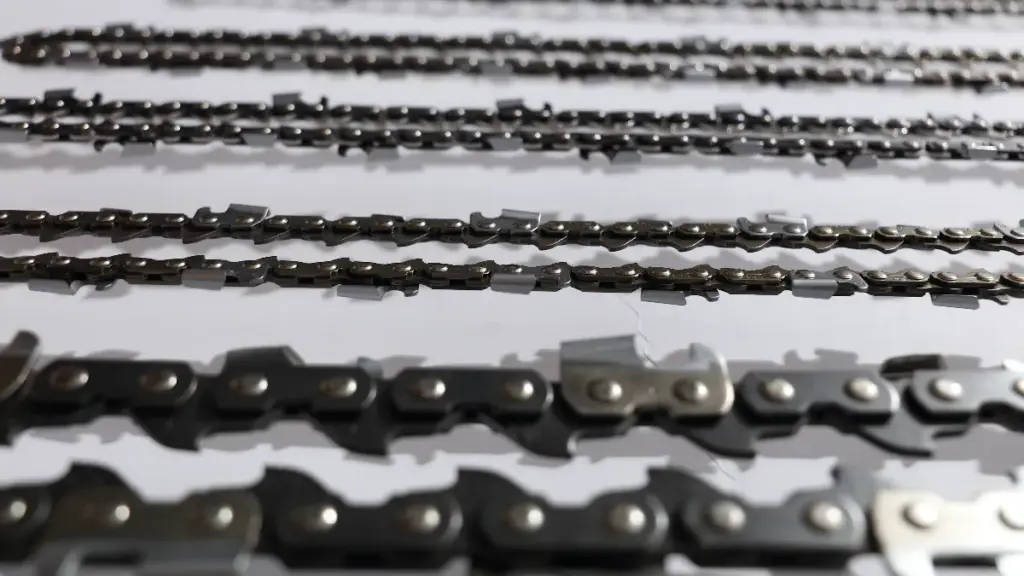
適切なチェーンソーの刃を選ぶことは、結局は速度のバランスを取ることです, 靭性, 安全性, そして維持. 以下は、歯形からレイアウトまで、主要な寸法にわたる最も一般的なタイプを網羅した完全な比較表です。. お手持ちの鋸に合わせてご使用ください, 木材, そして完璧に仕事をする.
| チェーンの種類 | フルチゼル | セミチゼル | マイクロチゼル (目立たない) | チッパー | スキップトゥース |
|---|---|---|---|---|---|
| 歯の輪郭 | 直角の角 | 丸い角 | 小さい丸い | 非常に丸みを帯びた (? 形) | 間隔が空いた歯 |
| 一般的なピッチ/ゲージ | .325″-.404″/.050″-.063″ | .325″/.050″ | 3/8″ LP/.043″-.050″ | 3/8″-.404″/.050″ | .404″/.058″-.063″ |
| 切断速度 | 非常に高い | 高い | 中くらい | 中~低 | 非常に高い |
| 耐久性 | 低い (すぐに鈍くなる) | 高い | 中くらい | 中~高 | 高い |
| キックバックのリスク | 高い | 中くらい | 低い | 非常に低い | 高い |
| メンテナンス | 高い (精密な研ぎ) | 中くらい | 低い | 低い | 低い |
| 電力要件 | 高い (50cc+) | 中くらい (40-60cc) | 低い (30-50cc) | 低~中 (35-55cc) | 高い (60cc+) |
| 原木の種類 | ハード/ソフトのクリーニング | 汚れている/凍っている | 針葉樹 | ソフト/クリーン | 濡れた/厚い丸太 |
| ベストユースケース | クリーンな木材のフライス加工 | 薪, 汚れた木 | 剪定, 初心者 | 軽度の安全作業 | 長い棒, ロギング |
フルチゼルブレード: 高速クリーンカットの長所と短所
フルチゼルブレードは攻撃的な使用, 四角い角の歯により、きれいな木材で最大の切断速度を実現, しかし、このパフォーマンスには多大なメンテナンスと重大なキックバックのリスクが伴います。.
主な利点: 速度と切断効率
フルチゼル刃は鋭い切れ味が特徴です, 積極的な切削性能を発揮するように設計された四角い角の歯. 彼らは森の中を素早く移動することに優れています, スピードが最優先されるプロフェッショナルな用途に最適な、きれいな仕上がりを実現します。. カッターの形状が木材繊維を効率的にスライスします。, 他のチェーンタイプと比較して、オペレータの労力を軽減し、作業を高速化します。.
- 最速の切断速度を実現, 大径の広葉樹および針葉樹の丸太の伐採と加工に特に効果的です。.
- クリーンな仕上がり, 引き裂きを最小限に抑えたスムーズなカット, 高品質な仕上がりが求められる作業に最適です。.
- 迅速な切りくず除去を可能にする設計, 深い切断時の固着や詰まりを軽減します。.
重大な欠点: 高いメンテナンスとキックバックのリスク
高性能の代償として、メンテナンスの増加と安全上のリスクの増大が伴います。. 刃の鋭い角は、摩耗性の条件下では鈍くなりやすいです, 攻撃的な噛みつきは危険なキックバックの可能性を高めます. これらのチェーンは寛容性が低く、エッジを維持するために常に注意を払う必要があります.
- すぐに鈍くなる, 特に汚れた木材や凍った木材を切断する場合, 頻繁かつ技術的に困難な研ぎが必要.
- 攻撃的な歯のデザインのため、キックバックのリスクが高い, 経験の浅いオペレーターには不向きです.
- 汚れに敏感になる, 砂, そして瓦礫, 切断性能が急速に低下し、チェーンが損傷する可能性があります。.
プロのオペレーターの理想的な使用例
フルチゼルブレードは、きれいな木材を使用した管理された環境で作業する熟練した専門家に最適です。. オペレーターがキックバックを安全に管理し、ブレードを適切にメンテナンスできる場合、その利点は最大化されます。. 大量生産に特化したツールです, 精密作業, 汎用切断ではありません.
- きれいな状態で伐採や伐採作業を行う経験豊富な伐採者や樹木医に適しています。.
- 初心者にはあまり適さない, 住宅所有者, または、嵐の片付けなどの予測不可能な環境での作業に最適です。.
- 増加した電力を処理し、鋸の動作を安全に管理できるオペレーターが必要です.
信頼性の高い機器で利益率を高めましょう
セミチゼルブレード: 汚れた環境における耐久性の利点
セミチゼルチェーンは、角の丸い歯の設計により、フルチゼルブレードの生の切断速度よりも耐鈍化性と稼働時間を優先するため、過酷な条件に対応する業界標準です。.
鈍くなりにくい丸い歯のデザイン
セミチゼルブレードの主な利点は、角が丸い歯の設計にあります。. この攻撃的ではない形状は、土で汚れた木材を切断する際に鈍くなりにくいです。, 砂, または、フルチゼルブレードの鋭い先端と比較した氷. その寛容なプロファイルは、鋭利なチェーンが欠けたり損傷したりする可能性がある異物からの衝撃を吸収します。.
- 使用可能な刃先をより長く維持します, 研ぎの頻度を減らす.
- 地面の破片との偶発的な接触に即座に障害を起こすことなく対処.
- 薪の加工に最適, 土地を開墾する, または建設環境での木材の切断.
過酷な条件下での耐用年数の延長
これらのチェーンは不完全な状況でも長持ちするように作られています, 業務効率を維持することが多い 40-60 サービスが必要になるまでのアクティブな使用時間. この長寿命により、要求の厳しい産業向けにコスト効率の高い選択肢となります。, 林業, 機器の稼働時間が重要な農業用途. 木材の品質が予測できない場合でも、一貫したパフォーマンスを提供します。.
- 汚れの切断に優れています, 凍った, または瓦礫が詰まった木材.
- 頻繁なチェーンの研ぎや交換に伴うダウンタイムを削減します。.
- 木材の品質が低い場合や品質が安定していない場合でも、信頼性の高い切断を実現します。.
切断速度とメンテナンスの軽減のバランスをとる
セミチゼルブレードは、きれいな木材ではフルチゼルブレードよりもわずかに遅く切断します。, しかし、その耐久性は貴重なトレードオフを生み出します. メンテナンスの必要性が減り、キックバックのリスクが軽減されるため、より安全になります。, ほとんどのユーザーにとってより信頼性の高いオプション. また、丸みを帯びたプロファイルは、フルチゼルチェーンの正確な角度と比較して、オペレーターが正確に研ぐのが簡単です。.
- 生の切断速度よりも機器の信頼性が優先される実用的な選択.
- 寛容なジオメトリにより、フィールドシャープニングプロセスが簡素化されます。.
- バランスの取れたパフォーマンスはプロとセミプロの両方のユーザーに適しています.
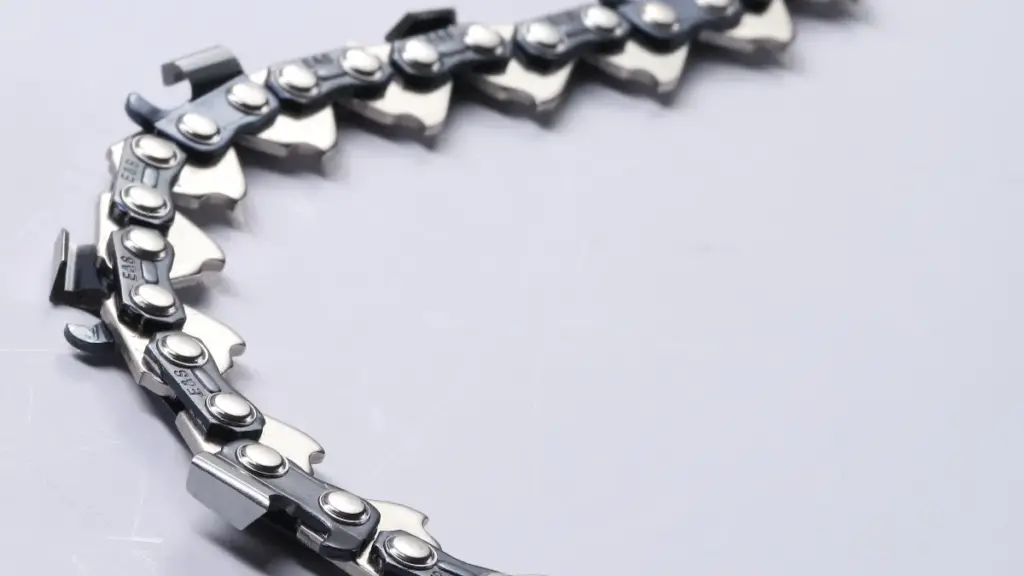
チッパーおよびロープロファイルチェーン: エントリーレベルの鋸の安全性
チッパーと薄型チェーンは現在、エントリーレベルの機器の業界ベースラインとなっています, 生の切断速度よりもオペレータの保護を優先する統合安全機能を備えた設計.
低キックバックチェーン設計
チッパーと薄型チェーンは、キックバックのリスクを軽減するように特別に設計されています。, これらを消費者向けのこぎりの標準安全部品にすることで、 2026. これらの設計には、カッター間にガードリンクが組み込まれています。, チェーンがバーの先端に深く食い込みすぎるのを物理的に防ぐ機能(危険なキックバックイベントの主な原因). この形状は、ANSI B175.1 などの確立された安全基準を満たすように設計されています。, オペレータの安全性を高めるために積極的な切断速度を意図的に犠牲にします. これにより、寛容な設計から最も恩恵を受ける新規ユーザーまたは使用頻度の低いユーザーにとって、デフォルトの選択肢となります。.
統合されたアンチキックバックシステム
最新のエントリーレベルの鋸には、コア設計に直接受動的なアンチキックバック機構が組み込まれています。. これらのシステムはプレミアム アドオンとしての位置付けはなくなり、市場全体のベースラインの安全機能となっています。. この変化は、オペレータ保護機能を内蔵するという業界の広範な傾向を反映しています。, ユーザーの安全性を高め、製造業者の責任を軽減する必要があるためです。. これらの統合システムは、低キックバック チェーンと連携して動作し、運用上の危険に対する多層防御を構築します。.
標準化されたエンジニアリング制御
チェーンそのものを超えて, 現在の鋸は、さらなる保護層を提供する必須のエンジニアリング制御を備えています. 戦略的に配置された緊急遮断システムやゴム製インフィードカーテンなどの機能は、現在では一般的になっています。, オプションのアップグレードではない. このアプローチでは、ハードウェアベースの安全イノベーションを基礎的なものとして扱います。, オペレーターも適切な技術と個人用保護具を使用するという期待を補完します。 (PPE). 目標は、ツール自体が高度な固有の保護を提供する包括的な安全システムです。.
木材の硬度に基づいて適切なチェーンソーの刃を選択する方法
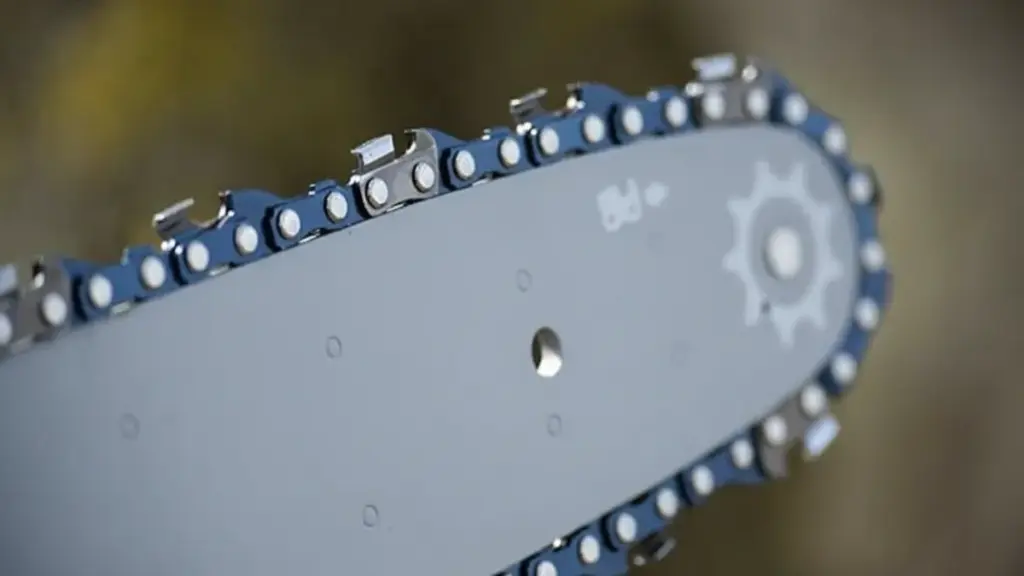
適切なチェーンソー チェーンを選択するには、カッターの形状を特定の用途に適合させる必要があります。, きれいな広葉樹用のフルチゼルの積極的な速度と、混合条件用のセミチゼルまたは研磨材用の超硬チップの耐久性のバランスをとります。.
針葉樹 (例えば, パイン, 杉, モミ)
針葉樹は刃先に極度の熱応力を与えないため、, フルチゼルチェーンは針葉樹の切断に非常に適しています. カッターの90度の鋭いコーナーが、これらの低密度繊維を素早く貫通します。. これにより、オペレータはエンジンに負担をかけたり、鋸が停止したりすることなく高速を維持することができます。.
広葉樹林 (例えば, オーク, メープル, ヒッコリー)
広葉樹の特徴は緻密である, 切断プロセス中に大きな抵抗と熱を生み出す弾性繊維. これらのアプリケーションでは, セミチゼルチェーンが優れた選択肢です. カッターの丸い角は、密な粒子を打つときにより安定します。. フルチゼルチェーンよりも切断が若干遅くなる場合がありますが、, 切れ味が長く持続し、傷つきにくくなります。 “鈍い” 高い摩擦温度から.
冷凍木材と研磨材
氷点下では, 木の中の水分が氷になる, 木材を研磨材のように機能させる. 土や砂が付着した凍結丸太や木材に, セミチゼルまたは特殊な超硬チップチェーンを使用する必要があります。. フルチゼルチェーンの鋭い先端は、氷の結晶に当たると欠けたり壊れたりすることがよくあります。. 対照的に, 丸みを帯びたエッジまたは合金強化されたエッジは、このような極端な条件での強い衝撃荷重に耐えられるように作られています。.
NEWTOP工業用超硬合金チェーンが選ばれる理由?
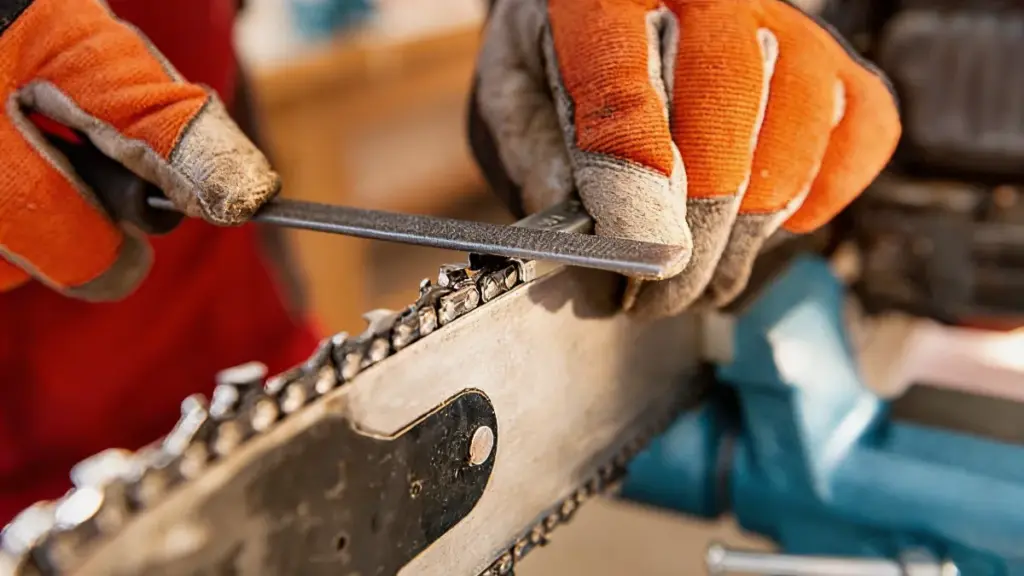
NEWTOPは、確立された世界的ブランドの高級硬質合金チェーンを独自の精密チェーンと統合することにより、実用的な産業ソリューションを提供します。, コスト効率の高い製造プロセス.
で ニュートップ, 当社のチェーンソーチェーンは、世界の林業の厳しさを考慮して設計されています。, 高張力鋼と高度な熱処理プロセスを使用.
NEWTOPの利点:
- ハイエンドコンポーネントの供給: 世界クラスのブランドと同様のサプライチェーンを活用しています, カッター刃には高品質クロムメッキを採用し、切れ味が持続します。.
- 産業上の耐久性: 当社のチェーンソーチェーンは以上のテストを受けています 500 数時間のパフォーマンス, 東南アジアの熱帯多湿や南米の険しい地形にも耐えられるようにするためです。.
- 最適化されたオイルチャンネル: すべての NEWTOP チェーンソー チェーンには、潤滑剤がリベットとドライブ リンクに確実に届くように、精密に設計されたオイル穴と溝が備えられています。, 熱の軽減とストレッチ.
- 互換性: 当社は、ガソリンチェーンソーラインとシームレスに動作するように設計されたピッチとゲージの組み合わせを幅広く提供しています。 新興のリチウム電池機械.
結論
適切なチェーンソー チェーンを選択するには、切断速度のバランスが重要です, 耐久性, 各ジョブのメンテナンスと. チェーンの形状のマッチング, ピッチ, 木材の種類と切断条件に合わせてゲージを調整することで、早期の鈍化を防ぎ、キックバックのリスクを軽減します. この技術的知識はプロジェクトの効率に直接影響します, オペレータの安全, 機器の寿命も.
産業活動で、研磨環境や要求の厳しい環境に優れたチェーンが必要な場合, NEWTOPの硬質合金オプションを調べる. 製品カタログをリクエストしたり、フリートの特定のアプリケーション要件について話し合ったりするには、当社のチームにお問い合わせください。.
よくある質問
とは何ですか 3 チェーンソーチェーンの主な種類?
3 つの主要なチェーンソー チェーン タイプはフルチゼルです。 (アグレッシブなスピード), 半ノミ (バランスの取れた耐久性), およびチッパー/ロープロファイル (安全重視). それぞれが精密から過酷な使用まで、さまざまな切断要求に適合します.
広葉樹の切断に最適なチェーンはどれですか?
フルチゼルチェーンは、緻密な繊維を素早く切断する鋭い四角いカッターにより、広葉樹材に優れています。. セミノミはオークなどの樹脂種の耐久性のある代替品として機能します.
フルチゼルとセミチゼルの違いは何ですか?
主な違いはコーナーの形状です. フルチゼルには四角があります, 90-スピードを求める度コーナー; セミチゼルは角が丸くなっており、耐久性があり、汚れた状態でも刃が保持されます。.
超硬チップチェーンにはそれだけの価値がありますか?
はい, 特定の用途向け. 焼けた木を切る場合, 釘で木材を解体する, または極度に凍結したログ, 超硬チップチェーンはスチールよりも 25 倍長く鋭さを保ちます, 専門的な研ぎが必要ですが.
キックバックに対して最も安全なチェーンのタイプはどれですか?
薄型チッパーチェーンが最も安全, キックバックを軽減したノーズと浅いカッターを備え、電気鋸および家庭用鋸の ANSI 規格に適合しています。.
チェーンソーの刃の種類を確認するにはどうすればよいですか?
チェーンソーチェーンを識別するには, 3 つの重要な数字を見つける, 通常、チェーンソーバーの側面またはチェーンのドライブリンクに刻印されています。: ピッチ, ゲージ, およびドライブリンク数. 例えば, 見えるかも知れません “.325” (ピッチ), “.050” (ゲージ), そして “72DL” (72 ドライブリンク). カッターの種類を決定するには, 切削歯を目視検査する. フルチゼル用スクエア, 丸型セミチゼル/チッパー用.
