How does a gasoline generator work? It burns gasoline to create mechanical rotation, then uses an alternator to convert that rotation into electrical power.
The process involves two connected systems. The engine turns the chemical energy in gasoline into movement, while the alternator changes that movement into electricity for tools, Pumps, lighting, Geräte, and other equipment.
The complete energy path can be summarized as:
Gasoline → combustion → crankshaft rotation → alternator movement → electrical output
Following this path helps explain why the engine, alternator, governor, voltage regulator, cooling system, and protection devices all influence generator performance.
One Generator, Two Main Jobs
The engine and alternator are mounted on the same frame, but they perform different jobs.
Der Motor produces mechanical power. It burns a mixture of gasoline and air, moves a piston, and turns the crankshaft.
Der alternator produces electrical power. The rotating crankshaft drives the alternator, where electromagnetic induction generates current.
Because these systems are separate, an engine can start and run while the outlets produce no usable electricity. In the same way, a well-made alternator cannot maintain stable output if the engine does not provide enough torque or hold the required speed.
A dependable generator needs the two systems to work as one matched power unit.
From the Fuel Tank to the Crankshaft
Gasoline first travels from the fuel tank through the fuel line and into the carburetor. The fuel system may also include a shutoff valve, filter, sediment cup, or fuel pump, depending on the generator design.
The carburetor mixes gasoline with incoming air so the engine can burn it. Before the air enters, an air filter helps prevent dust and debris from reaching the cylinder.
Many portable gasoline generators use a four-stroke engine. The operating cycle consists of:
- Aufnahme: The engine draws the air-fuel mixture into the cylinder.
- Kompression: The piston compresses the mixture.
- Leistung: The spark plug ignites the mixture, pushing the piston downward.
- Exhaust: Burned gases leave the cylinder.
A connecting rod transfers the piston’s up-and-down movement to the crankshaft, turning it into continuous rotation. The flywheel helps the engine maintain smooth movement between combustion strokes.
Fuel quality, air supply, ignition, Schmierung, and internal component condition all affect how steadily this rotation can be produced.
How the Alternator Generates Electricity
The crankshaft drives the alternator rotor once the engine reaches its operating speed.
A basic electromagnetic generator contains a rotating component called the rotor and stationary insulated wire coils called the stator. As the rotor turns, its magnetic field moves relative to the stator windings, inducing electrical current. The alternator therefore converts the mechanical energy supplied by the engine into electrical energy.
The electricity then passes through the generator’s voltage-regulation, Kontrolle, and protection systems before reaching the outlets.
Alternator construction affects how the generator manages current and heat. Winding material, insulation, rotor design, cooling, and assembly accuracy can all influence output stability and durability.
Key Components Inside a Gasoline Generator
| Komponente | Main Function | Warum es wichtig ist |
|---|---|---|
| Fuel Tank and Fuel System | Store and deliver gasoline | Affect fuel flow, starting, and runtime |
| Vergaser | Mix gasoline with air | Supports stable combustion |
| Air Filter | Reduce dust entering the engine | Protects engine performance and internal parts |
| Spark Plug and Ignition System | Ignite the compressed air-fuel mixture | Affect starting and combustion stability |
| Piston and Connecting Rod | Convert combustion pressure into movement | Transfer power to the crankshaft |
| Crankshaft and Flywheel | Produce and maintain rotation | Drive the alternator |
| Governor | Respond to changes in engine speed | Helps the engine recover as load increases |
| Rotor and Stator | Generate electrical current | Form the core of the alternator |
| Voltage Regulator | Manage voltage output | Helps reduce voltage fluctuation |
| Circuit Breaker | Interrupt excessive current | Protects against overload and electrical faults |
| Cooling and Exhaust Systems | Remove heat and exhaust gases | Support safe and sustained operation |
| Frame and Vibration Mounts | Support the complete machine | Improve stability during use and transport |
This is why generator quality cannot be judged by engine horsepower alone. The engine, alternator, control system, protective components, and frame must be properly matched.
What Happens When a Load Is Connected?
A generator does not work as hard while running with nothing plugged in.
Once a tool, Pumpe, refrigerator, or other device is connected, the alternator begins supplying current. The electrical demand creates additional resistance against the rotor, so the engine must produce more torque to maintain speed.
The response happens quickly:
- Electrical demand rises.
- Engine speed begins to fall.
- The governor opens the throttle.
- More gasoline and air enter the engine.
- Combustion output increases.
- The engine returns toward its operating speed.
- The voltage regulator responds to the new load.
A brief change in engine sound is normal when a substantial load starts. Persistent surging, heavy voltage drop, breaker tripping, or failure to recover may point to overload, restricted fuel flow, unstable engine speed, or an electrical fault.
Rated Output and Maximum Output
Generator specifications usually show both rated and maximum output, but the two figures serve different purposes.
Rated output is the power the generator is designed to provide during normal operation.
Maximum output is temporary additional capacity that helps the generator handle short increases in demand, particularly when motor-driven equipment starts.
A generator with a 6.0 kW maximum output may not be designed to supply 6.0 kW continuously. Buyers should calculate normal demand using rated output and leave enough reserve for starting loads.
This is especially important for:
- Water pumps
- Refrigerators and freezers
- Air compressors
- Construction tools
- Electric motors
- Equipment that starts automatically
Adding only running wattage can underestimate the short surge required during startup.
How Generator Design Affects Power Delivery
Manufacturing a generator involves more than placing an engine beside an alternator.
The engine must provide enough torque for the selected alternator. The alternator must match the intended voltage, frequency, rated output, and phase. Cooling airflow must reach the major heat-producing components, while the frame and vibration mounts must keep the machine stable.
The NEWTOP NTGR6500H2 shows how these elements are combined in a gasoline generator. It uses a 389 cc, single-cylinder, air-cooled four-stroke OHV engine with a synchronous brushed SENCI copper-wire alternator. Its specifications list 5.5 kW rated output, 6.0 kW maximum output, A 25 L fuel tank, electric starting, low-oil warning, and short-circuit protection.
The engine also uses a forged crankshaft and camshaft, while the full steel frame and vibration-absorbing mounts support the complete engine and alternator assembly. These features address different parts of the power-generation process rather than relying on one headline specification alone.
How Finished Generators Are Checked
A generator that starts successfully is not necessarily ready for shipment. The complete unit also needs to be checked after the engine, alternator, control panel, frame, and protection systems have been assembled.
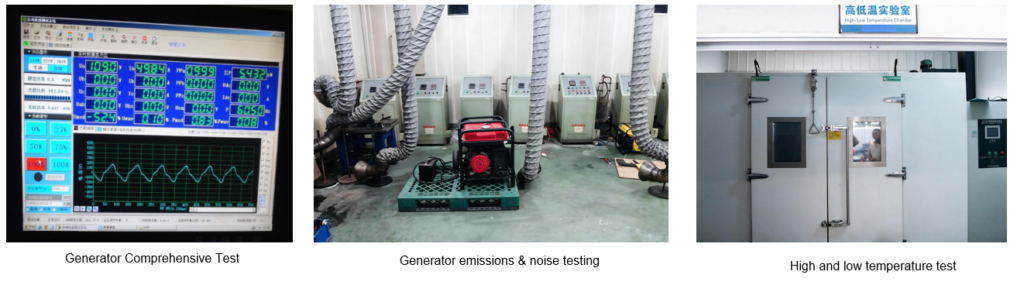
Comprehensive performance, emission and noise, and high- and low-temperature testing for finished NEWTOP generators.
NEWTOP’s finished-generator inspection facilities cover three areas shown in the factory testing images:
Comprehensive Generator Testing
Electrical output and overall operation are observed after final assembly. This helps check whether the engine, alternator, control system, and outlets work together as a complete unit.
Emission and Noise Testing
Emission and operating-noise checks examine characteristics affected by combustion, exhaust design, engine condition, vibration control, and working load.
Hoch- and Low-Temperature Testing
Environmental testing checks generator operation under changing temperature conditions. Temperature can influence starting, fuel delivery, Schmierung, Batterien, wiring, and other electrical components.
These checks connect the generator’s technical specifications with the performance of the finished machine. They also provide stronger evidence than relying only on an engine start-up inspection.
Basic Maintenance Keeps the System Working
Every maintenance task protects one part of the energy path.
Fresh gasoline and a clean fuel system help fuel reach the carburetor. A clean air filter supports the correct mixture. The spark plug supports ignition, while suitable engine oil protects the piston, crankshaft, camshaft, and bearings.
Cooling openings should remain clear, and cables, plugs, breakers, and electrical connections should be checked regularly. Backup generators also need periodic starting and inspection so that fuel deterioration, battery discharge, Korrosion, or loose connections are found before an outage occurs.
Operate Gasoline Generators Outdoors
Gasoline generator exhaust contains carbon monoxide, a colorless and odorless poisonous gas. Portable generators must never operate inside homes, garages, basements, sheds, or other enclosed areas.
The U.S. Consumer Product Safety Commission advises using portable generators outdoors, at least 20 feet away from homes, with the exhaust directed away from doors, Fenster, und Lüftungsschlitze.
The generator should also be switched off and allowed to cool before gasoline is added. Connection to a building’s electrical system should use suitable transfer equipment installed according to local electrical requirements.
From Gasoline to Usable Power
Also, how does a gasoline generator work from beginning to end?
Gasoline and air enter the engine. The spark plug starts combustion, moving the piston and turning the crankshaft. The crankshaft spins the alternator rotor inside the stator, where electromagnetic induction produces electrical current. The governor and voltage regulator then help the generator respond as the connected load changes.
The engine creates rotation. The alternator creates electricity. The control, cooling, protection, and frame systems help the complete unit deliver that power safely and consistently.
Understanding this relationship makes generator specifications easier to evaluate. Engine displacement shows only part of the machine’s capability. Nennleistung, alternator construction, voltage regulation, testing, protection systems, and component matching reveal more about how the finished generator will perform in real use.