Zum Inhalt springen



For chainsaw parts importers, Großhändler, and distributors, packaging plays an important role in product protection, Bestandsverwaltung, and brand presentation. Whether purchasing guide bars, Sägeketten, sharpening files, or smaller replacement components, buyers need packaging that keeps products organized, protects them during transportation, and provides clear product information.
Choosing the right packaging also helps distributors manage different product models, reduce picking errors, and prepare products for retail sales. For businesses developing their own product brands, customized packaging and labeling can further support brand recognition and market positioning.
This guide explains common packaging options for chainsaw spare parts, essential labeling information, and what importers should consider when working with OEM and private label suppliers.
Wichtige Erkenntnisse
- Choose packaging based on component size, Material, Auftragsvolumen, and sales channel.
- Use clear product codes and compatibility information to reduce inventory and ordering errors.
- Include essential specifications, barcodes, and brand details on product labels.
- Confirm packaging samples, labeling accuracy, and export requirements before approving bulk production.
Why Does Packaging Matter in the Chainsaw Spare Parts Business?
Packaging serves several practical purposes throughout the Ersatzteile für Kettensägen supply chain. Für Importeure und Händler, its value goes beyond making products look presentable.
Product protection during storage and transportation
Chainsaw components may have sharp edges, exposed metal surfaces, or precision-machined parts. Guide bars, Sägeketten, and cutting accessories can be damaged by impact, Feuchtigkeit, friction, or improper handling. Suitable packaging helps reduce scratches, corrosion risks, and component deformation during storage and international transportation.
Inventory identification and warehouse management
Distributors often stock multiple sizes and specifications of the same spare part. Without clear labels, visually similar products can easily be mixed up. Product names, model numbers, dimensions, and barcodes help warehouse staff identify items, manage stock, and process orders more accurately.
Retail presentation and customer information
For dealers selling chainsaw accessories through physical stores or retail channels, packaging provides customers with essential product information before purchase. Clear specifications and compatibility details help buyers identify the right replacement parts.
Brand recognition and market positioning
Consistent packaging gives distributors and private label businesses greater control over how their products are presented. Branded boxes, Etiketten, and product inserts help establish a recognizable product range across different chainsaw accessories.
What Are the Common Packaging Types for Chainsaw Spare Parts?
Packaging requirements vary according to order quantities, product characteristics, and distribution channels. Three common approaches are bulk packaging, retail packaging, and customized private label packaging.
Bulk Packaging for Wholesale Orders
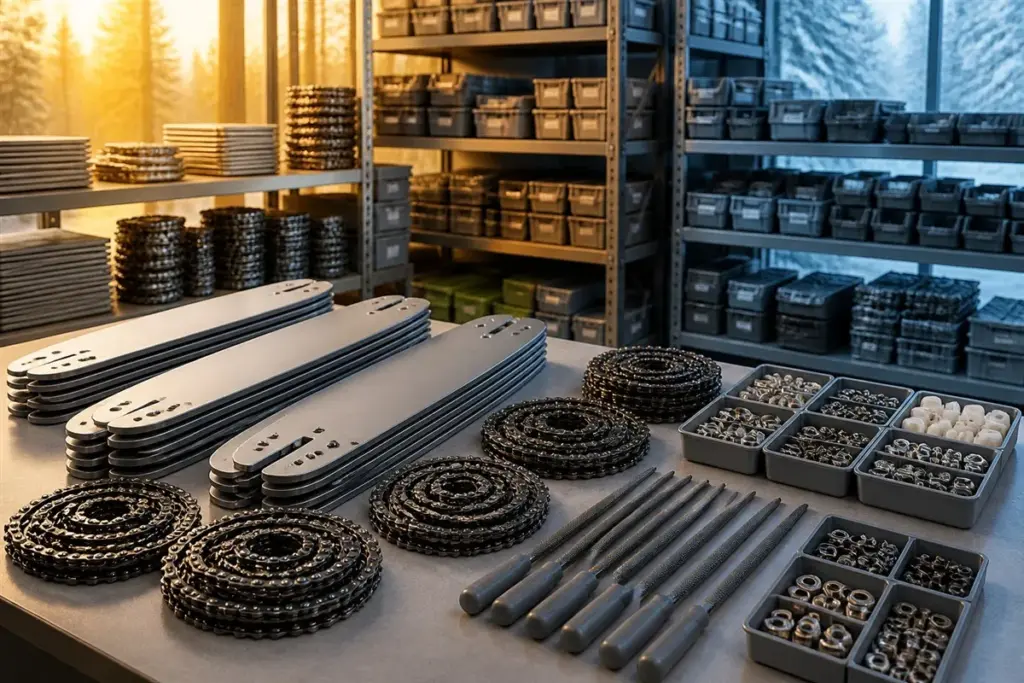
Bulk packaging is commonly used for large-volume orders supplied to importers, Großhändler, and distributors. Instead of preparing individual retail boxes for every item, products are packed in larger quantities using suitable inner packaging and outer cartons.
Common options include:
- Poly bags: Suitable for grouping smaller components and protecting them from dust and surface contamination.
- Corrugated cartons: Used for packing multiple products and organizing wholesale shipments.
- Protective separators: Help prevent metal components from rubbing against each other during transportation.
- Inner cartons: Separate different models or specifications within a larger shipping carton.
Bulk packaging can reduce individual packaging costs and simplify warehouse handling. Jedoch, buyers should confirm that products are sufficiently protected and that different specifications are clearly separated and identified.

Retail Boxes and Blister Packaging
Retail packaging is designed for products sold individually through hardware stores, chainsaw dealers, and other retail channels.
Common formats include:
- Printed paper boxes: Provide space for product names, Spezifikationen, brand information, and usage instructions.
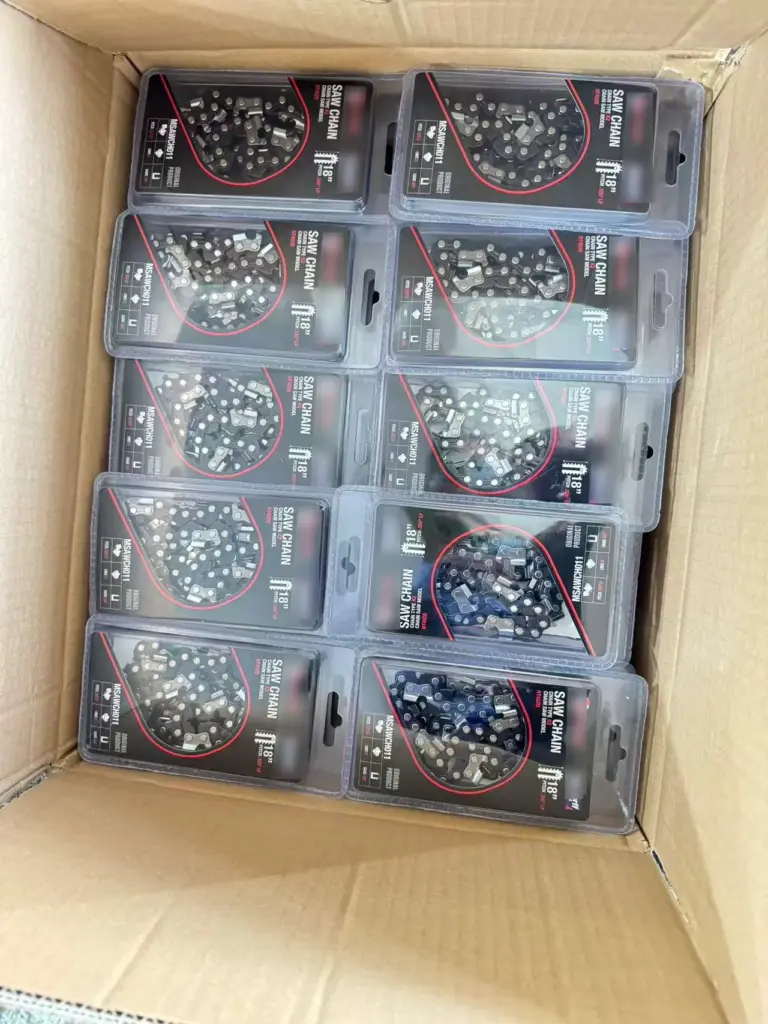
- Blister packaging: Uses a transparent plastic shell attached to a printed backing card, allowing customers to view the product while keeping it secured.
- Hang-tab packaging: Includes a hanging feature for displaying lightweight accessories on retail shelves.
- Printed labels: Offer a practical way to identify products when full-color retail boxes are unnecessary.
Retail packaging should balance product visibility, Schutz, and shelf presentation. Buyers should also consider whether the packaging can accommodate the product’s dimensions without leaving excessive empty space.
Customized Packaging for Private Label Products
For distributors developing their own chainsaw accessory brands, customized packaging provides an opportunity to create a consistent product identity.
Depending on the product and supplier’s available options, customization may include:
- Printed packaging with the buyer’s brand logo and colors.
- Customized product labels and model identification.
- Branded instruction sheets or product inserts.
- Consistent packaging layouts across different product categories.
Before selecting a customized format, buyers should confirm printing requirements, Mindestbestellmengen, artwork specifications, and production lead times with the supplier.
How to Choose Packaging for Different Chainsaw Components
Packaging requirements for chainsaw spare parts depend on their dimensions, material properties, sharp edges, and storage conditions. These factors should guide the selection of suitable packaging materials and designs.
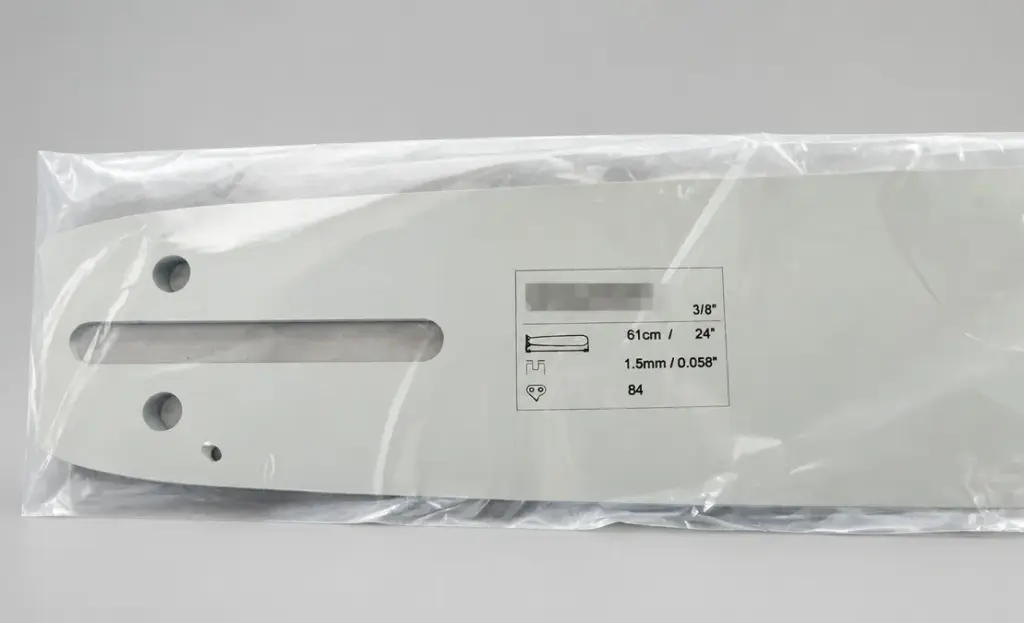
Packaging for Chainsaw Guide Bars
Bars are the longest and thinnest item in the parts range. Length runs from 14 inch on the NT3200 to 42 inch on the NT9200, so the carton has to be long, stiff and flat. A bar travels flat in a stiff bundle, with a nose sleeve and a separator between bars.
Unser durable replacement guide bar range follows the same lengths.
Packaging for Saw Chains and Sharpening Files
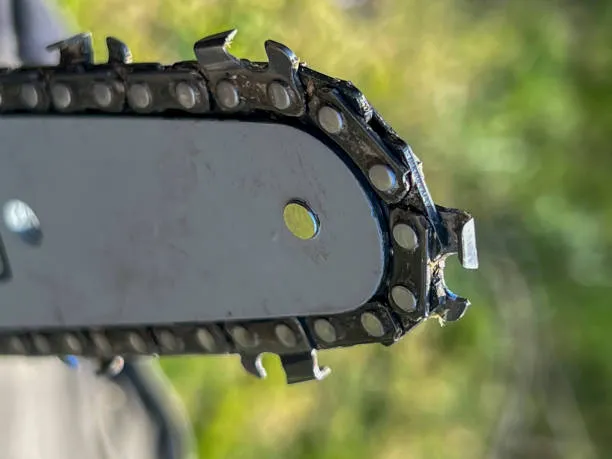
A chain arrives coiled. The loops rub in transit, and a dry chain in a warm carton can pick up rust between the links. A sealed bag holds the coil together and keeps air off the steel; VCI paper releases a corrosion inhibitor into the enclosed space.
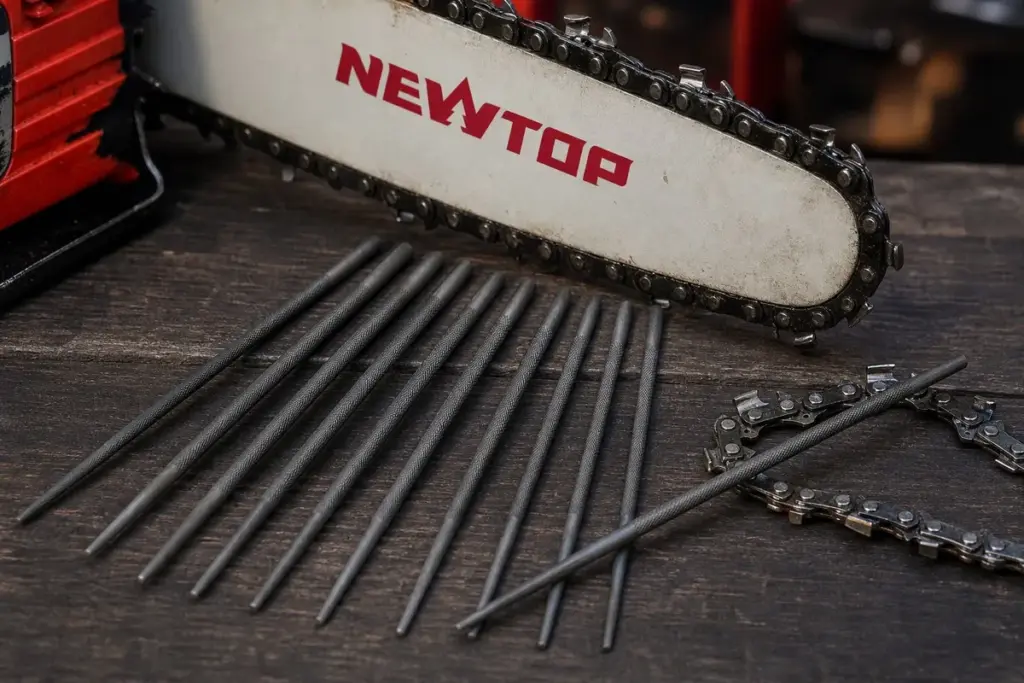
A file’s teeth chip rather than bend. Each file needs its own tube, and files travel away from bars and sprockets. Rust on the teeth dulls the cut before the file is used.
Packaging for Small Chainsaw Spare Parts
Small parts fail in the opposite way. A bag of sprockets is crushed when a heavy carton is stacked on top. Rigid boxes with dividers, or bags inside a box, spread the load and keep the count right.
| Part family | Main transit risk | Packing approach | Detail to print on the pack |
|---|---|---|---|
| Guide bars | Bent nose, scored rails, rail moisture | Flat bundle, nose sleeve, bar separators | Bar length, Tonhöhe, Messgerät, mount pattern |
| Sägeketten | Coil rub, rust between links, loose loops | Sealed bag with oil film or VCI paper | Tonhöhe, Messgerät, drive-link count, drive-sprocket tooth count |
| Sharpening files | Chipped teeth, rust on the cut, Biegen | Individual tube, away from heavy parts | Durchmesser, file type, cut, Menge |
| Sprockets and drums | Crushed rims, mixed tooth counts | Rigid box with dividers, inner bag | Teilenummer, tooth count, model fit |
| Filter, plugs and hardware | Crushing, spillage, wrong count | Sealed bag by count, then a rigid outer box | Teilenummer, Menge, barcode |
Packing rules by part family for chainsaw spare parts packaging. The risks are handling and storage risks, not a statement about part quality.
What Information Should Be Included on Chainsaw Spare Parts Labels?
A product label should provide enough information for buyers, warehouse staff, and end users to identify the item correctly. The exact details depend on the product category and the intended sales market.

Product Names, Model Numbers, and Specifications
The product name should describe the part in words a counter can search, wie zum Beispiel 18 inch saw chain rather than a family name alone. The part number must never change, because it ties the part to the drawing and the reorder. Specifications should include only what a buyer needs to confirm fit. For a chain that means pitch, Messgerät, drive-link count and drive-sprocket tooth count. For a bar it means bar length, Tonhöhe, gauge and mount pattern.
| Label field | Why the counter needs it | Format to use |
|---|---|---|
| Product name | Identifies the part | 18 inch saw chain, .325 Tonhöhe |
| Part or model number | Ties the part to the drawing | Internal code, unchanged between orders |
| Tonhöhe | Confirms the chain matches the drive sprocket and bar nose | 3/8 oder .325 |
| Messgerät | Confirms drive-link thickness against the groove | .043, .050, .058 oder .063 |
| Bar length | Confirms the cutting length and the chain loop that fits it | Nominal length in inches |
| Bar mount pattern | Confirms the bar tail matches the mount studs and slot | Mount code or slot width and stud spacing |
| Drive-sprocket tooth count | Confirms the chain matches the sprocket that drives it | 7, 9, 10, 11 oder 12 teeth |
| Drive-link count | Confirms the loop length matches the bar | Counted number, not a size class |
| Barcode | Scans at goods-in and at the till | Number owned by the brand |
| Brand and origin | Shows the brand owner and origin | Logo and country name |
| Compatibility note | Tells the counter which saws the part fits | Model list with pitch and gauge |
Label content checklist for a parts carton. Bar mount pattern applies to bars; drive-sprocket tooth count applies to chains.
Table 1 carries the family-specific fields: file diameter, type and cut for sharpening files; tooth count and model fit for replacement sprockets; quantity and barcode for filters, plugs and hardware.
Brand Logos, Barcodes, and Country of Origin
In addition to technical information, labels may include commercial, identification, and compliance details.
Brand logo and product identity: A logo, brand name, or product series helps customers recognize products and maintain consistent branding across different accessory categories.
Barcode or QR code: Barcodes can support warehouse scanning, stock tracking, and retail checkout. QR codes may direct users to product catalogs, Installationsanleitung, or additional product information.
Country of origin: Origin information may be required depending on the destination market, Produktkategorie, and applicable import regulations. Buyers should confirm the correct wording and placement with their suppliers and customs or compliance advisers.
Compliance information: For products subject to specific market regulations or certification requirements, relevant compliance markings or references to supporting documentation may also be necessary. NEUTOP‘s outdoor power equipment portfolio includes products associated with CE, GS, EURO V, EPA, SGS, and RoHS requirements, depending on the product category and applicable market. Buyers should verify the relevant documentation before including any compliance claims on product packaging.
Other details may include the manufacturer’s or importer’s information, batch numbers, packaging quantities, and handling instructions.
Importers should not assume that one label format meets every country’s requirements. Local labeling and product information regulations should be checked before mass production.

How to Use Product Codes and Compatibility Information on Labels
A product code is a promise that one string of characters resolves to one specification. The promise breaks when a supplier reuses a code for a new length, or when the same part ships under two codes for two markets. Both habits save work at the factory and cost the dealer a season of picking errors.
Building a Code That Points to One Part
The code should be built from fields a buyer can read. A family prefix names the part type, a size field carries the length or diameter, and a pitch and gauge field narrows the fit. A suffix covers variants such as tooth count or nose type. The chain matrix gives a working example: NT16-63VVH is a 16 inch chain, .063 Messgerät, .325 Tonhöhe, cut for a 12-tooth drive sprocket. A counter can read the fit from the code.
A buyer who learns one structure can order without a catalogue, and a warehouse clerk can check a carton without opening it. When one part ships under two market codes, keep one master code and add a market suffix; never reuse either code for a different specification. A supersession list maps the old code to the new one, and both appear only during the changeover.
Writing the Compatibility Note
A compatibility note turns a code into a sale. It should name the saw models the part fits and state the pitch and gauge that make the fit work. A note that says fits most saws gives the counter nothing to check, and it invites a return the dealer cannot argue. Where a part is sold for a third-party saw, the fit has to come from that machine’s mount specification.
How Does Customized Packaging Support Private Label Chainsaw Parts?
For a buyer selling under its own brand, the carton is the product at the point of sale. The part inside may be identical to a stock item, and the pack is what separates the two in the customer’s mind.
What Customization Covers
We customize inner and outer packaging to your artwork. That covers printed cartons, inner bags, Etiketten, insert cards and master carton marks. The scope stops at packaging. Machine design and part specification are separate conversations, and a packaging programme does not change the drawing of a bar or a chain.
What It Adds to the Approval Cycle
Custom work adds two steps before production. Artwork has to be proved against a dieline, and a printed sample has to be approved. The buyer supplies logo and label artwork as a vector file, and the dieline proof fixes the logo block, barcode quiet zone and fit fields.
Barcode ownership is settled at the same time: a number owned by the printer or supplier will not scan into the buyer’s price file. On the first run, the buyer reconciles one sealed sample against the approved proof and packing list, then signs off the reference carton.
The return is shelf presence and price control.
What Should Importers Check Before Approving Spare Parts Packaging?
Approving chainsaw spare parts packaging should happen on a physical pack, not on a PDF. Print separates on a screen and colours on a carton rarely match.
The Physical Sample Check
Ask for a production sample filled with the actual part. Check that the bar is straight after handling, that the chain bag is still sealed, and that the file tubes are not crushed. Stack the cartons the way the container will and look for compression at the corners.
The Artwork and Label Proof Check
Scan the barcode with a counter scanner, not a phone app. Read the part number from a metre away and check that the model list matches the order. Compare carton marks with the packing list, then confirm the quantity per carton and the gross weight.
| Überprüfen | How to test it | What counts as a pass |
|---|---|---|
| Carton compression | Stack three high for a week or use a compression test | No corner collapse and no bulge at the base |
| Drop and handling | Drop a filled carton from waist height on one corner | Part intact, inner pack still closed |
| Bar straightness | Lay the bar on a flat surface after unpacking | No gap under the rail and no bent nose |
| Chain seal | Open the master carton and inspect the inner bags | Bags sealed, no oil loss, no rust |
| Barcode scan | Scan with the dealer’s own counter scanner | First read, correct price file lookup |
| Marks and counts | Compare carton marks with the packing list | Menge, weight and origin all agree |
A pre-shipment approval list. Run it on a production sample rather than on a design file.
How NEWTOP Supports OEM Packaging and Private Label Programs
Our packaging and labeling work is built around the part families a dealer stocks: bars, Ketten, files and small hardware. We have supplied outdoor power equipment to distributors and brand agents in 65 Länder seitdem 2003, with annual capacity above 500,000 Einheiten.
Sample Flow and Lead Times
A print run starts only after the dieline and label proof are signed, and we keep the approved fit data on the pack. Samples go out 7-10 Tage nach der Zahlung, and a container order takes about 30 Tage. Core parts carry a six-month warranty.
Working With Our Parts Team
Our bar range covers 14-16 inch on the NT3200, 16-24 inch on the NT5800 and NT6200, Und 20-42 inch on the NT9200. Chains run 10-20 Zoll, .043 Zu .063 Messgerät, 3/8 oder .325 Tonhöhe, mit 7 Zu 12 tooth drive sprockets. Send us the models you service and the artwork you want, and we will confirm each line in writing.
Der replacement saw chain page lists the chain sizes, und die spare parts case from a Latin American market shows how a mixed range is trimmed after the first season. Der parts and accessories overview covers the rest of the range. Start at NEUTOP with the model list and the pack you want.
Häufig gestellte Fragen
Should the Barcode Go on the Inner Bag or the Master Carton?
Put the unit barcode on the inner pack the counter scans. Repeat it on the master carton as an internal carton mark with the quantity and batch, and use a separate case code when the buyer’s GS1 system requires one. The master carton also carries the carton marks for goods-in.
How Do We Label a Part That Fits Two Saw Models With Different Pitch?
Treat it as two fits, not one. If the pitch differs, the chain is a different part; give each fit its own part number and compatibility line, and do not print a combined fits-both claim.
Can You Print Our Brand on Chainsaw Spare Parts Packaging?
Ja. We print your artwork on inner and outer packs, including cartons, inner bags and labels. We confirm the fit data before the print run, and we send a sample 7-10 Tage nach der Zahlung.
Does a New Chain Need Rust Protection in the Box?
Ja, for export or long storage. A chain in a sealed bag with an oil film or VCI paper is better protected against condensation than a chain in an open carton. Rust between the links is difficult to remove at the counter and usually becomes a claim.
How Do We Approve Packaging Before the First Container?
Ask for a filled production sample, scan the barcode with a counter scanner and compare the carton marks with the packing list. Keep one sealed reference carton for later shipments.