Passer au contenu



A distributor may have shelves full of brush cutter spare parts yet still lose orders because the components customers need most are out of stock. Entre-temps, expensive engine parts can remain unsold for months, tying up money that could be used for faster-moving products.
Building an effective inventory takes more than choosing popular parts from a supplier’s catalog. Importers need to understand which brush cutters operate in their markets, how local customers use them, and how long replacement stock takes to arrive.
The following approach helps dealers turn that information into practical purchasing and replenishment decisions.
Start with the Brush Cutters Already in Your Market
Before deciding how many replacement parts to order, identify the equipment your customers already own.
A distributor selling mostly 43cc brush cutters may face different service demand from one supplying larger machines for intensive vegetation clearing. Even within the same engine capacity range, component specifications and replacement requirements can vary.
Three sources provide a useful starting point: machine sales records, repair workshop requests, and information about popular models already circulating in the local aftermarket.
Sales records reveal the equipment your business has supplied. Workshops can identify frequently requested repairs, including components that are difficult to obtain. Entre-temps, looking beyond your own machine sales helps capture demand from customers who purchased their equipment elsewhere.
For a dealer with limited historical data, start with the models handled most often by local repair shops. Record customer requests over several weeks before committing to a broad inventory.
The resulting information should guide individual part numbers and quantities, not just the overall range of products you carry.
Match Brush Cutter Spare Parts Inventory to Local Working Conditions
Machine models are only part of the picture. Daily operating conditions also influence maintenance and replacement requirements.
A landscaping contractor using brush cutters throughout the working week may purchase parts differently from a farmer maintaining field boundaries occasionally.
The table below outlines which components distributors can monitor across different applications.
| Local Application | Parts to Monitor | What Dealers Should Check |
|---|---|---|
| Residential Gardens & Estate Maintenance | Têtes de coupe, ligne en nylon, bougies d'allumage, filtres à air | Cutting-head specifications and repeat consumable purchases |
| Roadside & Commercial Clearing | Metal blades, mounting hardware, gearbox components | Attachment wear, repair requests, et compatibilité des machines |
| Fermes & Agricultural Maintenance | Filtres à air, filtres à carburant, démarreurs à rappel, carburetor components | Seasonal demand and workshop service records |
| Machinery Repair Workshops | Ignition coils, gasket sets, kits de carburateur, engine components | Frequently repaired models and exact replacement specifications |
These are suggested inventory checks rather than confirmed replacement-frequency rankings.
Par exemple, dealers supporting machines used in dusty environments should pay attention to air-filter inspection and maintenance. Cependant, the actual quantity needed should come from sales and service records, not assumptions about climate alone.
Manufacturers also provide useful maintenance references. Husqvarna’s brushcutter maintenance guide covers items such as air filters and spark plugs, although maintenance schedules and replacement requirements vary by model.
Which Parts Need More Stock—and Which Need Less?
Two components may sell at similar rates but require different inventory quantities.
Consider a commonly requested trimmer head that a supplier can replenish quickly. A dealer may not need to hold several months of stock if repeat deliveries are straightforward.
Now consider a model-specific ignition component with a longer import lead time. Even if demand is lower, keeping a small reserve could prevent repeated stockouts at local repair workshops.
Four factors help determine the appropriate stock depth: sales frequency, replenishment lead time, unit cost, and supplier minimum order quantity.
Low-cost items with regular demand may justify larger repeat orders. Expensive components with irregular demand require closer attention to cash tied up in inventory.
Supplier MOQ can complicate the decision. If a factory requires a larger quantity than your market can reasonably sell, ask whether the item can be combined with other compatible parts in a mixed order. Cependant, combining purchases only makes sense when the additional items have genuine demand.
If you’re still deciding which components belong in your initial product range, see our guide to which brush cutter spare parts importers should order first.
Once the assortment is established, the next task is deciding how much stock each SKU deserves.
Keep a Compatibility Record for Every Spare Parts SKU
One incorrectly matched component can create problems across an entire wholesale shipment.
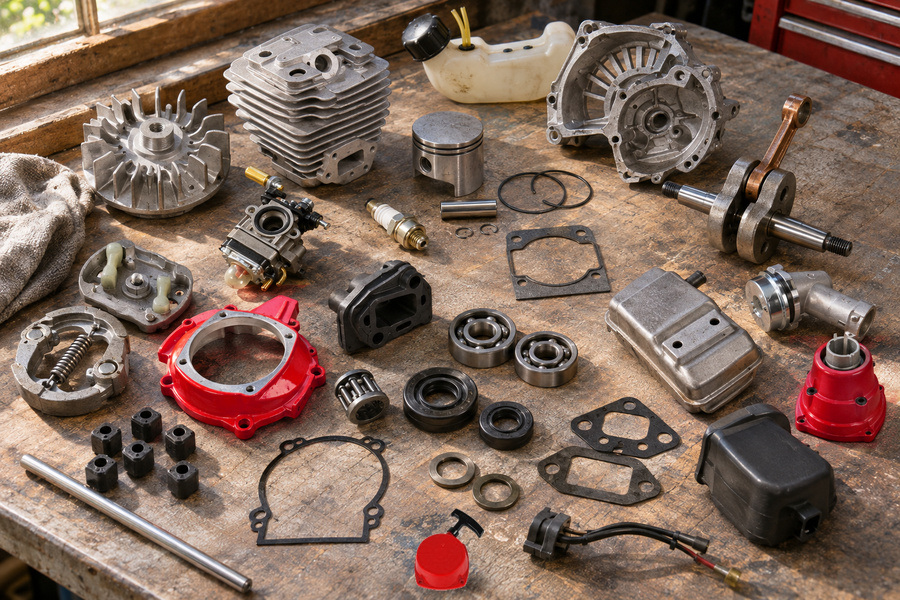
Par exemple, NEWTOP offers the NTB143 brush cutter with a 41.5cc engine and the NTB520B with a 51.7cc engine. Both are gasoline brush cutters, but displacement alone cannot establish whether their carburetors, starter assemblies, or other components are interchangeable.
A practical inventory system should record more than the product description.
For each SKU, maintain:
- Machine Reference: Confirmed brush cutter model and engine configuration.
- Part Identification: Numéro de pièce du fournisseur, product photograph, or technical drawing.
- Critical Dimensions: Relevant measurements, mounting threads, shaft specifications, or connection details.
- Stock Information: Current quantity, average demand, replenishment lead time, and outstanding orders.
This information becomes particularly useful when several machines share similar appearances but use different internal components.
A well-maintained SKU record also makes repeat purchasing easier. Instead of confirming the same specifications from scratch each time, dealers can provide their supplier with an established reference list and verify any product revisions before ordering.
How Much Brush Cutter Spare Parts Stock Should You Keep?
Once a dealer knows which parts are selling, the next question is when to replenish them.
A simple reorder point calculation helps estimate how much inventory is needed to cover demand while another shipment is on its way.
Reorder Point = Average Demand During Lead Time + Safety Stock
Consider a hypothetical distributor selling one particular replacement component.
Example inventory data:
- Average weekly sales: 4 unités
- Replenishment lead time: 5 semaines
- Safety stock: 8 unités
The calculation is:
(4 × 5) + 8 = 28 unités
Dans cet exemple, the distributor should consider placing the next order when the inventory position reaches 28 unités.
Inventory position accounts for stock on hand plus incoming orders, minus outstanding backorders. Looking only at warehouse stock can lead to unnecessary repeat purchases if replenishment orders are already on the way.
The eight-unit safety stock is an illustrative assumption, not a recommended quantity for every dealer. It should be adjusted according to demand fluctuations and delivery uncertainty.
This approach follows the standard reorder point principle described in Oracle’s inventory planning guidance.
Reorder Point Is Not the Same as Order Quantity
The reorder point tells you when to buy, pas how many units to purchase.
In the example above, atteindre 28 units does not mean the dealer must order another 28.
The actual purchasing quantity depends on expected sales until the following replenishment, supplier MOQ, available cash, and warehouse capacity.
A dealer might purchase a larger batch ahead of a predictable busy season. Another may prefer smaller repeat shipments to avoid holding expensive, slow-moving components.
Both decisions can be reasonable, provided the quantities reflect actual demand and supply conditions.
Use Stockouts to Improve Your Next Purchase Order
Sales records show what customers bought. They do not always reveal what customers wanted but could not purchase.
A repair workshop might request a recoil starter that your warehouse does not carry. If the request goes unrecorded, the next purchase order may overlook the same demand.
Keep a simple log of unfulfilled inquiries, including the requested part, compatible machine model, quantité, date, and reason the order could not be completed.
This information can reveal several useful patterns.
Repeated requests for the same unavailable SKU may justify adding it to regular stock. A part that remains unsold despite several replenishment cycles may need a smaller order quantity. Where sales rise during a particular agricultural or vegetation-clearing season, purchasing schedules should reflect that timing.
For a newly introduced parts range, a review after the first 90 days can help identify early demand patterns. Cependant, seasonal products may require a longer comparison period before making major inventory decisions.
Reviewing these records before each wholesale purchase gives distributors a clearer basis for increasing, reducing, or discontinuing individual SKUs.
Source Brush Cutter Spare Parts with NEWTOP
Fournitures NEWTOP brush cutter spare parts and accessories for overseas importers, concessionnaires, and machinery repair businesses.
Our product range also includes gasoline brush cutters and grass trimmers, allowing distributors to discuss complete machines and matching replacement components together.
When requesting a wholesale quotation, provide the machine models you support, required part numbers or photographs, estimated purchasing quantities, and any specific compatibility requirements.
NEWTOP can assist with component identification, specification confirmation, and available supply arrangements to help you prepare a parts order suited to your market.