Pular para o conteúdo



A chainsaw guide bar can seat on the saw and still be wrong on pitch, gauge or drive-link count. The mistake waits until a customer fits a chain, and then the whole line comes back.
This guide sets out what professional buyers check before a guide bar order. It covers the specifications that decide fit and how bar length maps to the work. It also compares laminated, milled and solid tip bars, explains model matching, and shows how local working conditions change the assortment.
What to take from this guide
- A chainsaw guide bar is bought with its chain, so length, mount pattern, tom, gauge and drive-link count must be confirmed together.
- Published NEWTOP ranges run 14-16 inch bars on the 31.8cc NT3200, 16-24 inch on the NT5800 and NT6200, e 20-42 inch on the 91.6cc NT9200.
- Laminado, milled and solid tip bars differ in build and service life, and the duty class of the saw should drive the choice.
- Rail condition, nose type and oil delivery decide how long a bar lasts in professional service.
- Wood species, pó, humidity and fleet mix shift the right assortment by market, so the first order should be corrected after one season.
What Should Buyers Consider When Choosing a Chainsaw Guide Bar?
Buyers usually start with bar length because it is the number printed on the box. Length alone does not make a bar fit a saw. The purchase is a short specification exercise, and five values have to agree with the machine and the chain: length, mount pattern, tom, gauge and drive-link count.
Comprimento da barra guia, Tom, and Gauge
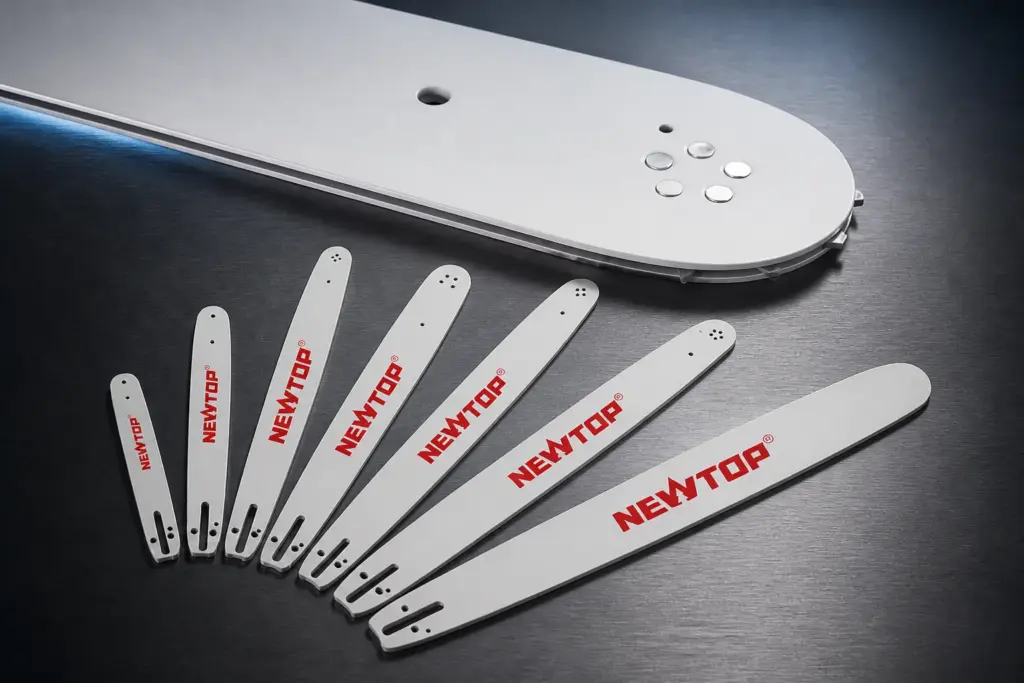
Bar length is the called length, the effective cutting length measured from the front of the saw housing to the tip of the bar. The physical bar is longer than the number on the label, because the tail sits inside the powerhead and does not cut. Measuring the whole bar from tip to tail is a common ordering error, and it adds the tail length to the figure the buyer orders. Pitch is the distance across three rivets divided by two, and it sets the spacing of the chain that rides the rail. Gauge is the width of the groove, and it has to accept the thickness of the drive links.
Drive-link count is the value buyers most often miss. The same bar length in the same pitch can take a different number of links when the tail shape differs. A chain that is one link short will not close, and a chain that is one link long will run loose no matter how the tensioner is set.
Chainsaw Power and Intended Applications
Engine displacement sets the practical bar range. A small saw with a long bar has to pull more chain than the engine was designed to drive, and the cut slows while the engine runs hot. A large saw with a short bar leaves capacity unused, and the operator pays for weight without getting reach. The published range from the manufacturer is the safest starting point, and it should be read with the intended work in mind.
| NEWTOP model | Deslocamento | Published bar range | Pitch options | Gauge options |
|---|---|---|---|---|
| NT3200 | 31.8cc engine | 14-16 inch bar | 3/8 inch pitch | .050 medidor |
| NT5800 | 54.5cc engine | 16-24 inch bar | 3/8 ou .325 inch pitch | .050 ou .058 medidor |
| NT6200 | 61.5cc engine | 16-24 inch bar | .325 ou 3/8 inch pitch | .058 ou .063 medidor |
| NT9200 | 91.6cc engine | 20-42 inch bar | 3/8 ou .404 inch pitch | .063 medidor |
Ranges as published on the NEWTOP model pages. The table is a planning view for assortment work, not a cutting-performance comparison.
How Do Guide Bar Lengths Affect Chainsaw Applications?
A chainsaw guide bar changes reach, weight and balance at the same time. A longer bar reaches through bigger timber, and it also moves the centre of gravity further from the operator. The right length is the shortest bar that still covers the market’s main cutting jobs.
Short Guide Bars for Light-Duty Cutting
Short bars in the 14-16 inch band suit limbing, poda, orchard work and clearing light brush. The saw stays close to the body, the nose is easier to watch, and the operator carries less weight through a long day. In garden and smallholder markets this band covers the common cutting jobs, and the NT3200 range is published at 14-16 polegada.
A short bar also limits damage when the tip meets a fence, a stone or the ground. There is less bar to bend, and a bent bar is cheaper to replace at this length. Dealers stocking a first container for retail counters should keep the lower end of each range deep and the top end thin.
Medium and Long Guide Bars for Professional Applications
Medium bars from 16 para 24 inch cover felling, bucking and firewood work on the NT5800 and NT6200. This is the working band for semi-professional and professional users, and it usually carries the highest replacement volume in a forestry market. Long bars from 20 para 42 inch belong to the high-power class, where the saw has the torque to pull a long chain through large diameter timber.
A long bar demands more oil and more attention to tension. The rail has more contact length, so lubrication matters more than it does on a short bar. Buyers serving felling crews should confirm that the oil pump and the oil holes on the bar match the duty. The operator should also know how to check oil flow at the nose.
What Are the Differences Between Laminated, Milled, and Solid Tip Guide Bars?
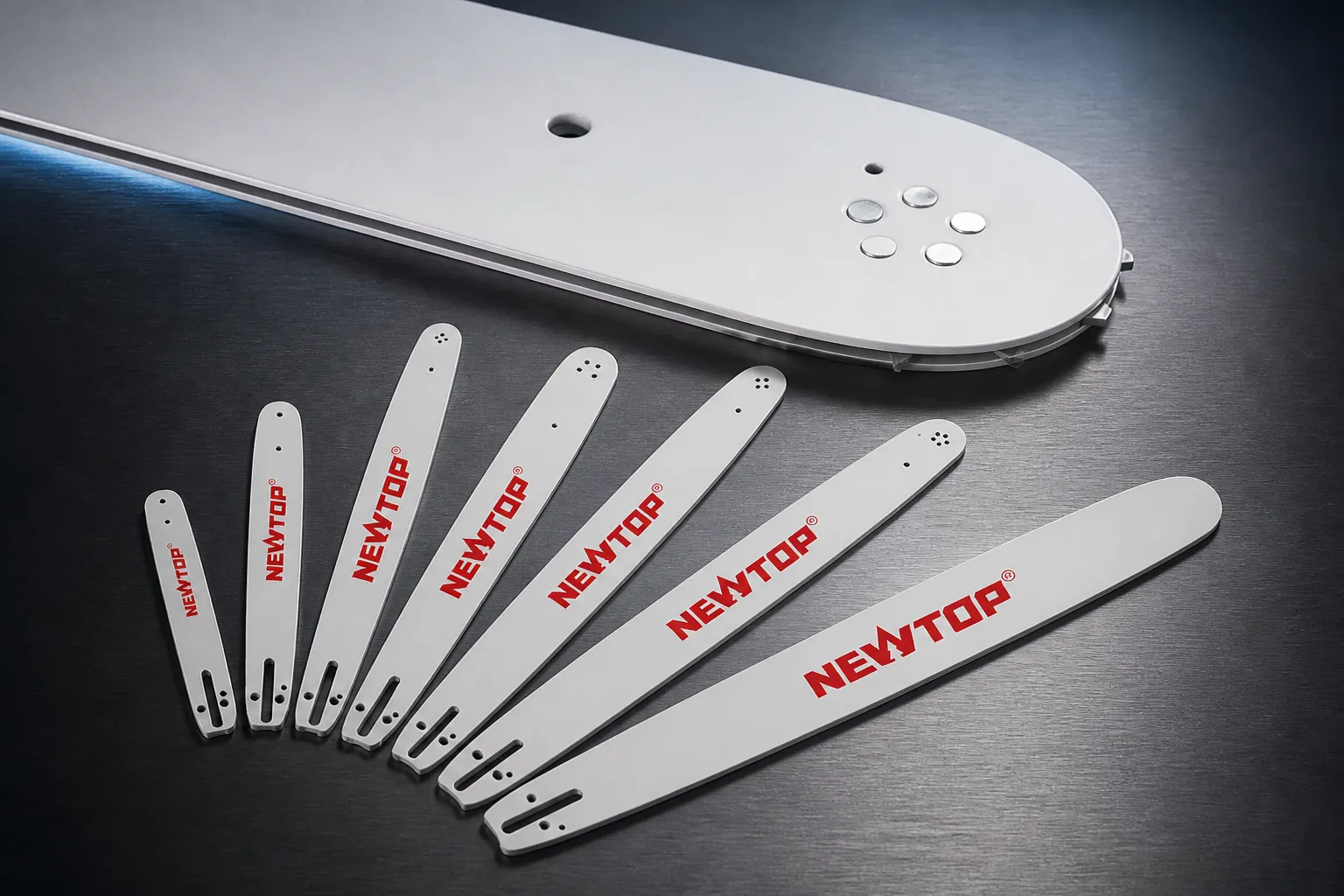
The three builds answer different service lives. Laminated bars are built from stamped layers, milled bars are machined with a replaceable nose, and solid tip bars are one piece of steel with a hardened nose. Price and service model follow the build, so the assortment decision is really a decision about the duty class of the customer.
Laminated Guide Bars for General-Purpose Use
Laminated bars join several stamped plates into one body. The build saves weight and cost, and it suits lower-power saws, occasional users and price-sensitive retail. The trade-off sits in service life: once the rails wear or the groove opens, the bar is normally replaced rather than reworked. That is an acceptable model for a garden-class saw that cuts a few hours a week.
Milled Guide Bars with Replaceable Tips
Milled bars are machined from a solid blank, and some carry a nose that can be replaced when the sprocket wears. A replaceable tip extends the working life of an otherwise sound bar, and a workshop can swap the nose without scrapping the body. Professional users who run long bars tend to value that service route, because the nose is the first part to fail on a bar that is otherwise straight.
Solid Tip Guide Bars for Heavy-Duty Applications
Solid tip bars carry a hardened nose with no moving sprocket. The fixed tip resists abrasive grit and heavy contact, which suits dirty work, stump cuts and conditions where a sprocket nose would pick up wear quickly. The trade-off is friction on long cuts, so this build is usually paired with the applications where durability matters more than the lightest possible cut.
How to Match Guide Bars with Chainsaw Models and Saw Chains
Matching a chainsaw guide bar starts at the tail. The mount pattern is set by the saw, and it covers the stud spacing, the slot width and the shape of the tail. A bar from a different saw family may look close and still not seat. The safe route is to read the model code, then confirm the mount, pitch and gauge against a written specification.
The chain side has to agree on pitch, medidor, drive-link count and drive sprocket tooth count at once. Our replacement chain range is published as 10-20 inch lengths across .043 para .063 gauge and 3/8 ou .325 tom, with drive sprocket tooth counts from 7 para 12. Representative part numbers show the same thing. PO16-50SR is a 16 polegada, 3/8, .050 chain with a drive sprocket tooth count of 7. PO16-50NR is the same 16 polegada, 3/8 chain with 9 drive sprocket teeth, so one bar length carries more than one chain variant.
| Value to confirm | What it controls | Where to read it |
|---|---|---|
| Mount pattern | Whether the bar seats on the saw | Model page, manual, supplier confirmation |
| Bar length | Reach and balance | Published bar range for the model |
| Tom | Chain spacing on the rail | Bar marking and chain part number |
| Medidor | Groove width against drive-link thickness | Bar marking and chain specification |
| Links de direção | Whether the chain closes at the right tension | Chain part number, counted on the fitted chain |
A matching checklist for mixed-brand orders. Confirm every line in writing before the container is booked.
Sprocket wear belongs in the same check. A worn drive sprocket can damage a new chain, and a worn nose sprocket can damage a new bar. Dealers who inspect the sprocket at the same time as the bar catch the wear before it reaches either part. Nosso guide to pitch and gauge explains the measurement, e o bar length guide covers the tape measure method for a fitted saw.
Which Guide Bar Features Matter Most in Professional Markets?
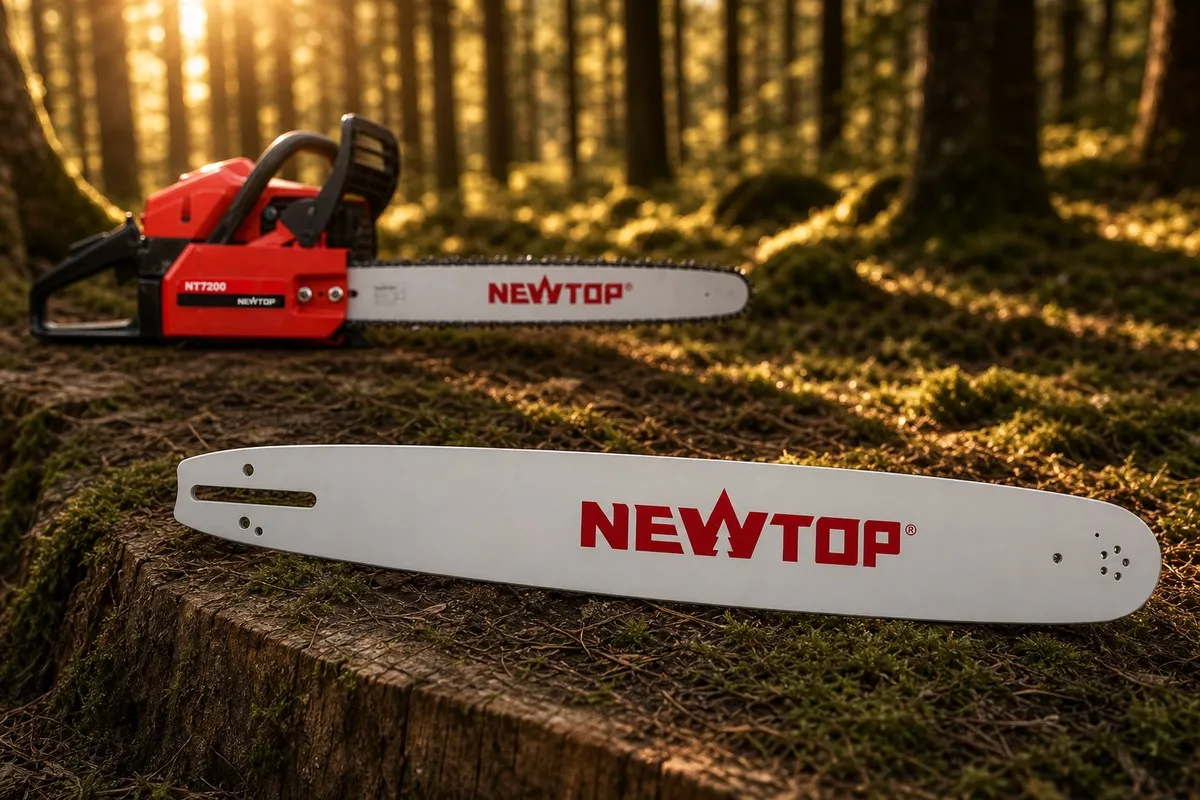
Professional buyers pay for the chainsaw guide bar features that decide how long the part stays in service. The rail, the nose and the oil system carry most of that burden. Steel quality and rail hardness set how long the groove holds its width, and a groove that opens will let the chain rock and cut crooked.
Rail Hardness and Nose Condition
Nose type changes the friction and the service route. A sprocket nose reduces drag on long cuts and can be replaced when it wears, while a solid nose resists grit and needs no bearing. Oil holes and the oil channel decide whether the rail receives enough lubricant at the nose. A blocked hole usually shows as a dry, blue rail before it shows as a broken chain.
A straight edge along the rail and a gauge in the groove tell a dealer more than a visual check. Rails dressed unevenly hold a new chain at an angle, and a groove that has opened past the chain gauge lets the drive links rock. Both are reasons to retire the bar rather than fit a new chain to it.
Peso, Equilíbrio, and Operator Fit
Weight and balance matter to the operator, and they matter to the dealer as a return risk. A bar that makes the saw nose-heavy tires the user and invites a shallow, angled cut. In the UK, chainsaw operators must have received adequate training for the work they do. Dealers serving professional accounts should expect that level of competence from the crews they supply. O UK HSE guidance on chainsaw operators sets out the requirement.
How Do Working Conditions in Different Markets Affect Guide Bar Selection?
Two markets can buy the same saw and need different bars. Wood species, pó, humidity and operator skill all push the assortment in a direction. The table below is a planning aid rather than a set of rules, and local sell-through should correct it after the first season.
| Market condition | Effect on bar choice | Stocking response |
|---|---|---|
| Dense hardwood | Longer contact time and more heat in the rail | Favour solid builds and confirm oil delivery |
| Dry and dusty sites | Grit enters the groove and wears the nose | Stock solid tip bars and cleaning advice |
| High humidity and coastal air | Rust on rails and stored bars | Check packaging and storage guidance |
| Mixed-brand fleets | More mount patterns on one shelf | Limit SKUs to the models actually serviced |
A planning view for assortment work, not measured field data. Confirm the mix against local repair records.
Cold markets add another variable, because frozen timber and stiff oil change the way a bar feels on the cut. Operators in those regions usually prefer a shorter bar for limbing and a longer bar for felling, and they value a nose that clears ice and debris. Tropical markets tend to see faster rust on stock that sits, so packaging and warehouse rotation deserve as much attention as the bar specification.
Where a market runs many small saws on light work, the assortment should lean on the short laminated band. Where it runs felling crews on mature timber, the middle and long bands carry the volume. O NEWTOP chainsaw range e o chainsaw parts category give the model and part starting points for that planning.
Why Source Chainsaw Guide Bars from NEWTOP?
Dealers buy a guide bar as part of a parts list, not as a single item. Our parts range is organised around that: bars, chains and files can be ordered against the same model codes in one shipment. We have built outdoor power equipment since 2003, supply distributors and brand agents in 65 países, and run annual capacity above 500,000 unidades.
We machine core components on CNC equipment and run incoming, in-process and final inspection. Our machines carry CE, GS, EURO II, EPA, ETL and RoHS certification, and the plant runs under ISO9001 and ISO14001. We also supply the durable replacement guide bar as a stocked part, so a dealer can reorder the same specification instead of rebuilding the range each season.
For private-label buyers, we customise inner and outer packaging to your artwork. Envio de amostras 7-10 dias após o pagamento, a container takes about 30 dias, and core parts carry a six-month warranty against the one-year cover on machines. Our distributor programme is built around protected distribution rights in the agent channel, tiered pricing and technical support.
If you are building a guide bar range for a mixed fleet, send us the saw models you service and the wood your market cuts. We will confirm the mount, comprimento da barra, tom, gauge and drive-link count for each line in writing before you place the order. O NOVOTOP parts team can also review your current spare parts mix against a live market case.

Perguntas frequentes
How Do I Match a Guide Bar to a Chainsaw?
Start with the model code and confirm the mount pattern, then check bar length against the published range for that saw. Match pitch and gauge to the chain you plan to run, and count the drive links before the order is confirmed.
What Is the Difference Between Laminated and Solid Tip Guide Bars?
A laminated bar is built from stamped layers and is normally replaced when the rails wear. A solid tip bar is one piece of steel with a hardened nose, which resists grit and suits dirty work where a sprocket nose would wear quickly.
How Long a Guide Bar Can My Saw Run?
Stay inside the range published for the model. The NEWTOP NT5800 and NT6200 list 16-24 inch bars, the NT3200 lists 14-16 inch and the NT9200 lists 20-42 polegada. A longer bar than the range allows will ask the engine for more chain speed than it can hold.
When Should a Guide Bar Be Replaced?
Replace a bar when the groove has opened beyond the chain gauge, when the rails are scored or burred, or when the nose no longer turns freely. A bar that has been re-dressed once may still serve, and a bar that has lost its rail hardness should come out of service.
Do You Supply Guide Bars Under Private Label?
We customise inner and outer packaging to your artwork, and we confirm the bar specification against your saw models in writing before production. Samples go out 7-10 days after payment so you can test the fit on your own machines.