Pular para o conteúdo



Chainsaw sharpening files are essential maintenance accessories for chainsaw owners, forestry professionals, landscaping contractors, and equipment dealers. Although these tools are relatively small, selecting the correct file directly affects chain maintenance, desempenho de corte, and tool compatibility.
For chainsaw distributors and wholesale buyers, choosing the right file range requires more than stocking several common diameters. Different markets may use different chain pitches, cutter designs, and sharpening methods. Buyers also need to consider product quality, embalagem, and compatibility with the chainsaws and replacement chains they already sell.
This guide explains the main types of chainsaw sharpening files, how to match file diameters with chain specifications, and what wholesale buyers should consider when building a practical product range for their markets.
What to take from this guide
- A round file restores the cutter edge, and a flat file controls the depth gauge, so a complete kit carries both shapes.
- File diameter follows chain pitch, com 5/32 inch for 1/4 and low-profile 3/8 chain and 7/32 inch for standard 3/8 e .404.
- Pitch is the strongest signal for file size, and the cutter marking on the chain confirms it before an order is placed.
- Bulk orders should fix steel grade, cut pattern, diâmetro, length and packaging before production starts.
- The right assortment follows the saw mix in the market rather than a generic catalogue list.
What Are the Different Types of Chainsaw Sharpening Files?
Chainsaw sharpening files come in three main types: round files, flat files, and square files. Each serves a different maintenance purpose.
Round Files for Sharpening Standard Chainsaw Cutters
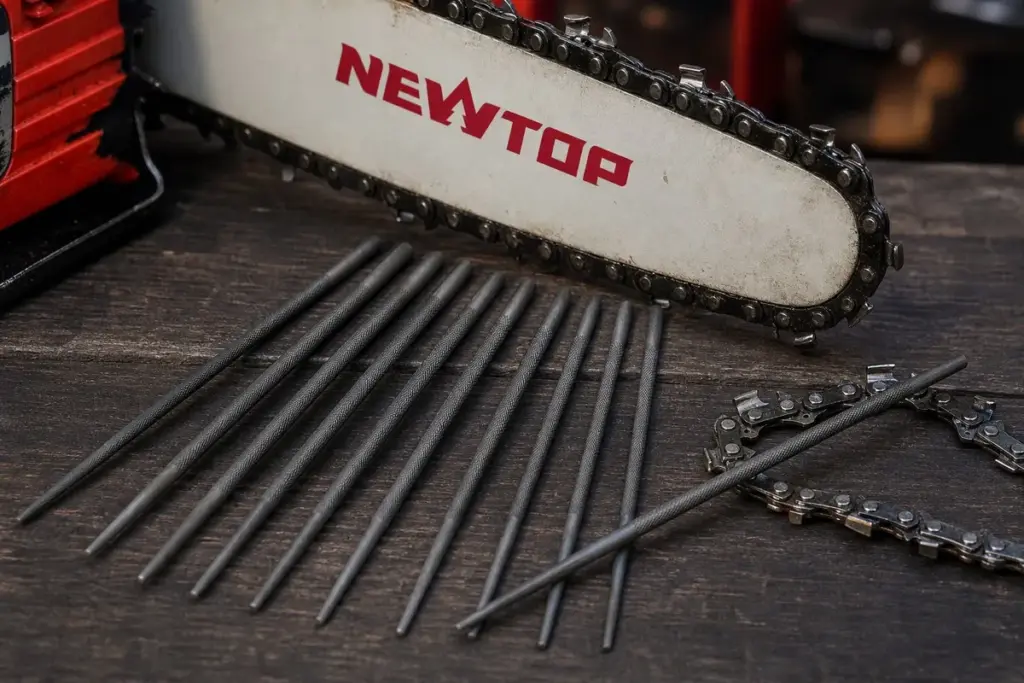
Round files are the most common chainsaw sharpening tools. Their cylindrical profile follows the curved cutting edges of chain teeth. Available in different diameters, they must match the chain manufacturer’s recommendations to maintain the correct cutter geometry. They are essential products for most chainsaw dealers and wholesalers.
Flat Files for Adjusting Chain Depth Gauges
Flat files are used to lower depth gauges, also known as rakers, which control how deeply cutters enter the wood. They are typically used with a depth gauge tool to maintain the recommended clearance. Para distribuidores, flat files are useful complementary products to round files.
Square Files for Specialized Chain Sharpening
Square files have a specialized triangular profile and are used in square-ground filing for certain full-chisel chains. This technique requires greater manual skill and precise filing angles. They mainly serve professional users and can be included as a specialized option in markets with relevant demand.
How to Choose the Correct File Diameter for Different Chainsaw Chains
File diameter decides whether a chainsaw sharpening file suits a given chain. A file one size off still removes metal, so the error is easy to miss. It shows later as a chain that cuts slowly or wanders in the kerf.
File Diameter for Different Chain Pitch Sizes
Pitch is the distance across three rivets divided by two, and it sets the spacing of the cutters along the chain. The Oregon size recommendations below are a common industry reference for matching a file to a pitch.
| Chain pitch | File diameter | Metric size | Chain class it usually fits |
|---|---|---|---|
| 1/4 polegada | 5/32 polegada | 4.0 milímetros | Small top-handle and pole saws |
| .325 polegada | 3/16 polegada | 4.8 milímetros | Mid-range and farm saws |
| 3/8 inch low profile | 5/32 polegada | 4.0 milímetros | Homeowner and light commercial saws |
| 3/8 inch standard | 7/32 polegada | 5.5 milímetros | Professional felling saws |
| .404 polegada | 7/32 polegada | 5.5 milímetros | Large timber and milling saws |
| 3/8 inch thin top plate | 13/64 polegada | About 5.2 milímetros (converted) | Professional low-profile cutters with a thinner top plate |
Sizes as listed in the Oregon file size recommendations; o 13/64 inch metric value is converted (13/64 in = 5.16 milímetros, shown as about 5.2 milímetros). A trade reference lists 3/8 inch as 5.2 milímetros, so confirm the chain is standard 3/8 or thin top plate before ordering. The table is a planning reference for assortment work, not a substitute for the marking on a specific chain.
How to Check Manufacturer Sharpening Recommendations
The safest check starts on the chain itself. Many chains carry a marking near the rivet that gives the file size or the chain code, and the chain packaging and manual repeat it. A dealer who reads the marking avoids the common error of matching a file to bar length instead of pitch. Nosso guide to pitch and gauge explains the measurement in detail.
Where a chain carries no marking, compare the cutter with a chain of known pitch. A cutter that takes a 7/32 inch file sits visibly larger than one that takes 3/16 polegada. Record the match on the order before the carton leaves the supplier.

Round Files vs. Flat Files: What Is the Difference?
A round file and a flat file do different jobs on the same chain. A chainsaw sharpening file kit that carries only one shape will leave half of the maintenance undone. The round file works inside the cutter, and the flat file works on the depth gauge in front of it.
How the Two Shapes Cut Differently
A round file cuts a concave edge across the cutter face, and the curve has to follow the original profile. The contact area is small, so the file removes metal only where the operator pushes. A flat file cuts with a broad face, and the contact spreads across the whole gauge. That makes the flat file slower to remove metal than a round file in the gullet, but easier to keep square.
The two shapes also wear in different ways. A round file loses its edge along a narrow line, and a flat file dulls across a wide face. A dull round file is easier to notice, because the cut slows.
A file guide holds the round file at the cutter angle, and a depth gauge tool sets the height of the flat file. Without a guide, the angle changes from cutter to cutter, and the chain cuts unevenly.
Sharpening Sequence for Cutters and Depth Gauges
A sharpening pass should start with the cutters. Every cutter on the chain needs the same number of strokes, or the chain will cut unevenly and wear the bar. The operator then checks the depth gauge, files it only where the gauge reads high, and brushes the chain before refitting it. A test cut in scrap wood shows whether the chain pulls straight and clears chips.
The sequence matters because sharpening lowers the cutter top. The depth gauge stays where it is, so a gauge filed before the cutter pass ends up too high once the cutter is sharpened back. The raker then limits how deep the cutter can bite, and it must be filed down again to restore the clearance.

How Do Chain Pitch and Cutter Design Affect File Selection?
Pitch sets the starting size, but the cutter shape decides whether that size is right. Two chains with the same pitch can carry a different top-plate thickness. The file has to follow the cutter that is on the saw, not the number on the box.
Pitch as the Primary Size Signal
Pitch groups chains into families that share a file size. UM 3/8 inch low-profile chain takes the same 5/32 inch file as a 1/4 inch chain, even though the two chains look different on the saw. UM 3/8 inch standard chain takes 7/32 polegada, and the step up is large enough that a mixed shelf invites error. A pitch measured wrongly will send the whole order one size off. O file size chart from Sims Garden Machinery makes the same point: pitch is the biggest determinant of file size.
Bar length does not change the file size. A long bar and a short bar can share one pitch, so the file stays the same while the drive-link count changes. A counter that sorts files by bar length sends the wrong size home.
Cutter Profile and Top-Plate Thickness
Cutter design adds a second variable. Full chisel, semi-chisel and chipper cutters have different face shapes, and the file has to sit against the face that the maker ground. Low-kickback chain adds a bumper on the tie strap or drive link; it limits how the chain feeds but does not change the file size. Thin top plate 3/8 inch chain needs 13/64 polegada, a size between the two standard steps, because the reduced top plate leaves a smaller gullet.
A file that suits a standard 3/8 cutter is too large for a thin top-plate gullet. Cutter length also falls as the chain is sharpened. Once the cutter is filed back to the wear mark on the top plate, the chain is worn out.
What Should Buyers Consider When Sourcing Chainsaw Files in Bulk?
When you source chainsaw sharpening files in bulk, the specification has to be written down. A file that looks right in a sample bag can differ in steel, cut pattern or tang length.
File Material, Hardness, and Cutting Performance
Files are made from high-carbon steel that is cut and then hardened. A harder file holds its teeth longer and cuts faster when new, and it also becomes brittle. A softer file wears more evenly and resists chipping at the corner. The balance matters at the file corners, where a hard file can break a tooth.
A buyer should ask for the steel grade and cut pattern in writing, then test a sample on the market’s own chain. A single-cut file leaves a smoother edge, and a double-cut file removes metal faster for the same shape. The pattern is a sourcing choice, not a rule tied to one part of the chain. Specify it line by line and test it on the chain the market actually runs.
Product Specifications and Packaging Options
A file order needs diameter, length, cut, tang and handle option fixed line by line. Packaging then decides how the product sells at the counter. Blister cards suit retail hooks, poly bags suit bulk bins, and tubes protect files in humid storage.
| Verificar | Why it matters | How to verify |
|---|---|---|
| Steel grade and hardness | Decides how long the teeth hold an edge | Ask for the grade in writing and file a sample chain |
| Cut pattern | Sets the speed of metal removal and the finish | Compare single cut and double cut on the same chain |
| Diameter and length | Must match the pitch and the working space | Measure a sample with a caliper against the size chart |
| Tang and handle fit | A loose handle wastes strokes and risks injury | Fit the handle supplied with the sample before ordering |
| Packaging and labelling | Decides counter sales and shelf life in humid stores | Review artwork, barcode and rust protection on a sample |
A sourcing checklist for a first order. Confirm every line in writing before the container ships.
How to Build a Practical Chainsaw Sharpening Tool Range for Your Market?
A sharpening range should follow the saws a market actually runs. The sizes that sell in a garden market are not the sizes that sell to a felling crew. A generic list will leave dead stock on the shelf.
Starting Assortment by Saw Mix
Start with the chain pitch, because pitch sets the file size. Nosso replacement chain range runs 10-20 inch in .043 para .063 medidor; 3/8 e .325 pitches appear in the range. Those pitches point to 5/32, 3/16 e 7/32 inch files, but the chain page does not label each part as standard or low-profile. O .043 gauge points to low-profile 3/8, which takes 5/32, so confirm standard vs low-profile per part number before choosing 7/32. A market that runs small saws on garden work will sell the two smaller sizes, and a felling market will move 7/32 inch fastest.
A dealer who counts the saws in service can size the first order from that count. O NEWTOP chainsaw range gives the model list, and the model pages state the bar range.
Files, Guides and Accessories That Complete the Range
A file on its own is an incomplete sale. File handles, guide plates, depth gauge tools and chain brushes turn a single item into a kit. Kits carry a higher value per sale and reduce the chance of a wrong-size purchase. A dealer should carry at least one guide for each pitch family.
| Tipo de mercado | Chain mix in service | Sizes to stock deep | Supporting items |
|---|---|---|---|
| Garden and smallholder | 3/8 low profile and 1/4 on small saws | 5/32 polegada | Handles and simple guide plates |
| Farm and mid-range | .325 on mid-length bars | 3/16 polegada | Guides, gauge tools and kits |
| Professional forestry | 3/8 standard and thin top plate on long bars | 7/32 polegada; 13/64 inch for thin top plate | Guides, flat files and bulk packs |
| Milling and large timber | .404 on high-power saws | 7/32 polegada | Long files and heavy handles |
| Mixed-brand counter | Several pitches on one shelf | All three core sizes in shallow depth | Display packaging and size labels |
A planning view for assortment work, not measured field data. Correct the depth after one season of local sell-through.
NEWTOP Chainsaw Files for Dealers and Wholesale Buyers
Chainsaw sharpening files are part of NEWTOP’s parts and accessories range, alongside guide bars and saw chains. We help dealers source compatible sharpening tools based on their existing chainsaw models and local market demand.
Why source from NOVOTOP?
- Established supplier: Working with distributors and brand agents in 65+ países desde 2003.
- Controle de qualidade: Key file specifications, including steel grade, cut pattern, and rust protection, are confirmed before production.
- OEM packaging: Custom product cards, barcodes, and carton printing are available.
- Flexible sourcing: Samples in 7–10 days and container orders in approximately 30 dias.
- Distributor support: Protected agent-channel distribution rights, tiered pricing, and technical support.
Send us your chainsaw models and chain pitches. Our team will help confirm suitable file diameters, cutting profiles, and packaging options for your wholesale order. You can also explore our spare parts supply case in Mexico.
Perguntas frequentes
What File Size Do I Need for a .325 Chain?
UM .325 inch chain takes a 3/16 polegada (4.8 milímetros) round file under the Oregon size recommendations. Check the cutter marking on the chain before you order, because a thin top plate or a non-standard cutter can change the size.
Do I Need Both a Round File and a Flat File?
Sim, for a full sharpening pass. The round file restores the cutter edge, and the flat file is used only after the cutter pass, when the depth gauge stands too high. A dealer should still carry both, because a customer who never lowers the rakers will bring the chain back as a slow cutter.
Does One File Size Fit Every Chain?
Não, but one size covers pitches within a family. UM 5/32 inch file suits 1/4 inch and 3/8 inch low-profile chain, e um 7/32 inch file suits 3/8 inch standard and .404 corrente. Using the smaller file on a standard 3/8 cutter leaves a hollow edge that dulls quickly.
How Should a Dealer Store Chainsaw Files?
Keep files dry and separated, because files that rub together lose their teeth before they are sold. Leave them in the original tube or sleeve, rotate stock by age, and check the corners for rust when a carton arrives at the counter.
Do You Supply Chainsaw Sharpening Files Under Private Label?
Sim. We supply chainsaw sharpening files with inner and outer packaging printed to your artwork, and we confirm diameter, cut and length against your chain list before production. Samples go out 7-10 days after payment for approval before the production run.