When buyers compare propane vs gasoline generator run time, the number of hours printed on a product page rarely tells the whole story. Runtime changes with the amount of usable fuel, generator load, fuel-specific rated output, tank or cylinder size, ambient temperature, and the way fuel is replenished.
With the same liquid volume and a comparable electrical load, gasoline will generally support a longer run because it contains more energy per gallon. The U.S. Energy Information Administration lists motor gasoline at about 120,214 Btu per gallon and propane at about 91,452 Btu per gallon. A larger propane cylinder or bulk tank, しかし, can provide more total fuel than a generator’s built-in gasoline tank and may therefore keep the generator operating for longer overall.
The useful question is not simply, “Which fuel lasts longer?」
It is:
How long can the generator support the required load with the fuel supply actually available at the site?
Why Published Run-Time Numbers Are Difficult to Compare
A runtime figure only becomes meaningful when the test conditions are clear.
Consider two specifications:
- Generator A: 10 実行時間数時間
- Generator B: 8 実行時間数時間
Generator A appears to perform better. But suppose its figure was recorded at 25% load, while Generator B was tested at 50% load. The longer figure no longer proves better fuel performance because the second generator was producing more electricity during the test.
Fuel quantity creates another problem. A gasoline runtime figure may be based on the generator’s full onboard tank, while the propane figure may use one portable cylinder. Those containers do not necessarily hold comparable amounts of usable energy.
A proper comparison needs answers to five questions:
How much fuel was used?
For gasoline, check the tank capacity in liters or gallons. For propane, check the actual fuel weight or usable liquid capacity of the cylinder.
What load was applied?
Runtime at 25% load cannot be compared directly with runtime at 50% or rated load.
Was output different on each fuel?
Dual-fuel generators may provide different rated and maximum outputs on gasoline and propane. The same appliance load can therefore represent a different percentage of the generator’s capacity on each fuel.
Was economy mode active?
An engine that automatically reduces speed under light demand may consume less fuel than one operating at a fixed speed.
Were the operating conditions similar?
温度, elevation, equipment condition, and load changes can all move real-world runtime away from the published figure.
Without these details, an advertised number should be treated as a reference rather than a promise.
Put Both Fuels on the Same Basis
The simplest runtime estimate is:
Estimated runtime in hours = usable fuel quantity ÷ hourly fuel consumption at the expected load
The fuel quantity and consumption rate must use matching units. Pounds of propane cannot be divided directly by a gasoline consumption figure expressed in liters per hour. Similarly, a fuel-consumption value stated in grams per kilowatt-hour needs rated output and fuel mass before it can be translated into operating hours.
The expected load also needs to reflect real use.
A generator supplying steady lighting may consume fuel differently from the same generator powering a refrigerator, compressor, ポンプ, or construction tool. Motor-driven equipment can draw substantially more power during startup, and repeated starting cycles affect consumption even when average running wattage appears moderate.
Before comparing fuels, buyers should calculate:
- The equipment expected to run at the same time
- Normal running wattage
- Starting or surge demand
- Expected average load during the operating period
- The amount of reserve capacity needed
Using maximum generator output as the normal load figure will produce a misleading runtime estimate. Maximum output is intended for temporary demand, not continuous operation.
Fuel Supply Can Reverse the Result
The higher energy content of gasoline per gallon does not automatically mean that every gasoline setup will run longer. The total fuel supply often decides the practical outcome.
ガソリン: A Fixed Onboard Supply
Portable gasoline generators commonly carry their fuel in an integrated tank. This creates a clear, self-contained setup: the generator is transported with its tank, filled before use, and operated until fuel runs low.
The main limitation is fixed capacity. A 15-liter or 25-liter tank cannot be expanded without stopping the generator and refueling it according to the manufacturer’s instructions.
Gasoline condition also affects readiness. Fuel left unused for extended periods can deteriorate, so a generator intended for emergency use needs a fuel rotation and maintenance plan. Long theoretical runtime has little value when old fuel, deposits, or a neglected carburetor prevents dependable startup.
Propane: Runtime Depends on the Connected Supply
Propane is stored as a liquid under pressure and changes into gas as pressure is released for combustion. This makes external cylinders and larger storage tanks possible, giving users more flexibility over the quantity of fuel connected to the generator.
A small portable cylinder may provide less runtime than a full gasoline tank. A larger propane supply may provide considerably more. The comparison changes each time cylinder capacity changes.
Propane delivery also depends on vaporization. Tank size, liquid level, surrounding temperature, 湿度, and the tank surface in contact with liquid all affect the rate at which propane can turn into usable vapor. Lower temperatures and lower fuel levels reduce vaporization capacity, while tank frosting can further restrict it.
For a larger generator operating under sustained load, buyers therefore need to check more than total propane quantity. The cylinder and regulator system must also be able to supply fuel at the required rate.
Three Runtime Questions Buyers Actually Ask
Published hour figures become easier to assess when they are connected to a specific operating requirement.
“Can the generator cover one full work shift?」
A contractor planning an eight-hour shift should not begin with the brochure’s longest runtime claim. The calculation should use the expected average site load.
Power tools may run intermittently, while lighting, パンプス, charging equipment, or temporary facilities may stay active throughout the day. Motor-starting demand and repeated load changes also need to be included.
The fuel plan should show:
- Expected consumption during the shift
- Fuel remaining at the end of the shift
- Whether refueling or changing cylinders will interrupt work
- How reserve fuel will be transported and stored
- Whether the propane supply can maintain adequate vaporization under the expected temperature and load
A nominal ten-hour runtime at light load may not cover an eight-hour shift once heavier equipment is connected.
“Can it run through an overnight outage?」
Overnight backup is usually less about maximum output and more about maintaining essential loads.
Refrigeration, selected lighting, communication equipment, fans, security systems, and a small water pump may use much less power than the generator’s full rated capacity. Removing non-essential equipment can extend runtime more effectively than increasing fuel storage alone.
Buyers should calculate the likely nighttime load rather than using the total wattage of every appliance on the property. They should also allow a reserve rather than planning to empty the tank or cylinder completely before morning.
For portable generators, overnight operation still requires safe placement, weather protection, exhaust clearance, and regular supervision. Runtime should never be extended by moving the generator into a garage, shed, or other enclosed area.
“Can runtime be extended without buying a larger generator?」
Often, はい.
Possible measures include:
- Reducing unnecessary electrical loads
- Avoiding simultaneous startup of high-demand equipment
- Using a larger compatible propane supply
- Scheduling heavy equipment for separate operating periods
- Maintaining the engine, air filter, and fuel system
- Selecting a generator whose rated output places the normal load in a more suitable operating range
A larger generator is not automatically more fuel-efficient. If normal demand is low, an oversized unit may add purchase cost and operate outside its most practical load range.
The first step should be improving the load and fuel plan, not simply increasing maximum output.
A Real Gasoline Specification Shows What to Check
A manufacturer’s specification can provide the inputs needed for runtime planning even when it does not state one simplified number of hours.
The NEWTOP NTGR6500H2 gasoline generator, 例えば, lists:
- 5.5 kW rated output
- 6.0 kW maximum output
- 389 cc, 13 hp OHV engine
- Fuel consumption of no more than 370 g/kWh
- 25-liter fuel tank
- Electric starting
- Copper-wire alternator
- Low-oil and short-circuit protection
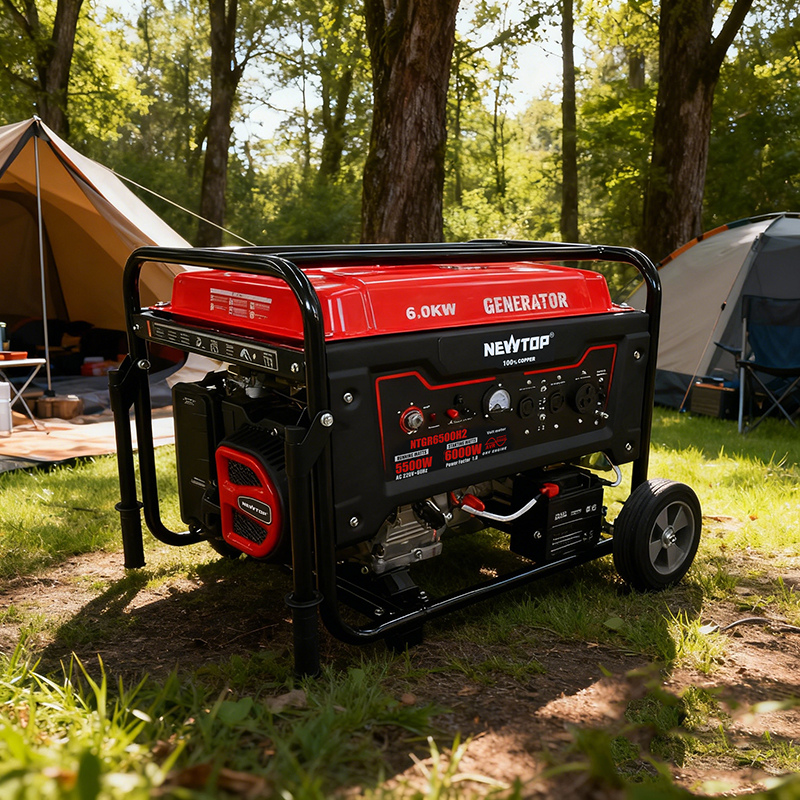
The model also uses a forged crankshaft and camshaft, a full steel frame, and vibration-absorbing mounts for extended outdoor, workshop, 工事, and backup operation.
These figures are more useful than a vague “long runtime” claim because they allow buyers to examine the relationship among tank capacity, rated output, そして燃費.
They still do not justify one fixed runtime prediction.
Actual consumption changes with load, and the published fuel-consumption value must be interpreted using the manufacturer’s test method. Buyers who need a precise operating-hour estimate should request consumption data at several load levels, のような 25%, 50%, 75%, and rated load.
NEWTOP’s gasoline generator range also includes compact 2.8 kW models, mid-range 5.5 kWと 7.8 kW units, and higher-output 10 kW configurations. This range illustrates why runtime cannot be separated from generator size: エンジン排気量, output demand, タンク容量, and intended workload change from one power class to another.
Runtime Information to Request from the Supplier
Instead of asking only, “How many hours will it run?」, buyers should request the test information behind the number.
| Information Required | なぜそれが重要なのか |
|---|---|
| Rated Output on Gasoline | Shows the usable continuous output for the gasoline calculation. |
| Rated Output on Propane | May differ from gasoline output on a dual-fuel generator. |
| Gasoline Tank Capacity | Identifies the fuel quantity behind the gasoline runtime. |
| Propane Cylinder Size and Usable Fuel Amount | Identifies the actual propane supply used in the test. |
| Runtime Test Load | Allows a fair comparison between published runtime figures. |
| Fuel Consumption at Several Loads | Supports more accurate calculations for different applications. |
| Economy-Mode Status | May affect fuel consumption when the generator operates under partial load. |
| Ambient Test Temperature | Provides important context for propane vaporization performance. |
| Starting Loads Used During Testing | Shows whether motor-driven equipment and surge demand were represented. |
| Required Regulator and Connection | Confirms that the propane supply can meet the engine’s fuel demand. |
| Recommended Fuel Reserve | Helps prevent an unexpected shutdown before refueling or cylinder replacement. |
| Refueling or Cylinder-Change Procedure | Reveals whether continuous work will be interrupted. |
A supplier that provides the test basis makes it easier for distributors and end users to set realistic expectations. A single hour figure without fuel quantity and load percentage offers far less value.
Safety Comes Before Additional Runtime
Both gasoline and propane generators produce carbon monoxide. Portable units must operate outdoors and away from occupied buildings, with exhaust directed away from doors, windows, and vents. The U.S. Consumer Product Safety Commission advises placing portable generators at least 20 feet from the home whenever possible.
Gasoline should not be added while the generator is running or hot. Propane cylinders, regulators, ホース, and connectors must match the equipment instructions and applicable gas-safety requirements.
A longer hose, improvised fuel connection, indoor placement, or unsafe hot refueling is never an acceptable way to gain more operating time.
What Buyers Should Really Compare
Gasoline contains more energy per gallon than propane, so an equal-volume comparison generally favors gasoline. Real generator installations rarely use equal fuel volumes, しかし. A propane generator connected to a larger external supply may run longer than a gasoline model limited to its onboard tank.
A reliable propane vs gasoline generator run time comparison should place both fuels under the same conditions:
- Comparable electrical load
- Clearly stated rated output
- Known usable fuel quantity
- Matching runtime test conditions
- Suitable tank or cylinder capacity
- Realistic temperature and operating pattern
- Safe refueling or cylinder replacement plan
The most useful runtime figure is not the largest number in a catalog. It is the number of hours the generator can support the required equipment before the available fuel supply must be safely replenished.