In modern agriculture, precision spraying is no longer optional—it directly impacts crop yield, chemical efficiency, labor cost, and environmental safety. Whether you are managing a small vegetable field in Southeast Asia, a coffee plantation in Latin America, or a large-scale grain farm in Africa, selecting the right knapsack sprayer type can significantly improve operational efficiency.
In this comprehensive guide, we’ll explore the different types of knapsack sprayers, compare their working mechanisms, analyze real farming applications, and help you choose the best model for your specific needs. If you are an importer, distributor, or OEM partner looking for reliable agricultural spraying equipment, this article will also show how working with NOUVEAUTOP can strengthen your product line.
What Is a Knapsack Sprayer and How Does It Work?
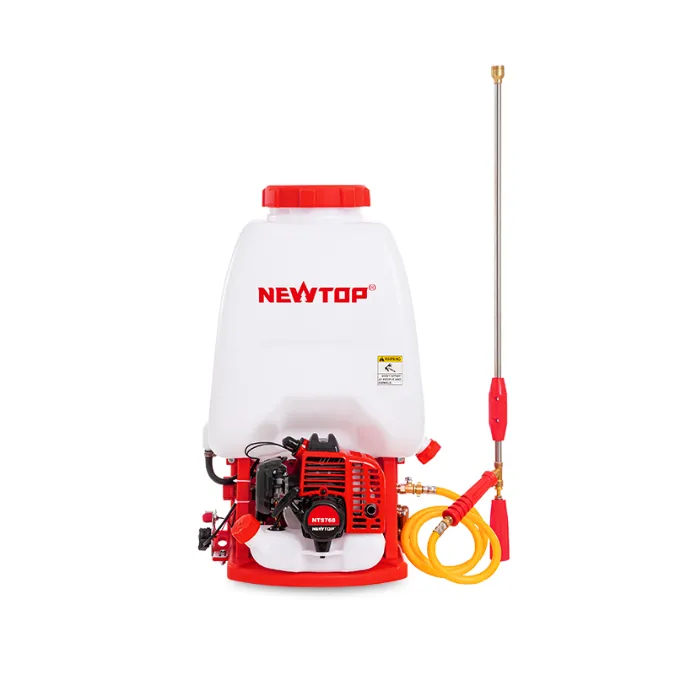
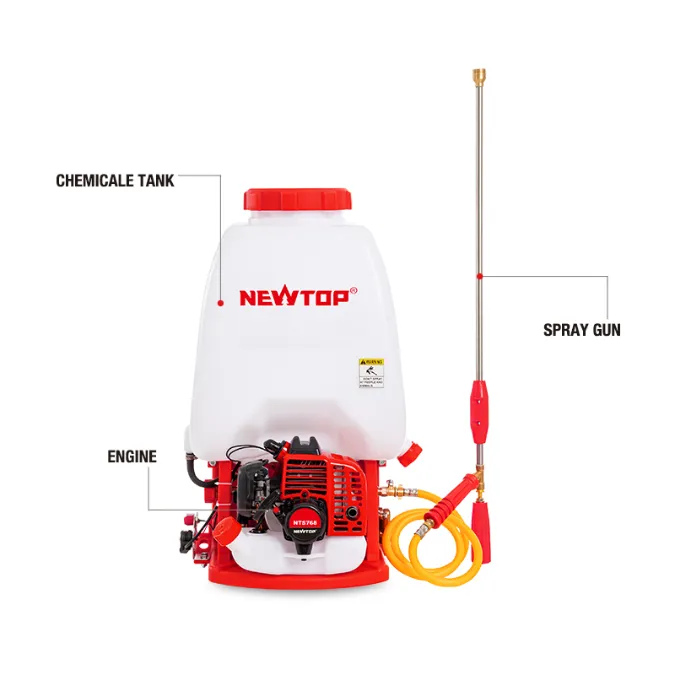
A knapsack sprayer is a portable, back-mounted agricultural machine that uses manual or powered pressure to apply liquids like pesticides and fertilizers with precision in agricultural and landscaping settings.
A knapsack sprayer (also called a backpack sprayer) is a piece of portable equipment worn on an operator’s back to apply liquids, such as pesticides, herbicides, and fertilizers. It is widely used for applying pesticides, herbicides, fungicides, engrais, and disinfectants.
Core Components and Their Functions
Every knapsack sprayer operates using a set of essential components that store, pressurize, and dispense the liquid. Understanding these parts clarifies how the sprayer functions.
- Tank: A container, typically holding 15 à 20 liters, that stores the chemical mixture.
- Pump and Lever: The mechanism used to create pressure. In manual models, an operator pumps a lever to pressurize the tank.
- Hose and Lance: A flexible hose connects the tank to a rigid wand, or lance, which allows the operator to direct the spray.
- Nozzle: The tip of the lance that atomizes the liquid into a fine mist or a targeted stream for even application. It determines the droplet size and spray pattern, such as fan, cone, or jet streams.
The Basic Working Principle
A knapsack sprayer’s function is based on generating and maintaining pressure to expel liquid in a controlled manner. The process is straightforward, whether the sprayer is manual or motorized.
- The operator fills the tank with the desired liquid solution.
- Using a hand lever or a powered motor, the operator builds pressure inside the tank.
- When the trigger on the lance is squeezed, a valve opens, releasing the pressurized liquid.
- The liquid flows through the hose and lance, exiting the nozzle as a spray.
- Consistent pressure is maintained through periodic pumping or a continuous power source to ensure an even application.
Depending on the model, pressure may be generated manually (lever pumping), electrically (battery-powered motor), or through a petrol engine. Advanced designs include pressure regulators, anti-drip nozzles, adjustable spray patterns, and ergonomic harness systems.
A well-designed knapsack sprayer ensures:
- Uniform droplet size distribution
- Stable spray pressure
- Reduced operator fatigue
- Minimal chemical waste
- Safe handling of agrochemicals
A Quick Comprison of Different Types of Knapsack Sprayers
Before diving deeper, it’s helpful to understand how different types compare in practical farming conditions.
| Knapsack Sprayer Type | Pouvoir / Mechanism | Poids / Reach | Pressure Stability | Best Application | Maint. / Coût |
|---|---|---|---|---|---|
| BY POWER SOURCE | |||||
| Manuel | Human Labor (Levier) | 5–10kg / Short | Low (Fluctuates) | Small farms, spot weeding | Low / $ |
| Batterie | Electric Motor | 6–8kg / Medium | Haut (Constant) | Greenhouses, row crops | Med / $$ |
| Essence | Gasoline Engine | 14–17kg / Long | Very High | Orchards, large plantations | Haut / $$$ |
| BY PUMP MECHANISM | |||||
| Piston | Cylindrical Piston | Varies / High PSI | Stable (Haut) | Fine misting, clear liquids | Med / $$ |
| Diaphragme | Flexible Membrane | Varies / Low PSI | Stable (Low) | Wettable powders, bleach | Low / $$ |
| Plunger | Solid Plunger | Varies / High Flow | Medium | Cotton, vegetables, general use | Low / $ |
| BY SPRAY MECHANISM | |||||
| Mist Blower | Air-Propelled Fan | Heavy / Max Reach | Constant | Tall trees, dense foliage | Haut / $$$ |
| Compression | Stored Air Pressure | Lumière / Short | Decreasing | Spot treatment, small gardens | Low / $ |
| Hydraulic | Direct Fluid Pump | Med / Consistent | Very Stable | Uniform field coverage | Med / $$ |
Types of Knapsack Sprayers by Power Source
The power source is the primary factor in determining operator fatigue and work speed. Chez NEWTOP, we analyze global market trends and have found that while traditional manual units remain a staple in emerging markets, the industry is rapidly pivoting toward battery and petrol solutions for increased labor efficiency.
Manual Knapsack Sprayers
Manual knapsack sprayers operate with a hand pump, giving the user direct control over pressure. They don’t need electricity or fuel, making them a reliable and low-cost choice for small to medium-sized farms. Their lightweight design, typically weighing between 5 et 10 kilos, makes them ideal for targeted applications where precision is needed to reduce chemical waste. The main drawback is the need for constant physical effort, which leads to operator fatigue during extended use. Maintaining consistent pressure manually over large fields is difficult, limiting their effectiveness for large-scale commercial operations.
Battery Powered Knapsack Sprayers
Battery-powered knapsack sprayers use a rechargeable battery to power an electric motor, providing continuous and consistent spray pressure without manual pumping. This design is well-suited for professional landscaping and commercial farming because it significantly reduces user fatigue. The steady, adjustable pressure ensures even coverage for herbicides and pesticides. A single charge typically lasts between 4 à 8 heures, allowing for a full day of work and making large jobs more manageable. The initial cost is higher than manual models, and operation is entirely dependent on having a charged battery.
Petrol Powered Knapsack Sprayers
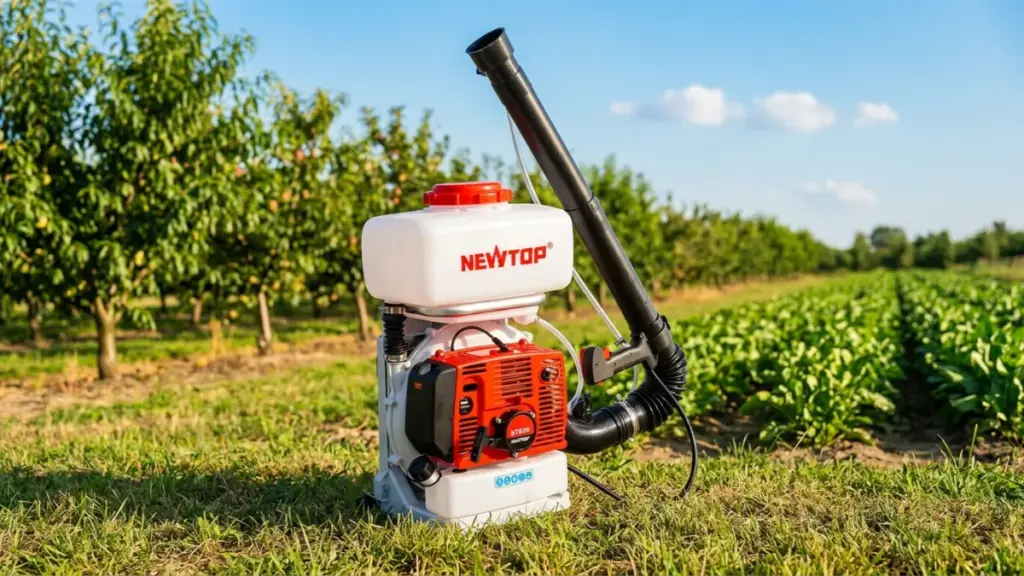
Petrol-powered knapsack sprayers are equipped with a small 2-stroke or 4-stroke gasoline engine to generate high pressure for spraying over large areas. They offer the most power and are built for demanding agricultural tasks like treating orchards or large fields. Petrol sprayers, often configured as mist blowers, can discharge liquid up to 10 ou 15 meters horizontally or vertically providing the necessary coverage for high-canopy orchards and wide agricultural fields. They operate independently of any electrical source, but they are also heavier and louder, with a fully loaded weight of 14–17 kg. They require regular engine maintenance, including managing fuel-oil mixtures for 2-stroke versions.
Boost Your Margins with Durable Outdoor Power Equipment

Types of Knapsack Sprayers by Pump Mechanism
The choice between a piston, diaphragm, or plunger pump mechanism directly dictates the sprayer’s chemical compatibility and pressure capabilities, with piston pumps excelling at high-pressure atomization and diaphragm pumps offering superior durability for abrasive formulations.
Piston Knapsack Sprayer
A piston backpack sprayer uses a cylindrical piston moving inside a chamber to generate pressure. This design is highly efficient for reaching high pressures, making it a strong choice for applications that need a fine mist or long-distance spray. Operators typically use them for applying liquid herbicides and pesticides that don’t contain abrasive particles, which could damage the internal seals.
- Reaches higher pressures, often up to 150 PSI, for atomizing liquids effectively.
- Best suited for liquid-only formulations, as abrasive powders can wear down the piston seals.
- Generally requires more maintenance on seals and O-rings compared to diaphragm pumps.
- Ideal for targeted pest control and applying insecticides where fine droplet size is beneficial.
Diaphragm Knapsack Sprayer
A diaphragm backpack sprayer uses a flexible membrane that pulsates to create pressure. This mechanism keeps the chemical solution separate from the pump’s moving parts. This separation makes the pump exceptionally durable when using abrasive materials like wettable powders or even bleach-based solutions.
- Highly resistant to corrosion and abrasion from aggressive or powder-based chemicals.
- Operates at a lower pressure, typically around 60 PSI, which produces larger droplets and reduces spray drift.
- Requires less maintenance because the diaphragm shields the pump’s critical components.
- The preferred choice for applying wettable powders, engrais, and herbicides where drift control is important.
Plunger Sprayer
The plunger backpack sprayer is a specific type of piston pump where a solid plunger displaces fluid to build pressure. It is known for its simple, robust design and its ability to generate high pressure with minimal operator effort. This makes it a reliable and economical choice for general-purpose agricultural spraying.
- Combines the high-pressure capabilities of a piston pump with a durable and simple design.
- Achieves a high work rate, making it efficient for treating medium-to-large areas.
- The mechanism is straightforward to maintain and repair in the field.
- Suitable for a wide range of crop applications, including vegetables, cotton, and groundnuts.
Types of Knapsack Sprayers by Spray Mechanism

The choice of spray mechanism—air-propelled mist, stored air pressure, or direct hydraulic force—directly dictates the sprayer’s application speed, coverage area, and operational consistency.
Motorized Mist Blowers
Motorized mist blowers are engine-driven sprayers that use a high-velocity air stream to atomize and propel liquid over long distances. This design is ideal for treating large areas, dense foliage, or tall trees quickly, making it a common choice for commercial agriculture, sylviculture, and public health pest control.
- Combines a liquid spray with a powerful fan to create a fine mist that can cover a horizontal range of 15 à 40 feet.
- Significantly reduces application time compared to manual or low-pressure sprayers, often completing jobs two to three times faster.
- The engine provides consistent power, which eliminates operator fatigue from manual pumping and ensures uniform coverage.
- Well-suited for applying pesticides and fungicides in orchards, vineyards, and large crop fields.
Compression Sprayer
A compression sprayer operates by manually pumping air into a sealed tank to build pressure. This stored pressure then forces the liquid out through a nozzle when the trigger is engaged. They are simple, low-cost, and widely used for spot treatments and smaller-scale applications in gardening and farming.
- Requires the user to pressurize the tank before spraying; the pressure gradually decreases as the liquid is used.
- Offers precise control for targeted applications of herbicides, insecticides, or fertilizers.
- Léger, portable, and easy to maintain due to its simple mechanical design with few moving parts.
- Operation is quiet and emission-free, but it can be labor-intensive for large areas.
Hydraulic Sprayer
Hydraulic sprayers use a pump to generate liquid pressure directly, forcing the solution through nozzles to form a spray. Unlike compression sprayers, they provide continuous and consistent pressure as long as the pump is active. This category includes everything from manual lever-operated pumps to engine-powered systems.
- Delivers a steady flow and pressure, resulting in more uniform droplet size and application.
- The operator uses a lever or a motor to activate the pump, which creates immediate hydraulic force.
- Commonly used in agriculture for applying chemicals that require consistent coverage.
- Models range from simple manual backpack units to larger, more complex systems for extensive fieldwork.
Common Applications of Knapsack Sprayers in Farming

Backpack sprayers are the primary agricultural machines for targeted, on-the-ground application of pesticides, herbicides, and liquid fertilizers, giving farmers precise control over crop health and management.
Pest and Disease Control
Knapsack sprayers are fundamental for applying insecticides and fungicides directly onto crops. This targeted approach helps protect plants from damaging insects and fungal diseases that can reduce yield and quality. The direct application minimizes waste and ensures the active ingredients reach the specific areas that need treatment.
- Delivers precise treatment to affected leaves, stems, and fruits in orchards and vegetable plots.
- Effective for managing localized infestations before they spread across an entire field.
- Allows farmers to use both chemical and organic solutions to combat common agricultural pests.
Weed Management
Applying herbicides with a knapsack sprayer is an efficient way to manage unwanted weeds that compete with crops for water, sunlight, and nutrients. It allows for controlled application in specific areas, preventing damage to the main crop while effectively eliminating invasive plants.
- Ideal for spot-treating weeds along fence lines, between crop rows, and in garden beds.
- Supports the use of selective herbicides that target weeds without harming the primary crop.
- Ensures uniform coverage for pre-emergent and post-emergent weed control strategies.
Fertilizer and Nutrient Application
These sprayers are commonly used for foliar feeding, where liquid fertilizers and micronutrients are applied directly to the leaves. This method provides a rapid nutritional boost to crops during critical growth stages, bypassing slower soil absorption for immediate effect.
- Facilitates quick absorption of nutrients to correct deficiencies faster than soil application.
- Ensures an even distribution of liquid plant food to promote consistent growth.
- Useful for applying growth regulators and supplements that improve overall plant health and productivity.
Key Factors to Consider When Choosing a Knapsack Sprayer for Your Farm
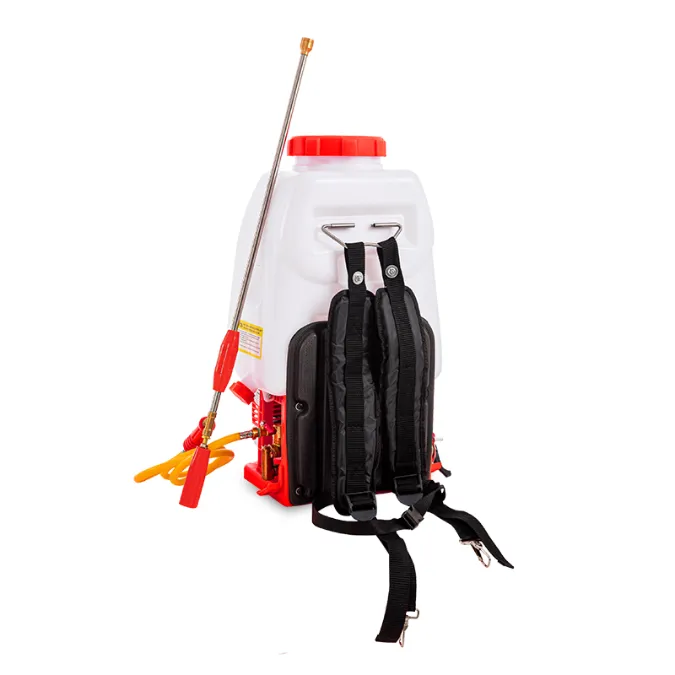
Choosing the right knapsack sprayer requires a practical assessment of your farm’s scale, the chemicals you use, the precision needed for your crops, and the physical demands on the operator.
| Factor | Key Consideration | Impact on Efficiency |
|---|---|---|
| Compatibilité chimique | Ensure the use of Viton™ seals and diaphragm pumps for petroleum-based solvents or abrasive powders. | Prevents seal swelling and pump failure, reducing maintenance costs and downtime. |
| Capacité du réservoir | Match tank size (10–20L+) to farm scale while considering manageable operator weight. | Reduces refill time on large plots but increases fatigue if too heavy for the task. |
| Material Durability | Select UV-resistant high-density polyethylene (HDPE) tanks to withstand harsh environmental exposure. | Prevents tank cracking and liquid leaks, extending the overall service life of the equipment. |
| Nozzle Configuration | Ensure the sprayer supports interchangeable nozzles (fan, cone, stream) for varied agricultural tasks. | Improves application precision, réduit les déchets chimiques, and increases treatment effectiveness. |
| Ergonomics | Look for padded shoulder straps, contoured back support, and balanced weight distribution. | Minimizes operator fatigue, enabling longer and more productive work periods in the field. |
Compatibilité chimique
Review the active ingredients of the chemicals you intend to use. If you use petroleum-based solvents or abrasive powders, ensure the sprayer is equipped with Viton seals and a diaphragm pump. Standard rubber seals will swell and fail when exposed to harsh solvents.
Tank Capacity and Farm Size
Matching the sprayer’s tank size to your operational scale is fundamental for efficiency. A larger tank minimizes refill breaks for extensive fields, but a smaller, more portable model is often better for targeted applications or smaller plots. The goal is to balance coverage with a weight that an operator can comfortably manage for a full workday.
- For small-scale or organic farming, a 10–15 liter tank provides a good balance of portability and capacity.
- Larger agricultural operations benefit from 20-liter or larger tanks to maximize coverage area per fill.
- Always consider the total weight when full, ensuring it is manageable for the operator over extended periods.
Material Durability and Chemical Compatibility
The construction materials of a sprayer dictate its longevity and safety. It’s important to select a model with a tank and seals that can withstand the corrosive effects of various agricultural chemicals. Poor material choices lead to cracks, leaks, and premature equipment failure, posing risks to both the operator and the environment.
- Look for tanks made from high-density polyethylene or other UV-resistant plastics that prevent cracking and degradation.
- Seals and gaskets made from chemical-resistant materials are necessary to prevent leaks when using aggressive fertilizers or pesticides.
- A robust frame and durable straps are also important for operator safety and equipment stability during use.
Nozzle Configuration and Application Precision
The nozzle is a critical component that controls the spray pattern, taille des gouttelettes, and flow rate. A sprayer with interchangeable or adjustable nozzles offers the flexibility needed for different crops and treatments. The right nozzle ensures that chemicals are applied effectively where needed, minimizing waste and preventing damage to non-target plants.
- Adjustable nozzles allow you to switch from a fine mist for insecticides to a direct stream for spot-treating weeds.
- Different nozzle types, such as fan, cone, or flood patterns, provide tailored coverage for broadacre, row crop, or specific plant applications.
- Precision application not only improves effectiveness but also reduces chemical waste and environmental impact.
Ergonomics and Operator Comfort
A 20L tank weighs approximately 20kg. Ergonomic features help distribute weight evenly and make the equipment easier to handle. A comfortable operator can work longer and more accurately, which directly translates to better results in the field.
- Look for contoured backrests with integrated ventilation, wide padded shoulder straps, and waist belts that shift the weight from the shoulders to the hips.
- A lightweight design is easier to carry and maneuver, especially across uneven terrain.
- An easy-to-reach and smooth-action pump handle helps maintain consistent pressure without causing excessive fatigue.
Maintenance Tips to Extend the Life of Your Knapsack Sprayer

Shifting from reactive repairs to a disciplined, preventative maintenance schedule built on post-use cleaning and regular component checks is the most direct way to maximize the operational lifespan of your equipment.
Implement a Post-Use Cleaning Routine
A consistent cleaning protocol after each use is the single most effective way to prevent chemical buildup and pump failure. This practice is non-negotiable for stopping corrosive residues from degrading seals, nozzles, and internal components. Overlooking this step is the fastest way to shorten your sprayer’s service life, leading to clogs and leaks.
- Thoroughly rinse the tank, hose, and nozzle with clean water immediately after finishing your work.
- When switching between different chemical types, perform a more intensive rinse to neutralize residues and prevent cross-contamination.
- Ensure the exterior of the sprayer is wiped down to remove any chemical spills that could damage the harness or plastic housing.
Regularly Inspect and Lubricate Seals and Moving Parts
Seals, gaskets, and pump mechanisms are the most common failure points because they are under constant chemical and mechanical stress. Routine inspection and proper lubrication maintain their integrity, preventing leaks and ensuring consistent pressure when you need it most. This proactive check catches wear before it leads to a failure in the field.
- On a quarterly basis, check all O-rings and seals for signs of cracking, brittleness, or wear and replace them if needed.
- Apply a manufacturer-recommended silicone lubricant to pump seals and other moving components to keep them pliable and protected. Avoid petroleum jelly as it can degrade specific types of synthetic rubber.
- Check that all clamps, fittings, and connections are tight to avoid leaks during operation.
Follow a Systematic Maintenance Schedule
Moving from reactive repairs to preventative maintenance extends the sprayer’s operational lifespan significantly, with professional operators achieving 4-5 years of daily use. A structured schedule removes guesswork and builds accountability, ensuring that critical tasks like filter cleaning or lubrication are not overlooked during busy periods.
- Create a simple checklist for daily tasks (rinsing), weekly checks (filter cleaning), and quarterly actions (lubrication).
- Consider an assigned-equipment system where each operator is responsible for the maintenance of a specific sprayer to improve accountability.
- Store the sprayer in a clean, dry place away from direct sunlight to prevent UV degradation of plastic and rubber parts.
Customizing Your Brand with NEWTOP’s Diverse Sprayer Types
NEWTOP provides comprehensive OEM and private labeling, enabling international distributors to tailor everything from sprayer color and branding to core technical specifications and packaging for specific regional markets.
As a professional agricultural machinery manufacturer since 2003, NOUVEAUTOP provides a comprehensive range of manual, alimenté par batterie, and petrol knapsack sprayers.
With advanced CNC machining centers, lignes de production automatisées, and strict quality control systems, NEWTOP ensures:
- Stable product performance
- Durable chemical-resistant materials
- CE and international compliance
- Flexible OEM/ODM customization
- Private label branding support
- Approvisionnement fiable en pièces de rechange
Pour les distributeurs en Afrique, South America, Asie du Sud-Est, and emerging markets, NEWTOP offers competitive pricing combined with consistent quality.
From tank color customization to packaging design and specification adjustments, NEWTOP helps partners build strong local brands with dependable agricultural spraying solutions.
If you are looking to expand your agricultural equipment portfolio, partnering with NEWTOP means accessing a proven manufacturing system with global distribution experience.
Conclusion
Choosing the right knapsack sprayer means matching its power source, pompe, and spray mechanism to your specific farming needs. A well-chosen sprayer helps you apply treatments with precision, protecting crop health while managing your operational costs. This alignment ensures you get the most out of your equipment, no matter the scale of your work.
Are you ready to optimize your agricultural output? Explore the NEWTOP Knapsack Sprayer Collection or reach out to our technical team at [email protected] for a professional consultation and OEM catalog.
Foire aux questions
What are the four types of sprayers?
The four common types are manual knapsack sprayers, battery-powered sprayers, petrol mist blowers, and compression sprayers, each suited for different farm sizes and applications.
Which type of sprayer is best for weed control?
A knapsack sprayer equipped with a flat fan nozzle is best for weed control. This setup provides a uniform spray pattern, ensuring even coverage of herbicides without damaging nearby plants.
Are battery powered sprayers reliable for heavy work?
Oui. High-quality battery-powered backpack sprayers with durable motors and lithium batteries can operate for several hours and are suitable for medium to large farms.
What is the difference between a piston and diaphragm pump?
A piston pump is best for high-pressure applications with clear, non-abrasive liquids. A diaphragm pump is the standard for harsh chemicals and abrasive powders because the pump components are protected from the solution.
Which knapsack sprayer is best for paddy farming?
Battery-powered or diaphragm-type hydraulic knapsack sprayers are ideal for paddy fields due to consistent pressure and resistance to corrosive chemicals.
How do I choose between manual and electric sprayers?
Choose manual knapsack sprayers for small farms and low budgets. Choose electric knapsack sprayers for larger areas, higher efficiency, and reduced labor fatigue.