Saltar al contenido



A chainsaw dealer who waits until spare parts inventory starts running low before placing an order may already be too late for the peak season. When forestry, agrícola, and property maintenance activities concentrate within certain months, demand for replacement chains, barras guía, and other components can rise quickly. Add production lead times and international shipping to the equation, and replenishment needs to start well before the busy season begins.
This guide provides a practical approach to seasonal purchasing. It covers how workloads shift spare parts demand across regions, which components deserve higher stock levels before peak season, and how to forecast requirements using historical sales data. You’ll also learn how to set reorder points and safety stock, and schedule wholesale orders around production and shipping timelines.
What to take from this guide
- Demand for chainsaw spare parts follows the work calendar. The buying calendar has to start at least two months ahead of the season it serves.
- Cadenas, bars, files, bujías, filtros, sprockets and starter parts carry a large share of peak volume.
- A forecast built on last season’s sell-through and repair records beats a guess from the shelf.
- Minimum stock is the reorder point, and safety stock is the buffer above it for a fast month or a late sailing.
- Confirm fit details and quantities before the container is booked.
Why Should Chainsaw Dealers Plan Spare Parts Purchases Seasonally?
Chainsaw spare parts demand is closely connected to equipment usage. When forestry, explotación florestal, agricultural maintenance, or landscaping activities become more intensive, chainsaws generally require more frequent maintenance and replacement components.
Para distribuidores, seasonal purchasing offers several practical advantages:
- Reduce stock shortages: Prepare fast-moving replacement parts before customers enter their busiest working periods.
- Control inventory costs: Avoid excessive purchases of components that may have limited demand during certain months.
- Improve customer service: Keep commonly requested spare parts available when customers need repairs or routine maintenance.
- Optimize purchasing schedules: Consolidate wholesale orders and arrange transportation ahead of expected demand.
Seasonal planning also helps distributors communicate more effectively with suppliers. Instead of placing urgent orders after inventory runs low, they can establish purchasing schedules based on sales trends, customer requirements, and expected lead times.
How Do Seasonal Workloads Affect Chainsaw Spare Parts Demand?
The same chainsaw may see seasonal use in one market and year-round operation in another. These differences affect both replacement frequency and the types of parts dealers need to stock. The following patterns provide a starting point for planning, but should be checked against local sales and repair records.
Seasonal Demand in Forestry and Logging
Professional logging crews often work around defined harvesting seasons. Higher cutting hours increase demand for saw chains, barras guía, files, and sprockets. Dealers serving these customers should build inventory before peak operations begin, especially for fast-moving parts used across multiple saws.
Demand from Agriculture and Property Maintenance
Orchard pruning, fence-line clearing, and storm cleanup can create demand peaks in spring and autumn. Municipal and utility crews may follow scheduled maintenance programs, making their purchasing needs more predictable. Stocking matched bar and chain combinations in commonly used lengths helps avoid incomplete orders.
Regional Differences Between Northern and Southern Markets
Northern temperate markets often see stronger activity from spring to autumn, while Southern Hemisphere markets follow an opposite seasonal cycle. Tropical markets may experience separate dry and wet season demand patterns. Distributors should build regional purchasing calendars around actual customer workloads rather than apply one seasonal forecast to every market.
| Market Pattern | Typical Work Period | Parts to Prioritize | Stocking Strategy |
|---|---|---|---|
| Northern Temperate Forestry | Spring to autumn | Cadenas, files, piñones | Build inventory before peak season |
| Southern Hemisphere Forestry | Varies by region; often spring to autumn | Cadenas, files, bujías | Align orders with local harvesting schedules |
| Tropical Dry Season | Dry months | Cadenas, filtros de aire | Monitor filter replacement demand in dusty conditions |
| Tropical Wet Season | Wet months | Filtros, fuel-system parts | Adjust stock based on maintenance records |
| Orchards and Property Care | Spring and autumn | Bar and chain sets, files | Prepare for two potential demand peaks |
Nota: These are general planning patterns, not measured market statistics. Actual demand varies by country, clima, industry, and equipment usage.
Which Chainsaw Spare Parts Should Dealers Stock Before Peak Season?
Before peak season, dealers should prioritize components according to replacement frequency, equipment compatibility, customer demand, and inventory turnover.
Fast-Moving Replacement Parts
Before peak season, dealers should prioritize replacement parts according to equipment compatibility, frecuencia de reemplazo, and local customer demand. Three important categories deserve particular attention:
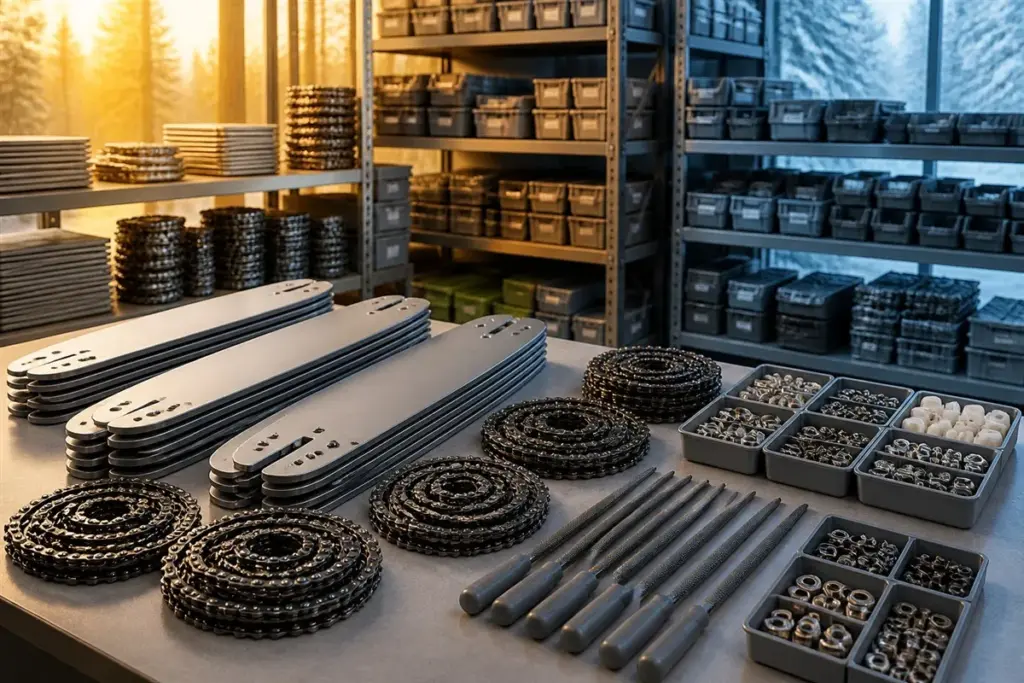
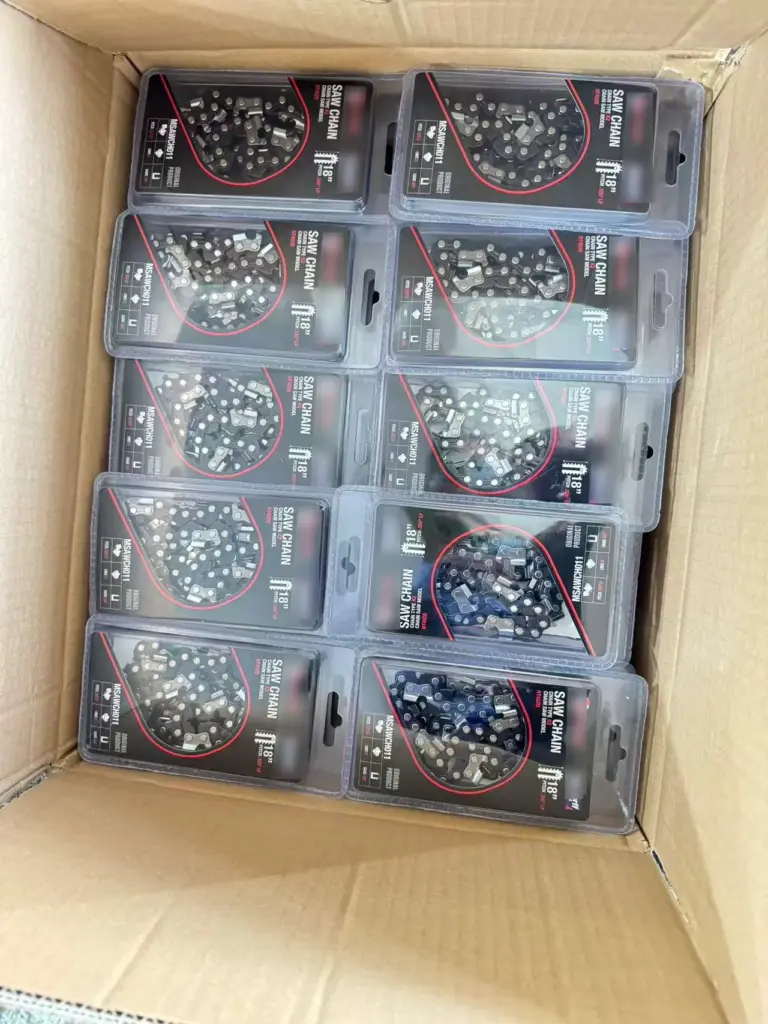
- cadenas de sierra: Dealers should stock different pitches, medidores, drive link counts, and cutter configurations to match the chainsaws used in their markets. NEWTOP offers multiple chain specifications, including 3/8″ and .325″ pitches and .043″, .050″, .058″, y .063″ medidores. Its OEM chain options also include different cutter configurations for general cutting and professional forestry applications.
- Barras guía: Stocking suitable bar lengths and mounting specifications is essential. NEWTOP offers laminated, milled guide bars with replaceable tips, and solid-tip designs. Por ejemplo, its chainsaw range includes models such as the NT3200 (14–16″), NT5800 and NT6200 (16–24″), and NT9200 (20–42″). Dealers can use these compatibility ranges as a reference when planning guide bar inventory.
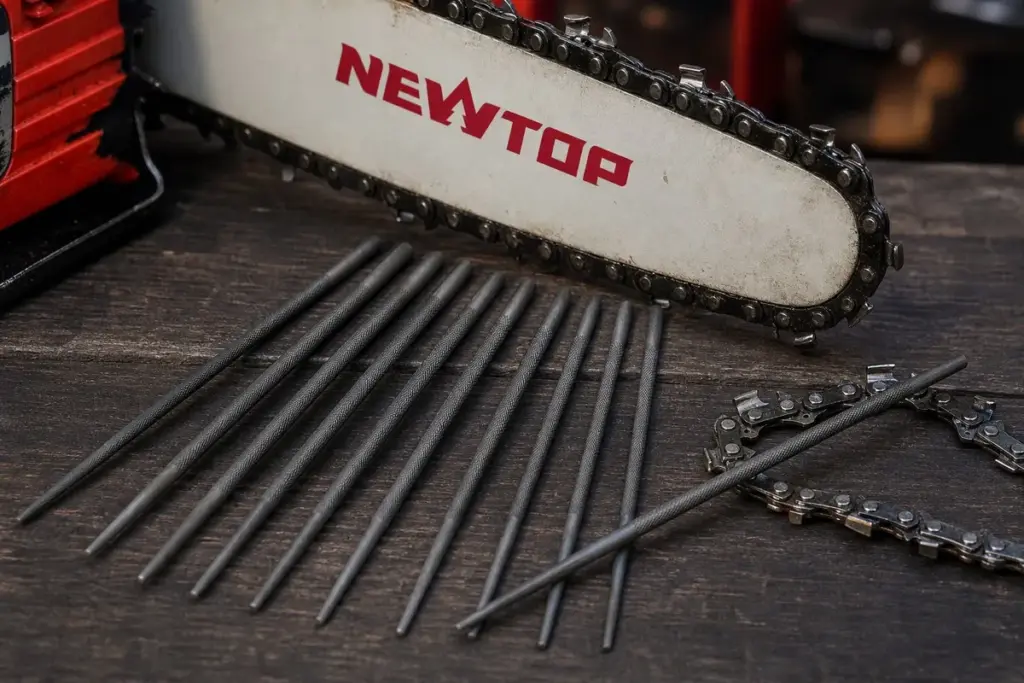
- Chainsaw files: Files are essential for routine chain sharpening. NEWTOP offers high-carbon steel files with quenched and tempered construction and double-cut spiral teeth, supporting regular maintenance and professional sharpening work.

How to Forecast Spare Parts Demand Using Historical Sales Data
A practical seasonal purchasing plan should be supported by sales records. Historical data provides a starting point for estimating future demand and identifying products that require closer inventory monitoring.
Analyzing Previous Sales and Replacement Frequency
Start with twelve to twenty-four months of invoices and separate complete machines from spare parts. Then group sales by part family and by month, and a pattern appears. A line that sells in the same weeks each year is seasonal, and a line that sells evenly is a service line. Both belong on the shelf, and they need different stock rules.
Use the months the line was actually on sale for the average, not all twelve. A line that sells 240 a month for four months and nothing for eight has a 12-month average of 80, which understates the peak by three times. Exclude or flag months when the line was out of stock, because a zero from an empty shelf is not zero demand.
Replacement frequency sets the depth. A workshop that records how many chains a crew uses before a bar is replaced has a ratio it can plan on. That ratio is local, and it is more useful than a figure borrowed from another market.
Using Customer Orders and Repair Records
Repair records show what actually failed, and a failure that repeats is a stock signal. Job cards for the same starter assembly across one model point to a batch problem or a hard-working fleet. Either way, the dealer should carry the part before the next failure arrives.
Customer orders carry the same information in a different form. A dealer who receives the same urgent request twice in one season should add that line to the standard list. Small late orders usually signal weak planning upstream, not low demand.
Nuestro Mexico spare parts case shows how a distributor tested fit and logistics with a trial order before committing to a container. The case is a useful comparison for a dealer opening a new territory.

How to Set Minimum and Safety Stock Levels for Chainsaw Parts
After estimating seasonal demand, dealers need to determine how much inventory to maintain.
Two useful inventory management concepts are minimum stock levels and safety stock.
Minimum stock level represents the inventory threshold at which a replenishment order should be considered. Safety stock is additional inventory maintained to reduce the risk of shortages caused by unexpected demand or supply delays.
A basic reorder point formula is:
Reorder Point = Average Daily Demand × Lead Time + Safety Stock
Por ejemplo, if a dealer sells an average of 10 chains per day, and the replenishment lead time is 30 días, expected demand during lead time is 300 cadenas.
If the dealer maintains 60 additional chains as safety stock, the reorder point becomes:
300 + 60 = 360 cadenas.
When available inventory approaches 360 cadenas, the dealer should consider placing a replenishment order.
The example is for inventory planning purposes only. Actual safety stock should reflect demand fluctuations, supplier reliability, transportation conditions, and the importance of each product.
Dealers can also classify inventory according to turnover:
- High-priority items: Fast-moving chains, barras guía, and frequently requested maintenance parts. These generally require closer monitoring.
- Medium-priority items: Components with regular but less frequent demand.
- Low-priority items: Model-specific or slow-moving parts that may be purchased in smaller quantities or when customer orders are confirmed.
The following example shows how dealers can calculate reorder points and target inventory levels for different chainsaw spare parts. It assumes a one-month supplier lead time, monthly inventory reviews, and safety stock equal to one month of average in-season demand. The figures are illustrative, but the same method can be adapted to actual sales records and replenishment schedules.
| Part Family | Monthly Demand | Plazo de entrega (Months) | Review Period (Months) | Reorder Point | Safety Stock | Order-up-to Level | Posición de inventario | Planned Order |
|---|---|---|---|---|---|---|---|---|
| 18-inch saw chain, boxed | 240 | 1 | 1 | 480 | 240 | 720 | 150 | 570 |
| 20-inch guide bar, packaged | 90 | 1 | 1 | 180 | 90 | 270 | 60 | 210 |
| Round sharpening file, carded | 300 | 1 | 1 | 600 | 300 | 900 | 220 | 680 |
| Bujía, small engine | 120 | 1 | 1 | 240 | 120 | 360 | 40 | 320 |
| Starter assembly, complete | 25 | 1 | 1 | 50 | 25 | 75 | 6 | 69 |
| Bar nose sprocket kit | 30 | 1 | 1 | 60 | 30 | 90 | 8 | 82 |
Nota: Illustrative calculations based on assumed in-season monthly demand. The example uses a one-month lead time, a one-month review period, and safety stock equal to one month of average demand. Reorder Point = Monthly Demand × Lead Time + Safety Stock. Order-up-to Level = Monthly Demand × (Plazo de entrega + Review Period) + Safety Stock. Planned Order = Order-up-to Level − Inventory Position. Inventory Position includes stock on hand and on-order inventory, minus outstanding commitments. The example assumes no additional stock is on order and no backorders. Actual lead times should include production, international shipping, and customs clearance. These figures are illustrative and do not represent NEWTOP sales data or market averages.
How to Plan Wholesale Orders Around Lead Times and Shipping Schedules
Lead time is the part of the plan that effort cannot compress. A confirmed order moves at the speed of production and shipping, and every week lost at the desk becomes a week of shortage at the counter.
Production Lead Times and Order Confirmation
Envío de muestras 7-10 días después del pago, and a container takes about 30 días. Both clocks start once the order is clear. Confirmation should lock part numbers, quantities and packaging, because a change after production starts moves the delivery date.
The confirmation is also the moment to check fit details. Bar length, mount pattern, paso, gauge and drive-link count should appear on the order line. A wrong gauge found at the counter is a return, and one found at the factory is a delay.
International Shipping and Customs Clearance
Shipping schedules tighten before a peak, and space books out. A dealer who confirms early can choose a sailing, and a dealer who confirms late takes what is left. Clearance adds days that depend on the port, the paperwork and the season.
Packaging and labels should match the documents. A carton that lists a different part number from the invoice slows clearance and confuses the warehouse. Part numbers on the outer carton also speed the receiving check in peak weeks.
| Order stage | Timing or condition | What to settle at this stage |
|---|---|---|
| Sample request | 7-10 días después del pago | Bar length, mount pattern, calibre de cadena |
| Order confirmation | Before production starts | Part numbers, cantidades, embalaje |
| Production and container build | About 30 días | Loading plan and carton marks |
| Shipping and clearance | Adds days by port | Documents, duty, forwarder booking |
| Receiving check | Before the peak opens | Counts against invoice, label match |
Sample and container times are NEWTOP’s published lead times; other stages are planning conditions. Clearance time varies by port and should be confirmed with your own forwarder.
How NEWTOP Supports Distributors with Chainsaw Spare Parts Supply
Seasonal parts supply is the part of our business built around distributors rather than one-off buyers. Desde 2003 we have supplied outdoor power equipment to distributors and brand agents in 65 países, and our machine capacity is above 500,000 units a year. The bar range is organised by saw model, and the chain range by length, gauge and pitch. A seasonal order can repeat against the same specifications instead of reopening every fit question.
One Parts System Behind Every Model
Our published bar ranges run 14-16 inch on the NT3200, 16-24 inch on the NT5800 and NT6200, y 20-42 inch on the NT9200. Our chain range covers 10-20 inch lengths in .043 a .063 gauge and 3/8 o .325 paso. The chain range covers bars up to 20 pulgadas. Para el 20-42 inch bars on the NT9200, confirm chain part numbers against the model page or with us before ordering. A dealer can build most of a seasonal order from those ranges; confirm the long-bar chains before the container is booked.
We machine core components on CNC equipment and run incoming, in-process and final inspection. Core parts carry a six-month warranty against one year on machines. We supply our durable replacement guide bar and our cadena de sierra as regular lines, so a reorder keeps the same specification.

Order Support for Seasonal Buyers
We confirm the order line in writing before production, and we customise inner and outer packaging to your artwork. We can check each line against the saw models you service, so the order matches the machines in your market. We schedule samples and the container against the dates in your season plan, which fits a calendar built on a season.
Our buyer mix runs about 60% OEM and private label, 30% agentes de marca y 10% tender or small business. Distributor partners work under protected distribution rights in the agent channel, with tiered pricing and technical support.
If you are building a seasonal parts order, send us the models you service and the season your market works to. Nuestro chainsaw range y chainsaw parts category are the starting points. El NOVEDAD parts team will send the confirmed order line before the container is booked.
Preguntas frecuentes
How Should a Dealer Split One Container Across Part Families?
Rank the lines by how much a stock-out would cost in the season. Chains and files come first because they are the wear items a crew replaces often. Bars follow, matched to the models the territory runs. Then add the small parts that stop a repair, such as sprockets, spark plugs and filters. Leave slow-moving catalogue depth for a later order.
What Should a Dealer Do If the Season Starts Late?
Keep the order on the water if it is already confirmed, and recheck sell-through when it lands. Shift depth toward service lines that sell all year, such as filters, spark plugs and fuel lines. Do not force seasonal stock into a shorter window; carry it into the next season with a clear count. A late season is a timing problem, not a reason to discount the whole container.
How Can a Dealer Correct the Plan After a Warm Winter?
Compare actual sell-through with the plan line by line. Warm winters can leave chains, bars and starter parts slower than forecast, while service parts hold. Cut the next order on the slow lines and keep the service lines level. Use repair records to see what still failed, then reset the safety stock for the next season.
How Do I Forecast Demand Without Any Sales History?
Start from the machine population in the territory and any service records you can obtain. If you have neither, order a narrow opening assortment in the most common bar lengths and gauges. Measure sell-through for one season, then correct the depth on the second order. Ask the workshop which parts stop a repair, because those are the first lines to hold.
How Does NEWTOP Support Seasonal Chainsaw Spare Parts Orders?
We build the order around the models you service and the season your market works to. We can check each line against those models, set the fit details and quantities in writing, and customise packaging to your artwork. We time samples and the container to the season dates you give us. Core parts carry a six-month warranty against one year on machines.