Saltar al contenido



For chainsaw distributors, importadores, y marcas de equipos, choosing a chainsaw chain involves more than comparing prices and product specifications. Chain quality directly affects cutting efficiency, operator experience, frecuencia de reemplazo, y satisfacción del cliente. A chain that wears out too quickly or does not fit the intended chainsaw can lead to complaints, regresa, and additional inventory costs.
This guide explains the key characteristics of high-quality chainsaw chains, compares common cutter types, and outlines practical inspection points to help wholesale buyers evaluate suppliers and make informed purchasing decisions.
What to Take from This Guide
- A chainsaw chain consists of interconnected components, and each part contributes to cutting performance, estabilidad, and service life.
- Paso, indicador, drive-link count, and sprocket compatibility must match the chainsaw and guide bar.
- Steel quality, cutter geometry, and heat treatment influence edge retention, resistencia al desgaste, and chain durability.
- Full chisel, semicincel, and chipper chains serve different cutting conditions and customer requirements.
- Wholesale buyers should evaluate samples, consistencia de fabricación, compatibilidad, and supplier quality control before placing bulk orders.
What Are the Key Components of a Chainsaw Chain?
A chainsaw chain is an assembly of interconnected metal links that move around the guide bar to cut through wood.
The main components include:
- Cortadores: The sharp teeth responsible for removing wood fibers. Each cutter has a top plate, side plate, and cutting edge. Cutter geometry determines how the chain engages with the wood.
- Depth gauges: Also called rakers, these components sit in front of the cutters and control how deeply each cutter enters the wood. Their height relative to the cutting edge influences cutting aggressiveness and smoothness.
- Enlaces de unidades: The lower projections that fit into the guide bar groove and engage with the drive sprocket. Their dimensions must match the bar and sprocket system.
- Correas de amarre: These connect the cutting links and drive links, maintaining the chain’s structure and flexibility as it travels around the bar.
- Remaches: These hold the individual links together and allow the chain to articulate during operation.
The quality of a chainsaw chain depends on how well these components are manufactured and assembled. Poorly formed links, inconsistent rivet connections, or uneven cutter geometry can affect chain movement and cutting stability.
How Do Chain Pitch, Indicador, and Drive Links Affect Compatibility?
Compatibility is one of the first factors to verify when purchasing chainsaw chains in bulk. Even a well-manufactured chain will not perform correctly if its dimensions do not match the chainsaw and guide bar.
Three key specifications determine chain compatibility: paso, indicador, and drive-link count. Buyers should also check the drive sprocket and guide bar specifications before confirming an order.
1. Paso de cadena
Chain pitch refers to half the distance between the centers of any three consecutive rivets. It is measured in inches and represents the size of the chain.
Por ejemplo, if the distance between the first and third rivet centers is 0.75 pulgadas, the chain pitch is 0.375 pulgadas, o 3/8 pulgada. Los tamaños de paso comunes incluyen 1/4″, .325″, 3/8″, and .404″.
Pitch compatibility is important because the chain must match both the sprocket at the nose of the guide bar and the drive sprocket on the chainsaw. A mismatch can cause improper engagement, accelerated sprocket wear, and operational problems.
2. Calibre de cadena
Chain gauge refers to the thickness of the drive links, also called center links or drive teeth. These are the projections on the underside of the chain that fit into the guide bar groove.
Common gauge measurements include:
- .043 pulgada (1.1 milímetros)
- .050 pulgada (1.3 milímetros)
- .058 pulgada (1.5 milímetros)
- .063 pulgada (1.6 milímetros)
The drive-link thickness must match the width of the guide bar groove. If the drive links are too thick, the chain may bind inside the groove. If they are too thin, excessive side-to-side movement can affect stability and increase the risk of derailment.
For a more detailed explanation of pitch and gauge, including measurement methods, common specifications, and compatibility considerations, lee nuestra guía: What Are Chainsaw Chain Pitch and Gauge?
3. Drive-Link Count
Chainsaw chain length is generally specified by the number of drive links rather than its physical length in meters or inches.
Drive-link count refers to the total number of drive links in a complete chain loop. These are the links that fit into the guide bar groove and engage with the drive sprocket.
Two chains with identical pitch and gauge may still be incompatible if their drive-link counts differ. The correct count depends on the specific guide bar and chainsaw configuration.
Por esta razón, buyers should confirm all three specifications rather than selecting a chain based on guide bar length alone.
| Value to confirm | What it controls | Where a buyer reads it |
|---|---|---|
| Paso | Spacing of the chain along the bar rail | Bar marking and the chain part number |
| Indicador | Groove width against drive-link thickness | Box label and the specification sheet |
| Enlaces de unidades | Whether the loop closes at working tension | Counted on the fitted loop before ordering |
| Drive sprocket teeth | Which part number and bar mount serve a given bar | Chain part number and supplier confirmation |
| Bar length | Alcanzar, balance and engine load | Published bar range for the saw model |
A matching checklist for mixed-brand orders. Confirm every line in writing before the container is booked.

What Materials Are Used in High-Quality Chainsaw Chains?
High-quality chainsaw chains are commonly made from carbon steel or alloy steel, as these materials offer the strength and wear resistance needed to withstand repeated friction and mechanical stress during cutting. Their composition also affects how well the cutters retain their edges. Sin embargo, hardness alone does not determine chain quality. The steel must also have sufficient toughness to resist chipping or cracking under working loads.
For its chainsaw chains, NOVEDAD uses high-quality steel materials imported from Germany to support consistent material composition and performance. Combined with controlled heat treatment, this helps achieve a balance of hardness, tenacidad, and wear resistance. The result is stable cutting performance and reliable operation during prolonged, high-load use.
How Does Heat Treatment Affect Cutter Hardness and Wear Resistance?
Several heat treatment processes may be involved:
Hardening
During hardening, steel is heated to a specified temperature and then cooled under controlled conditions. This process increases hardness and wear resistance by changing the steel’s internal structure.
Sin embargo, excessive hardness can reduce toughness, making the material more susceptible to cracking or chipping under impact.
Tempering
Tempering follows hardening and involves reheating the steel to a controlled temperature before cooling it again. This process helps reduce brittleness and improve the balance between hardness and toughness.
The appropriate tempering conditions depend on the steel composition and the intended use of the component.
Induction Hardening
Induction hardening uses electromagnetic energy to heat selected areas of a metal component rapidly. It can be applied to specific areas where increased surface hardness is required while retaining different mechanical properties in the underlying material.
For its chainsaw chains, we apply controlled heat treatment processes to achieve a balanced combination of hardness, tenacidad, and wear resistance. This helps support consistent cutting performance and reliable operation under prolonged working conditions.
If you are sourcing chainsaw chains for wholesale distribution, contacto NEWTOP to discuss product specifications and explore suitable options for your market.
Chisel vs. Semi-Chisel vs. Chipper Chains: Which Should Buyers Choose?
Cutter shape decides how a chain enters the wood and how it behaves when the wood is dirty. Three families cover most of the market, and each one trades speed against tolerance.
Full Chisel Chains for Fast Cutting
A full chisel cutter has a square corner and a sharp point. It cuts fast in clean timber and leaves a smooth kerf, which suits felling and bucking crews in softwood or clean hardwood. The same corner is fragile in grit and dulls quickly when bark carries sand.
Semi-Chisel Chains for Versatile Applications
A semi-chisel cutter has a rounded corner. It gives up some speed in clean wood and gains a working edge that lasts longer in dirty or frozen timber. This shape usually suits firewood producers, farm users and markets where wood arrives with soil on it.
Chipper Chains for Specific Cutting Requirements
A chipper cutter carries a round profile and a blunt, low corner. It cuts slowly and survives rough work, which makes it a fit for salvage, pallet timber and operators who cannot sharpen often. Demand is usually narrow, so it belongs in a range as a small line.
A dealer who stocks only one type may lose sales at both ends. A mix of full chisel for clean work and semi-chisel for general work covers more customers, with chipper kept as a specialist item. nuestra guía para chainsaw blade and cutter types explains the shapes in more detail.
| Cutter type | Speed in clean wood | Tolerance to grit | Usual market fit |
|---|---|---|---|
| Full chisel | Fastest in clean, green timber | Bajo, the corner chips on grit | Felling crews on clean hardwood and softwood |
| Semi-chisel | Estable, slightly slower in clean wood | Bien, the rounded corner survives soil | Leña, farm and general dealer stock |
| Alegre | Slowest, built for rough cutting | Highest, the blunt profile resists impact | Salvage, pallet timber and dirty wood lots |
A comparison of cutter shapes as usually supplied. Real performance depends on the wood, the saw and the sharpening routine.
How to Evaluate Chainsaw Chain Cutting Performance and Durability
A specification sheet cannot show how a cutter behaves in wood. A short trial can, and it needs no laboratory. The aim is to compare two loops on one saw, one bar and one set of logs.
Cut Tests That Reveal Cutter Quality
Fit the sample, tension it, and cut a set number of identical logs while timing each pass. A chain that starts fast and slows sharply is losing its edge early. Look at the chips as well, because fine dust points to a dull cutter or a gauge set too high.
Check the kerf for square. A loop that pulls to one side has uneven cutters, a bent bar or a worn nose sprocket, and the chain is often blamed for a bar fault.
Wear Checks After a Trial Run
After the run, loosen the tension and look at the drive links. Bright wear on the sides is normal, while blue colour points to heat from a dry bar or a tight loop. Check the rivets for slack and the cutter corners for chips.
Measure the loop against the bar again. A loop that no longer sits at the same tension has stretched at the rivets, which points to soft plates or a worn sprocket. Repeat the test at the same tension and log size so the comparison means something.

What Should Wholesale Buyers Check Before Ordering Chainsaw Chains?
The order stage is where many returns are prevented. A written confirmation for each line closes gaps that a photo cannot show.
Part Numbers and Cross-Reference
Every line should carry a full part number, longitud de la barra, indicador, paso, drive-link count and drive sprocket tooth count. Where a cross-reference exists, ask for it in the same row. A price list that shows only bar length can produce disputes at the container.
The drive sprocket tooth count belongs in the same confirmation, because it is part of the part number and cannot be read from the loop.
Embalaje, Labelling, and Sample Orders
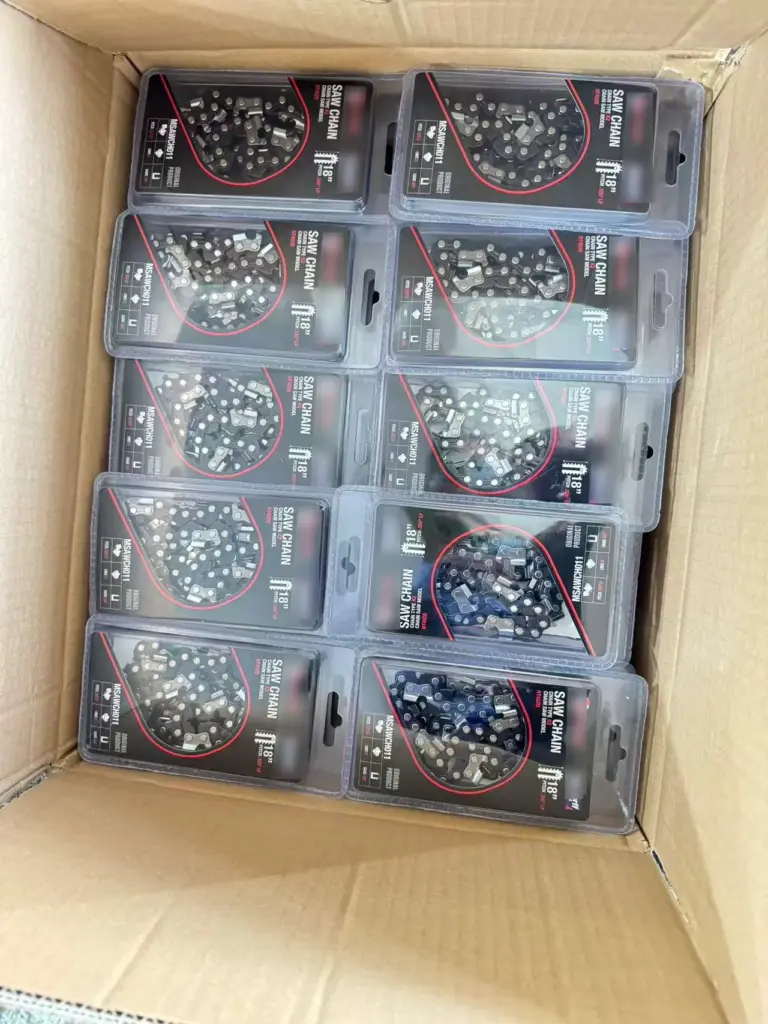
Nuestro 18 inch bulk pack ships ten loops to a carton, and the carton label should carry the part number, indicador, pitch and length. A label that shows only the bar length invites a picking error in a warehouse that stocks several 18 inch loops.
Order a sample before the container. Enviamos muestras 7-10 días después del pago, which leaves time for a cut test before the volume order is confirmed.
Dealers who serve professional accounts also carry a training expectation. El UK HSE guidance on chainsaw protective clothing covers leg protection, gloves and protective clothing, and a dealer may be asked which standards apply.
| Controlar | What to confirm in writing | Why it matters at the container |
|---|---|---|
| Número de pieza | Full code for every loop, not a length only | Prevents a substitute that looks close and does not fit |
| Cross-reference | The familiar number printed beside the code | Lets a counter match stock to what a customer already buys |
| Sample | One loop per family for a cut test | A trial on local wood catches a wrong cutter before volume |
| Label | Paso, indicador, length and code on each box | Stops warehouse picking errors across similar loops |
| Garantía | Core parts cover stated on the quotation | Sets the claim route before the first complaint arrives |
An order-stage checklist rather than field data. Add the items your own claims history has shown to matter.

Why Choose NEWTOP as Your Chainsaw Chain Supplier?
A replacement chain range works best when it matches the bars and saws already in a dealer’s market. We publish our loops as a matrix tied to the bar lengths in our own chainsaw range. Each row carries a part number, and most rows carry an Oregon cross-reference.
The matrix covers 10 a 20 inch lengths in eight steps, four gauges and two pitches, con 7 a 12 drive sprocket teeth across 48 rows. We have supplied outdoor power equipment since 2003. Distributors and brand agents in 65 countries carry the range, and our annual capacity runs above 500,000 maquinas.
A Parts Range Built for Reordering
A dealer who reorders the same part number gets the same loop, which keeps workshop stock predictable. Because the matrix follows the bar lengths our NEWTOP chainsaw range uses, a buyer can order machines, bars and chains against one set of codes.
We machine key components such as the crankcase on CNC equipment and run incoming, in-process and final inspection. Our machines carry CE, GS, Eurocopa II, EPA, ETL and RoHS certification, and the plant is certified to ISO9001 and ISO14001.
Muestras, Embalaje, and Delivery Terms
For private label, we customise inner and outer packaging to your artwork. A container takes about 30 días, machines carry a one-year warranty and their core parts carry six months.
Our buyers are about 60% OEM and private label, 30% agentes de marca y 10% tender or small B. Protective distribution terms apply to the agent channel only, so an OEM buyer and a brand agent are not sold against each other under the same terms.
Send us the saw models you service and the wood your market cuts. We will confirm pitch, indicador, drive-link count and part number for each line before you order. El NOVEDAD parts team can also review your current spare parts mix against a live market case. Our comparison of chainsaw chain manufacturers in China covers how a factory range differs from a trading company.
Preguntas frecuentes
Which Chainsaw Chain Fits My Saw?
Match pitch, gauge and drive-link count to the bar, then confirm the drive sprocket tooth count. Order by the full code rather than by bar length.
What Does the Gauge Number Mean on a Chain?
Gauge is the thickness of the drive link where it enters the bar groove, written as .043, .050, .058 o .063 pulgada. It must match the groove width of the bar.
Is a Full Chisel Chain Better Than a Semi-Chisel Chain?
Neither type is better in every market. Full chisel cuts faster in clean timber, while semi-chisel usually holds an edge longer in dirty wood. Many dealers need both.
How Do I Test a Chain Sample Before a Container Order?
Cut a set number of identical logs on one saw and time each pass, then check chips, kerf square and rivet slack. Enviamos muestras 7-10 days after payment for this test.
Do You Supply Chainsaw Chains Under Private Label?
We customise inner and outer packaging to your artwork and confirm each part number before production. A container runs about 30 days after the order is confirmed.