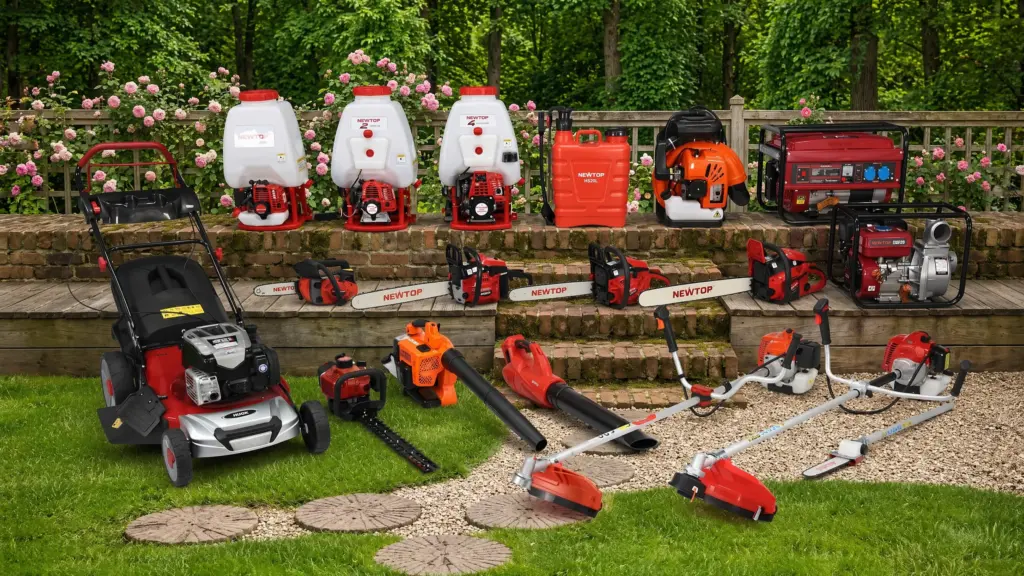
IL 2 ictus contro 4 stroke grass trimmer decision comes down to how each engine is fueled, lubricated and serviced rather than to cutting power alone. Both platforms cut grass and clear brush, and both appear in the NEWTOP range.
In questa guida, we first put the two platforms side by side in a comparison table. We then define each engine type, compare them across the dimensions that affect your shelf and service plan, and close with a decision framework and our product recommendations.
What to Take From This Guide
- IL 2 ictus contro 4 stroke grass trimmer choice shapes your service model and training plan as well as the power specs.
- Our two-stroke anchors are the 42.7cc NTB430F and the 51.7cc NTB520A, both listing a 25:1 mix on their spec sheets, and our four-stroke NTS140CG runs a GX35-class 35.8cc engine.
- Two-stroke fuel should be mixed to the nameplate ratio in labeled cans, while four-stroke tanks take straight gasoline and the crankcase oil joins the routine checks.
- Both platforms fall under the same EPA small spark-ignition engine program, where the standard follows displacement rather than the engine cycle, so certificates depend on the supplier and model.
- We ship samples 7-10 days after payment and container orders in about 30 giorni, so a sample-first comparison of both platforms can run within one season.
2 Ictus contro 4 Stroke Grass Trimmer
The table below summarizes the 2 ictus contro 4 stroke grass trimmer differences that matter at the counter.
| Dimension | 2-Stroke Brush Cutter | 4-Stroke Brush Cutter |
|---|---|---|
| Fuel in the tank | Gasoline pre-mixed with two-cycle oil at the nameplate ratio | Straight gasoline, with no measuring or mixing |
| Lubrication | Oil travels in the fuel mix itself | Oil sits in the crankcase as a separate check |
| Engine internals | No valves or camshaft, so fewer moving parts | Valvetrain adds parts to the service routine |
| Power delivery | Fires every revolution, strong response for the displacement | Smoother, quieter running that suits steady work |
| Weight and carry | Typically the lighter build in its output class | Typically heavier in its output class; check each spec sheet |
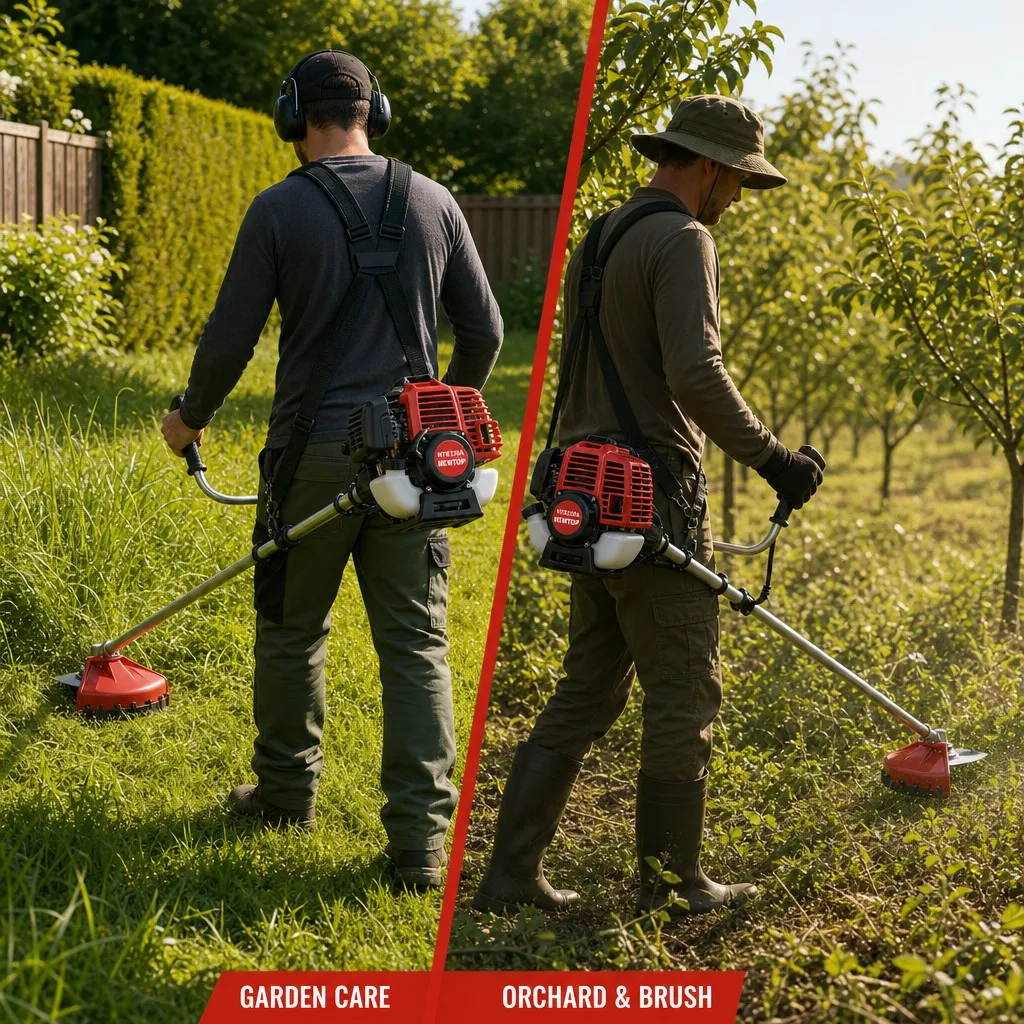
| Typical jobs | Dense growth, field clearing, mixed farm tasks | Slopes, frutteti, roadside and noise-sensitive venues |
| Maintenance focus | Fuel system: mix quality, plugs, carburatore | Crankcase oil checks plus valvetrain inspection |
| Common field faults | Wrong ratio, stale mix, fouled plugs | Skipped oil checks rather than fueling errors |
| Customer training | Mix discipline, labeled cans, no-start checks | No mixing to teach; crankcase oil added to the routine |
| NEWTOP models | NTB430F 42.7cc, NTB520A 51.7cc, both 25:1 | NTS140CG, GX35-class 35.8cc |
| Import paperwork | Both platforms fall under the same EPA small spark-ignition engine program, where the standard follows displacement rather than the cycle; certificates depend on the supplier and model | |
This table is a qualitative comparison for stocking discussions, not measured test data. Confirm final displacement, power and tank figures with us before you order.
Nostro category page for the full brush cutter and grass trimmer range filters the collection by engine type. That way you can see both platforms side by side before you shortlist models.
What Is a 2-Stroke Brush Cutter?
A two-stroke engine completes its power cycle in a single crankshaft revolution. There is no valve gear and no separate oil sump, so the lubricating oil travels in the gasoline itself. That is why every two-stroke nameplate carries a mix ratio, and ours state 25:1, written as gasoline 25 to two-cycle oil 1.
At the counter, that design carries one training obligation: the fuel must be pre-mixed to the nameplate ratio in labeled cans. In return, the engine has fewer moving parts, fires on every revolution, and is typically the lighter build in its output class.
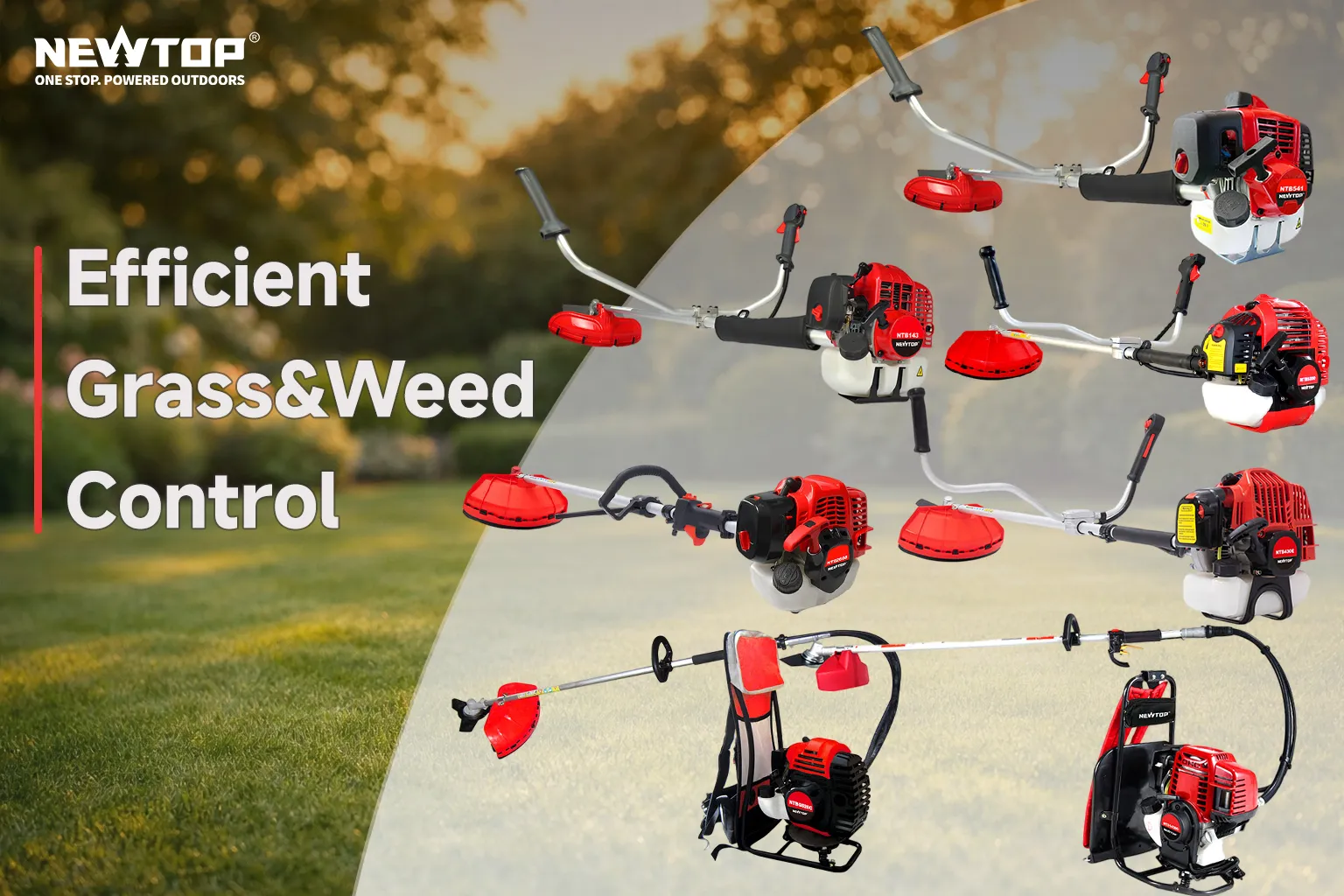
Our two-stroke anchors are the NTB430F at 42.7cc and 1.34kW at 8,000rpm, e il NTB520A at 51.7cc and 1.65kW at 7,600rpm with a 1,300ml tank. The NTBH520E high-handle variant extends the same engine family. Our spec sheets, and the nameplate on each unit, are the final word on the mix ratio.
What Is a 4-Stroke Brush Cutter?
A four-stroke engine spreads the cycle over two crankshaft revolutions and separates the jobs. Gasoline sits clean in the tank, oil sits in the crankcase, and valves meter the mixture in and out. The added valvetrain makes the engine more complex to build and adds items to the service routine.
Operationally, the mixing step disappears: any operator can fuel the tank without measuring. The crankcase oil level joins the routine checks instead, alongside the plug and filter checks both platforms share.
Our four-stroke slot is the NTS140CG, a backpack brush cutter listed in our category filters as a four-stroke machine. It pairs a GX35-class 35.8cc engine rated at 0.9kW and 6,800rpm with a 500ml fuel tank, positioned for slopes, orchards and roadside clearing.
How the Platforms Differ Dimension by Dimension
With the definitions in place, the 2 ictus contro 4 stroke grass trimmer differences can be compared dimension by dimension. The four dimensions below are the ones that drive stocking decisions: fueling, service items, running character and import paperwork.
Fueling and Daily Operation
Two-stroke fueling is a discipline: labeled cans, the nameplate ratio and fresh mix. A machine that runs on straight gasoline loses the oil its engine depends on, and it can seize as a result. Four-stroke fueling removes the measuring step, which is why rental counters and multi-operator crews often prefer it. Our machines use Walbro carburetors and NGK spark plugs, so the wear parts cross-reference to brands your workshop already stocks.
Maintenance and Service Items
Spark plugs, air filters, carburetor kits, fuel lines and trimmer heads are shared across both platforms. A four-stroke adds crankcase oil to the consumables list and valves to the inspection map, while a two-stroke concentrates its service story in the fuel system. Neither platform removes maintenance, and service intervals are not something to quote from a brochure. We suggest asking your supplier which service items the warranty actually covers before you publish intervals to your dealers.
Rumore, Weight and Running Character
In like-for-like displacement classes, two-stroke machines are typically the lighter build and deliver power on every revolution, which suits burst clearing work. Four-stroke machines run smoother and quieter, which suits long sessions in noise-sensitive settings. Weight and noise vary by model, so compare the spec sheets of the exact units rather than the platform labels.
Emissions and Import Paperwork
Both platforms fall under the program through which the EPA sets emission standards for small spark-ignition engines. The standards cover exhaust and evaporative emissions, and they follow displacement rather than the engine cycle. Fase 3 exhaust standards took effect in 2011 O 2012, depending on engine size. Compliance is therefore a supplier and model question, and the documents should be confirmed per unit rather than assumed by platform.
Which Power Type Fits Your Market?
IL 2 ictus contro 4 stroke grass trimmer question becomes easier once it is attached to jobs and buyer habits. Three market profiles cover most of the cases we see.
Markets That Suit Two-Stroke Machines
Two-stroke platforms fit jobs where carry weight, burst power and purchase price decide the sale. Contractors clearing dense growth, farm buyers covering several tasks and price-sensitive markets often sit in this group. In markets where users already mix fuel for chainsaws, the training requirement is small because the routine is familiar. Bench experience points to fuel quality as the recurring service issue: stale mix and unlabeled cans are the first things to check when a machine will not start.
Markets That Suit Four-Stroke Machines
Four-stroke machines suit buyers who prefer not to mix fuel and venues that want quieter, cleaner-running equipment. Residential services, hotels, schools and estate crews often sit in this group, and rental counters may favor the platform for the same reason. Our NTS140CG is listed for slopes, orchards and roadside clearing, which is where we suggest starting the four-stroke conversation. The trade-off is hardware: at the same displacement class, four-stroke builds generally cost more to make. In price-led markets, the two-stroke usually remains the higher-volume line.
Stocking Both Platforms
Mixed markets carry both profiles, and our commercial terms make it practical to test the combination. The platforms share most consumables, so the split appears mainly in fuel-system spares and customer education. We suggest adding one four-stroke SKU to an established two-stroke program, measuring the training load for a season, and scaling only when counter data supports it. Our warranty terms are the same across the lineup: one year for complete machines and six months for core parts.
Why Source Brush Cutters From NEWTOP
Our company, NEWTOP, has manufactured outdoor power equipment since 2003 and ships to customers in 65 Paesi, supported by more than 100 agenti del marchio. Our factory covers more than 10,000 square meters with annual production capacity above 500,000 unità, and our team of more than 300 people includes 50 R&D engineers. You can request the spec tables of the NTB430F, NTB520A and NTS140CG with any quotation.
Component sourcing is the second point we put in front of partners: Carburatori Walbro, Candele NGK, NSK bearings and Oregon chains. Certifications cover CE, GS, EURO II, APE, ETL and RoHS under ISO9001 and ISO14001 systems. Our order mix runs about 60 percent OEM purchasers, 30 percent brand agents and 10 percent tender and small-business buyers, concentrated in Africa, South America and Southeast Asia.
If you are weighing the two platforms for your market, send us your target customers and the jobs their machines do most often. We will suggest a starting mix of two-stroke and four-stroke models, confirm the certificates for your destination market and quote the lineup alongside your order terms.
Get a Platform Recommendation for Your Market
Tell us your target market, main customer types and the jobs their machines do. We will recommend a starting mix of NTB430F, NTB520A and NTS140CG, confirm the certificates for your destination market and quote sample-first order terms.
Domande frequenti
Which Engine Platform Should a New Distributor Import First?
We suggest starting with the platform your market already services. Where users pre-mix fuel for chainsaws, our two-stroke NTB430F and NTB520A usually slot in without a training program. Where buyers prefer not to mix fuel, the NTS140CG four-stroke is often the easier sale, with a narrower job range to explain.
What Fuel Mix Do NEWTOP Two-Stroke Brush Cutters Use?
Our NTB430F and NTB520A spec sheets both list 25:1, written as gasoline 25 to two-cycle oil 1. We advise treating the nameplate on each unit as the final word and repeating the ratio on every operator card. Machines from other factories may specify different ratios, so confirm each nameplate before you print.
Does NEWTOP Build a Four-Stroke Grass Trimmer?
SÌ. We list the NTS140CG as a four-stroke brush cutter in our own category filters. It is built on a GX35-class 35.8cc engine and positioned for slopes, orchards and roadside clearing, and it sits alongside our two-stroke NTB430F, NTB520A and NTBH520E models.
How Should I Brief Dealers on the 2 Ictus contro 4 Stroke Grass Trimmer Choice?
We suggest keeping the briefing to three contrasts. Fueling: pre-mixed gasoline at a fixed ratio against straight pump gasoline. Service: plug and carburetor checks against crankcase oil checks. Buyer appeal: carry weight and burst power against convenience and quieter running. Those contrasts usually show a dealer which platform matches its customers.
Do Emissions Rules Block Either Engine Platform?
Both platforms fall under the EPA small spark-ignition engine program. Its Phase 3 exhaust standards took effect in 2011 O 2012, depending on engine size. Compliance is a supplier and model question rather than a platform question, so we suggest asking which certificates ship with each unit. Ours are covered by CE, GS, EURO II, APE, ETL and RoHS documentation under ISO9001 and ISO14001 systems.