>

블로그

>

What Do Pitch and Diameter Mean on an Outboard Propeller?

What Do Pitch and Diameter Mean on an Outboard Propeller?

공유하다:

목차

When comparing outboard propellers, the first specification you’ll notice is a pair of numbers, such as 13¼ × 17 또는 14 × 19. The first number represents the propeller’s diameter, while the second indicates its pitch.

Pitch and diameter work together to determine how efficiently an outboard converts engine power into thrust. The wrong combination can prevent the engine from reaching its recommended RPM, reduce fuel economy, slow acceleration, or limit top speed. The right setup, 하지만, allows the engine and propeller to operate as a balanced system for better overall performance.

이 가이드에서는, we’ll explain outboard propeller pitch and diameter, how they work together, how to choose the right outboard propeller, and when changing your propeller is a better solution than upgrading your engine.

outboard motor propeller pitch and diameter guide

What Is Prop Diameter?

Propeller diameter is the primary factor controlling how much water the prop can move. This directly determines your boat’s thrust, pulling power, and the overall load on your engine.

Defining Propeller Diameter

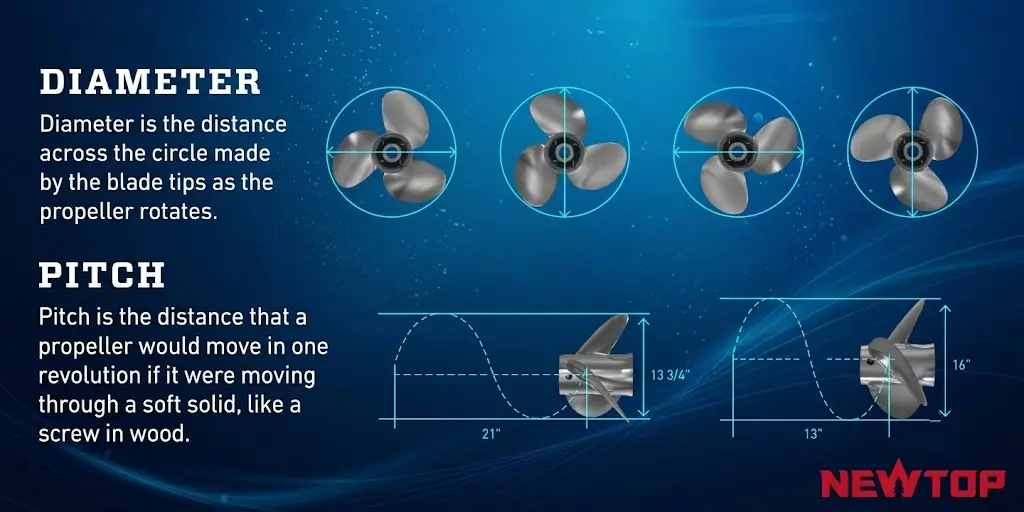
Propeller diameter is simply the width of the circle the blade tips trace as they spin. You can measure it by taking the distance from the center of the hub to the tip of one blade and multiplying by two. Propeller sizes are always listed as Diameter x Pitch, so in a “14 x 19” 소품, the diameter is 14 신장. It’s always the first number.

The Link Between Diameter, Thrust, and Engine Load

A bigger diameter lets the prop grab and push more water with every rotation, which generates more thrust. This isn’t free energy, though. That increased push puts a higher torque load on the engine, demanding more power to keep it turning. A smaller diameter moves less water, creating less thrust but also reducing the load. This can let the engine reach higher RPMs more easily.

What Is Prop Pitch?

Propeller pitch is the theoretical distance a prop travels in one revolution. It’s the final gear ratio, directly trading engine RPM for speed and acceleration.

The Technical Definition of Prop Pitch

Pitch is the theoretical forward distance, 인치로, a propeller would move in one full rotation if it were screwing through a solid block of wood. 예를 들어, a propeller with a 19-inch pitch is designed to push a boat 19 inches forward with every complete turn. This measurement is a direct function of the angle of the propeller blades relative to the hub.

How Pitch Is Specified on a Propeller

Propeller dimensions are always listed as Diameter × Pitch. 그래서, a prop marked “14.5 × 19has a 14.5-inch diameter and a 19-inch pitch. You’ll find this information stamped or cast directly onto the propeller’s hub, making it easy to identify. Most props are sold in 2-inch pitch increments (like 17, 19, 그리고 21), which allows for significant changes in boat performance with a simple swap.

Source Durable Power Tools, Boost Your Profits

Our machines are built with premium components for maximum durability, reducing warranty claims and increasing your ROI. Leverage our stable supply chain and OEM flexibility to build a powerful brand presence in your market.

도매 견적 요청 →

CTA 이미지

How Pitch Changes Affect Engine RPM and Fuel Economy

Changing propeller pitch directly trades engine RPM for load. Dialing in the right pitch to hit your target WOT RPM is the first step to optimizing fuel burn.

Change Effect on WOT RPM Effect on Performance Potential Fuel Economy Impact
Increase Pitch Decreases Slower acceleration, higher potential top speed. Improves if fixing an over-revving engine.
Decrease Pitch Increases Faster acceleration, better load carrying. Improves if fixing an under-revving (lugging) 엔진.

The Core Relationship Between Pitch and RPM

Propeller pitch is the theoretical distance, 인치로, a prop moves forward in one rotation. The relationship between pitch and engine speed is straightforward: they work in opposite directions. A one-inch change in pitch will typically alter your wide-open throttle (WOT) RPM by 150 에게 200. Increasing pitch adds more load to the engine, which makes the RPM drop. Decreasing pitch reduces that load, letting the engine spin up faster and increasing RPM.

Impact of Increasing Propeller Pitch

When you increase a prop’s pitch, the WOT RPM drops. This can improve fuel economy if your engine was previously running above its recommended RPM range. You’ll often see an increase in boat speed at a given cruise RPM, letting you cover more distance on the same amount of fuel. The trade-off is slower acceleration and hole shot because of the higher engine load. Be careful not to go too high with pitch. If the engine can’t reach its proper powerband, it will lug, which kills both performance and efficiency.

Impact of Decreasing Propeller Pitch

Decreasing pitch does the opposite: WOT RPM increases. This is the right move for an under-revving engine that needs help reaching its target operating range. You’ll notice a significant improvement in acceleration, 홀샷, and the boat’s ability to handle heavy loads. Another benefit is that the boat can stay on plane at lower speeds, which is great for rough water or towing for watersports. But if you go too low on pitch, the engine might over-rev. This can cause damage and will definitely lead to burning way too much fuel.

Finding the Optimal Balance for Fuel Economy

The best fuel economy is usually found when the engine can reach the upper end of its recommended WOT RPM range with a normal load. This setup means the engine is operating efficiently at typical cruise speeds, often between 3500-4500 RPM, without being overworked or under-loaded. The first step to optimizing fuel consumption is always to correct a pitch mismatch to get your WOT RPM into spec. The ideal pitch gives you a balance between efficient cruise speed and the acceleration you need for how you actually use your boat.

Real-World Examples of Pitch and Diameter for Common Boat Types

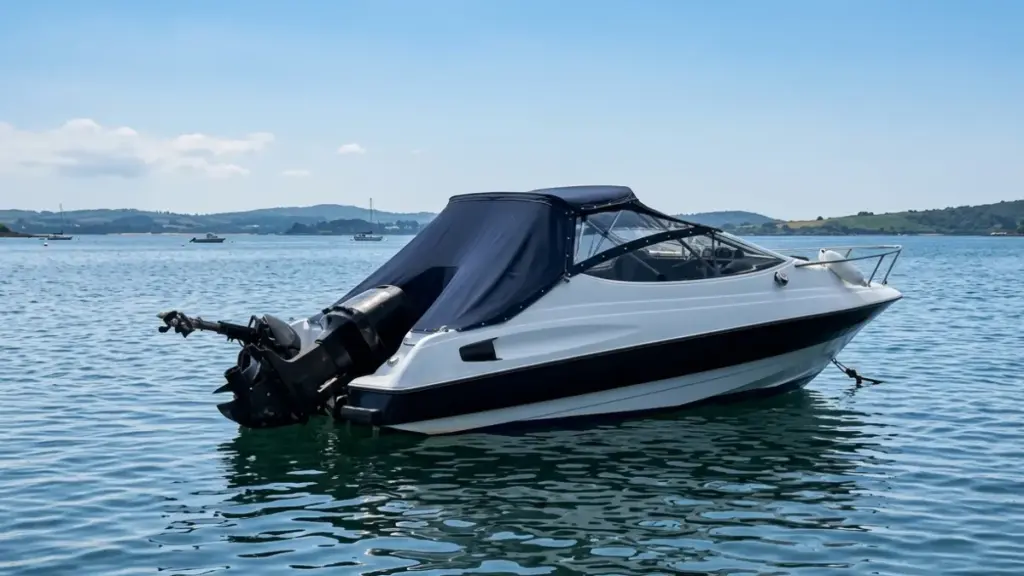
A white powerboat with a dark canvas cover is anchored on water near a distant coastline with hills, suitable for an overview

Prop choice depends entirely on the hull. A bass boat balances speed and acceleration, while a pontoon or workboat prioritizes thrust to move heavy loads.

Boat Type Typical Diameter Typical Pitch Main Goal
Small aluminum fishing boat 10–11 9–13 Easy planing and load carrying
Inflatable boat 9–11 9–13 Quick acceleration
Bass boat 13–14 21–25 High speed
Pontoon boat 13–15 13–17 Strong low-speed thrust
Offshore center console 15–16 17–21 Balanced cruising
Work boat 14–16 13–17 Maximum pulling power
Water sports boat 13–14 15–19 Fast hole shot

Fishing and Bass Boats

A typical stock propeller for a 17-foot aluminum bass boat with a 115 HP engine is a 14 엑스 17. That’s a 14-inch diameter and a 17-inch pitch. This setup gives a solid balance between the hole shot needed for quick acceleration and decent top-end speed for covering water.

For these lighter, planing hulls, the goal is a low propeller slip percentage. You’re typically looking for something in the 10-18% range to run efficiently.

Pontoon and Tri-Toon Boats

These boats are a completely different animal. They are heavier with high-drag hulls, so they prioritize thrust over top speed. The main job is to carry a load and get the boat up on plane. Propeller selection here often favors a larger diameter to move more water and get the push needed.

Pontoons usually operate with much higher slip percentages, sometimes between 20-30%. Efficiency isn’t the main concern; load-carrying ability is what matters.

High-Speed Performance Hulls

Faster boats often use propellers with the highest possible pitch to hit top speed. These setups might also use a smaller diameter to cut down on drag through the water at high RPMs. It’s a balancing act. Careful tuning is required to make sure the engine can reach its recommended wide-open-throttle (WOT) RPM range without being overloaded by too much pitch.

Workboats and Heavy-Load Applications

Just like pontoons, workboats are all about thrust for pushing heavy loads. Propellers with larger diameters and sometimes lower pitch are used to get better acceleration and low-speed handling. Top speed is secondary compared to the boat’s ability to maintain momentum with a heavy load on board.

How to Read Propeller Markings and Check Existing Setup

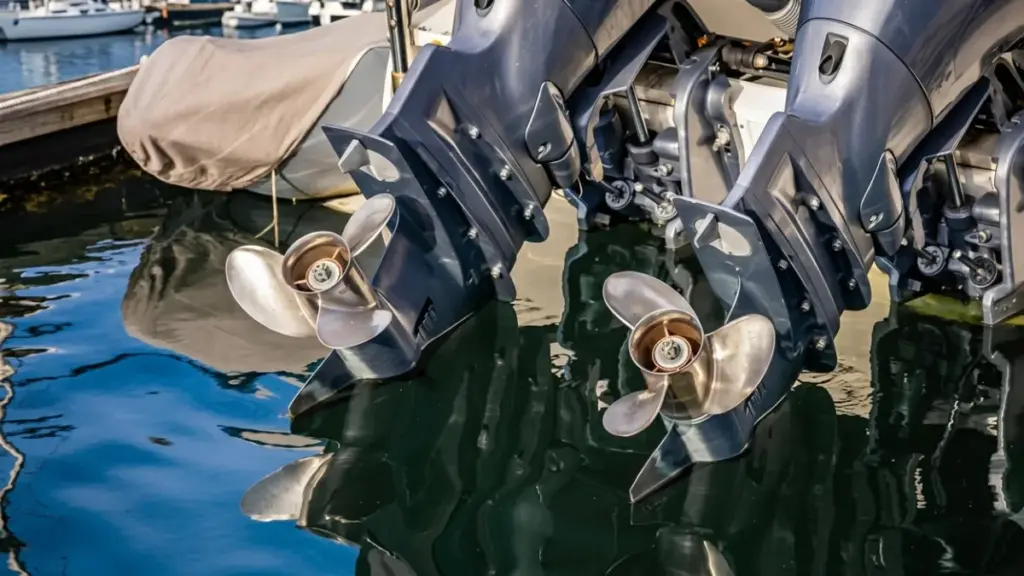
A close-up photograph of twin outboard marine engines with polished stainless steel propellers over calm blue water in a marina

Propeller markings reveal its size and type. You must check these specs against your engine’s Wide-Open-Throttle (WOT) RPM range to confirm the setup is correct for your boat.

Finding and Reading Basic Size Markings (Diameter x Pitch)

The size markings are usually stamped right on the propeller hub. Check the exterior of the hub between the blades, under the prop nut, or sometimes on the root of a blade itself. You’ll likely need to scrape away marine growth or light corrosion to see the numbers clearly.

You are looking for a format like ‘14.5 × 19’. The first number is the diameter in inches, which is the full circle the propeller makes when it spins. The second number is the pitch, which represents the theoretical distance in inches the prop would move the boat forward in one full revolution.

Interpreting Additional Markings for Rotation, 재료, and Series

Beyond the basic size, you’ll find other critical codes. A rotation code like RH means a standard right-hand rotation, which is what most single-engine boats use. LH signifies a left-hand rotation, typically found on one of the engines in a twin-engine setup to balance torque.

Material is often marked with ‘ALfor aluminum or ‘SSfor stainless steel. You may also see a brand name or a series code, like Yamaha’s K-series, which identifies the prop’s design and intended application. 마지막으로, locate the specific part number—this is the most reliable code for ordering an exact replacement.

Checking Your Setup Against Engine WOT RPM Specifications

The numbers on your prop mean nothing without context. You have to check them against your engine’s performance. First, find the recommended Wide-Open-Throttle (WOT) RPM range in your engine’s owner’s manual. This is the target your engine should hit at full power.

With a normal load of fuel and gear, run the boat at full throttle and see what your tachometer reads. If your max RPM is below the recommended range, your propeller’s pitch is probably too high. If the engine’s RPM exceeds the range (over-revving), the pitch is too low. A one-inch change in pitch typically affects your WOT RPM by about 150 에게 200.

What to Do When Markings Are Missing or Damaged

If the markings are gone, you can still figure out the basics. Measure the diameter by taking the distance from the center of the hub to the tip of one blade and doubling it. Measuring pitch, 하지만, isn’t something you can do accurately by hand. It requires a pitch gauge, a tool found at any decent propeller shop.

Be careful with used props. A previous owner might have had it repaired orreworked,” meaning a prop shop could have altered its pitch. In that case, the stamped number might not reflect the prop’s true geometry. If you have any doubts, take it to a professional shop for verification. They can tell you exactly what you’re working with.

When to Adjust Pitch or Diameter Instead of Changing the Engine

a close up of outboard motor

Before you even think about a new engine, fix your propeller. Pitch manages your RPM, and diameter handles thrust. Most performance problems are solved right there.

Correcting Engine RPM Issues with Pitch Adjustments

Pitch is your primary control for engine RPM. It acts like the final gear ratio between your engine and the water. Getting it right is the first step in tuning your boat’s performance.

  • If your engine is lugging (WOT RPM is too low), decrease the prop’s pitch to let it spin up and raise RPM.
  • If the engine over-revs (WOT RPM is too high), increase pitch to add more load and bring the RPM back down.
  • Use pitch as your main tool to hit specific goals, like lowering it for a better hole shot or raising it for a higher potential top speed.
  • Remember the rule: a 2-inch change in pitch typically moves your Wide Open Throttle RPM by about 400, making it the first thing to adjust.

Using Diameter for Thrust and Load Matching

While pitch controls RPM, diameter is all about thrust and how the prop grips the water. It’s how you match the engine’s power to the boat’s physical reality.

  • Go with a larger diameter prop on heavy boats or for work applications to get better low-speed thrust and maneuverability.
  • Use a smaller diameter on lighter, faster boats to cut down on drag and help the engine reach its full RPM range.
  • Think of diameter as the way you match the engine’s power curve to the boat’s specific weight and hull characteristics.
  • This is the key adjustment to make when your acceleration feels sluggish, even if the engine’s WOT RPM is already dialed in.

Addressing Major Load Changes with Both Pitch and Diameter

Sometimes a single adjustment isn’t enough, especially when the boat’s mission changes significantly. That’s when you need to look at both variables together.

  • Adjusting both is the right move when the boat’s main job changes, like when you add heavy permanent equipment or start pulling skiers for the first time.
  • A common strategy is to increase diameter for more push while dropping the pitch to keep the engine’s WOT RPM in the correct range.
  • This combined approach lets your current engine effectively handle a new, heavier load profile without you needing to spend money on more horsepower.

A Clear Diagnostic Path: Prop First, Engine Last

Don’t guess. Follow a logical diagnostic process to avoid wasting time and money on an engine you might not need.

  • Start by confirming the engine is healthy. Then perform a WOT test with a typical load to get a baseline max RPM.
  • If that RPM is outside the manufacturer’s recommended range, changing the propeller is the first and most logical step. Don’t jump to conclusions about the engine.
  • Systematically test different prop configurations to optimize performance for how you actually use the boat.
  • Only start shopping for a new engine after you have tried all the appropriate propeller options and they still fail to meet your performance goals.

자주 묻는 질문

What do the numbers on an outboard propeller mean?

The numbers identify a propeller’s core dimensions, mainly diameter and pitch, written as ‘diameter x pitch’ (예를 들어, 14 엑스 19). The first number is the diameter in inches, and the second is the pitch in inches. Markings may also include letters for rotation (R for right-hand), material (SS for stainless steel), and a part number.

What is propeller pitch on a boat?

Propeller pitch is the theoretical distance, measured in inches, that a propeller would move forward in one complete revolution without any slip. It acts like the boat’s gear ratio—a higher pitch is designed to travel farther with each turn, which can increase top speed if the engine has enough power.

How does propeller pitch affect engine RPM?

Pitch has an inverse effect on engine RPM. Increasing the pitch adds more load to the engine, causing the RPM at full throttle to decrease. Decreasing the pitch lightens the load, allowing the engine’s RPM to increase. A common guideline is that a one-inch change in pitch will alter the wide-open-throttle (WOT) RPM by about 150-200.

Does a higher pitch prop make a boat faster?

A higher pitch prop can make a boat faster, but only if the engine has enough power to operate within its recommended WOT RPM range. If the pitch is too high, it overloads the engine, causing RPM to drop too low and actually reducing the boat’s top speed.

How do I know if I need more or less pitch on my propeller?

Check your engine’s RPM at wide-open throttle (WOT) against the manufacturer’s specified range. If your RPM is too high (above the range), you need more pitch to bring it down. If your RPM is too low (below the range), the engine is struggling, and you need less pitch to allow it to spin up properly.

What is the difference between propeller pitch and diameter?

Diameter is the overall width of the propeller’s rotation, affecting its thrust and ability to move large amounts of water—important for heavy boats. Pitch is the theoretical forward travel per revolution, which primarily controls the balance between acceleration and potential top speed by managing engine RPM.

Can I change propeller pitch without changing diameter?

예. It’s common to change only the pitch to fine-tune performance. Propellers are often available in a series with the same diameter but different pitch options, allowing you to adjust your engine’s RPM and performance characteristics without altering the prop’s overall size.

스티븐 황

뉴탑의 창립자

저는 Shanghai NEWTOP Machinery Co.의 회장입니다., 주식회사. 그리고 Zhejiang Surtec Machinery Co., 주식회사. 베이징 공과 대학 대학원, 나는 상하이 NEWTOP을 설립했습니다. 2003 이후 대외 무역에서 산업 제조업으로의 성장을 주도해 왔습니다.. 수년에 걸쳐, I have also contributed to the development of China's market for chainsaws, 배낭 분무기, 선외 모터 및 기타 실외 전력 장비, 관련 예비 부품 및 액세서리와 함께.

~ 안에 2026, 다시 한번 NEWTOP의 지휘봉을 잡았습니다, opening a new chapter in the company's development. 우리는 이제 아프리카와 같은 주요 시장에서 유통업체와 파트너를 적극적으로 찾고 있습니다., 라틴 아메리카, 등.. 신뢰할 수 있는 OPE 제조업체와 함께 비즈니스를 성장시키려는 경우, NEWTOP 네트워크에 합류하여 함께 성공을 쌓아가신 것을 환영합니다..

당신도 좋아할 수도 있습니다

왓츠앱
×

견적을 받으려면 Newtop에 문의하세요.

귀하의 모든 정보는 존중됩니다 & NEWTOP에서 보호됨.

견적을 받으려면 Newtop에 문의하세요.

큰 주문 큰 할인. 도매 전용.

귀하의 모든 정보는 존중됩니다 & NEWTOP에서 보호됨.